The largest Cycladic island you’ll actually want to sleep on
Naxos doesn’t look like Santorini, and that’s the point of putting it on this site at all. Where Santorini is a thin, dramatic rim around a flooded volcanic crater, Naxos is the biggest island in the Cyclades: a solid, mountainous landmass with real farmland, real rivers running after winter rain, and a coastline long enough to hold half a dozen distinct beach towns without feeling crowded. It sits roughly in the middle of the archipelago, on the same north-south ferry line that also serves Paros and Mykonos, a little further out than Ios.
That distance matters for planning. Naxos is not a place you tack onto a Santorini holiday for an afternoon. It’s a place you go to slow down for a few days: swim on proper sand instead of black volcanic gravel, drive up into a green interior instead of walking a caldera path, and eat vegetables and cheese that were actually grown on the island you’re standing on. If Santorini is the postcard, Naxos is closer to what everyday Cycladic life still looks like.
Getting there: the ferry from Athinios
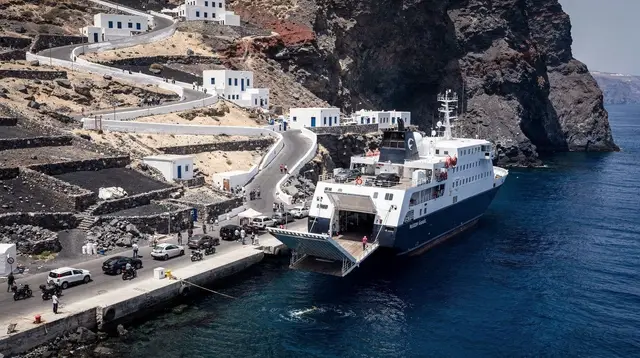
Every boat to Naxos leaves from the same place every boat to anywhere leaves Santorini: Athinios port, at the foot of the caldera cliff on the island’s west side. High-speed catamarans cover the route in roughly an hour and a half to two hours, though the real number depends on which company and which specific vessel you book, and conventional ferries take meaningfully longer. Don’t plan around a number to the minute; check the schedule for your actual dates before you build the rest of an itinerary around it.
Naxos sits further along the same corridor than Ios, and before Paros and Mykonos going north, so it’s common to see all four islands on one multi-stop route. That makes Naxos a natural link in a longer island-hopping plan rather than an isolated stop. For the mechanics of booking that route, our ferry guide and island-hopping guide cover timetables, luggage and how far ahead to book in high season. One genuinely useful difference from Santorini: ferries dock right in Naxos Town itself, not at a remote port with a long transfer, so arrival is far less of an ordeal than Athinios.
Naxos Town and the Portara
Naxos Town, also called Chora, wraps around its harbour in the layered, whitewashed style familiar from every Cycladic postcard, but with a Venetian layer Santorini doesn’t have: a hilltop Kastro built by the island’s Venetian rulers in the 13th century, its walls still partly standing and still lived in, with old family crests over doorways in the old town’s narrow lanes.
The single most photographed thing on Naxos, though, sits just offshore. The Portara is a freestanding marble doorway more than six metres tall, the surviving entrance to a temple of Apollo begun around the 6th century BC and never finished. It stands on the small islet of Palatia, connected to the harbour by a short causeway you can walk in a few minutes, and it frames the sunset in a way that draws a steady crowd every evening without ever reaching the density of Oia’s viewpoints.
If you want the moment on the water rather than standing in a group photo, a sunset boat past the Portara and along the coast is the alternative worth booking, and it’s the same idea behind a sunset cruise around Naxos that times its route to the light rather than a fixed viewpoint.
For a slower version of the same evening, a guided sunset walk through Naxos Town covers the Kastro, the old town and the Portara on foot, with the kind of local detail a self-guided stroll usually misses.
Beaches on the west coast
This is where Naxos separates itself most clearly from Santorini. There’s no black volcanic sand here, no cliff to climb down and back up; the west coast south of Naxos Town runs almost continuously through long, pale, sandy beaches backed by dunes rather than lava rock.
| Beach | Character | Best for |
|---|---|---|
| Agios Prokopios | Fine white sand, shallow entry, well organised | Families, first-time visitors |
| Agia Anna | Quieter continuation of Agios Prokopios | Relaxed swimming, fewer crowds |
| Plaka | Long, partly dune-backed, more low-key | Longer walks, a quieter day |
| Mikri Vigla | Split by a headland, exposed to wind | Windsurfing and kitesurfing |
Mikri Vigla in particular is a genuine wind-sports destination, catching the same meltemi that Santorini feels as a nuisance to boat trips and turning it into a reliable summer wind for kitesurfers and windsurfers. If watersports are part of the plan, this is a more dedicated setup than anything on Santorini’s east coast.
The mountain villages: Halki, Apeiranthos, Filoti
Inland is where Naxos earns the “big” in big, green Cycladic island. The interior climbs toward Mount Zas, at 1,004 metres the highest point in the Cyclades, and mythologically the cave where Zeus himself is said to have been raised. The lower slopes are genuinely fertile: olive groves, vineyards, potato fields and orchards, feeding an island that has always grown more of its own food than most of its neighbours.
Halki, once the island’s commercial capital before Naxos Town took over, is the best base for a slow inland afternoon: neoclassical mansions from its 19th-century citrus-trading wealth, and the Vallindras distillery, one of the traditional producers of Kitron, the citron-leaf liqueur that’s the closest thing Naxos has to a signature bottle. Apeiranthos, higher up, is built almost entirely of grey marble, streets included, with a small archaeological museum and a noticeably different, more mountain-village character than anywhere on the coast. Filoti, the largest of the inland villages, sits at the foot of Mount Zas itself and is the usual starting point for the walk up.
None of this interior is realistically reachable without a car or an organised tour; bus service exists but is limited, and the villages are spread out enough that public transport turns a half-day loop into most of a day.
Marble, kouroi and the Temple of Demeter
Naxos has been a marble island since antiquity, and the evidence is still lying in the fields where it was abandoned. Near the villages of Apollonas and Flerio, several enormous kouroi, unfinished archaic marble statues over five and six metres long, still lie exactly where ancient quarry workers left them, apparently cracked or judged unusable partway through carving. There’s no ticket, no fence, no crowd; you walk up a short path and find a 2,500-year-old sculpture lying in an olive grove.
Inland near the village of Sangri stands the Temple of Demeter, a 6th-century BC sanctuary built almost entirely of the local marble and partially reconstructed, with a small on-site museum. It’s a quieter, less visited counterpart to Santorini’s own archaeological sites, and worth combining with a village day rather than treating as a separate trip.
Food: potatoes, cheese and citrus
Naxos is one of the few Cycladic islands that can feed itself. The potatoes grown on its volcanic-free, genuinely fertile soil are considered some of the best in Greece and turn up on menus across the whole archipelago. Graviera Naxou, a hard, slightly sweet cheese made from local cow’s and sheep’s milk, has its own protected designation, and the citrus groves around Halki supply both the Kitron liqueur and a steady supply of fresh fruit. None of this is showy; it’s just what an island with actual farmland produces, and it makes the food noticeably different from the imported-everything menus common on smaller, drier islands.
Island hopping onward: Paros, Mykonos and beyond
Naxos’s position in the middle of the Cyclades makes it a natural hinge rather than a dead end. Short ferry hops connect it to Paros in well under an hour and to Mykonos a little further on, both of which have their own dedicated pages on this site rather than being covered here. Smaller islands in the other direction, including the low-key Koufonisia in the Petite Cyclades, are also reachable from Naxos and make a good extension for travellers with more than a week to spend.
For getting a boat directly onward without backtracking through Santorini, a direct boat transfer from Naxos to Paros is usually simpler and cheaper than routing back through a ferry-agency counter. Our Cyclades island-hopping routes guide lays out which combinations actually work within a one- or two-week trip, and the ten-day island-hopping itinerary uses Naxos as exactly this kind of midpoint stop.
How long to stay, and when
Because the ferry alone costs half a day each way, Naxos rewards a longer stay far more than a quick look does. Three nights is a reasonable minimum: one for Naxos Town and the Portara, one for the west-coast beaches, one for an inland loop through the mountain villages. Four nights adds enough slack for a beach day that’s actually a beach day, with no driving.
Late spring (late April through June) and early autumn (September into October) give warm, swimmable weather without August’s peak crowds and heat; the same seasonal logic that applies across the Cyclades. July and August are the busiest and hottest months, and by November many beach tavernas and some ferry frequencies wind down for winter, similar to what happens on Santorini itself. Our guide to how many days Santorini and its surrounding islands actually need sets Naxos in the context of a wider Cyclades trip, and the dedicated Santorini-and-Naxos one-week itinerary is built around exactly this pairing.
Naxos vs Santorini, in short
The two islands answer different questions, which is why pairing them works better than choosing one over the other. Santorini gives you the caldera view, the wine, the sunset drama; Naxos gives you long sandy beaches, a mountain interior you can actually drive and hike through, and a slower, more agricultural pace. Neither replaces the other. If you’re weighing which to prioritise on a short trip, our full comparison of Santorini and Naxos breaks down the trade-offs in more detail than fits here.
For a first look at the island from the water, before deciding how many nights it deserves, a full-day yacht tour around Naxos covers the coastline, sea caves and swimming stops that a short stay on land would otherwise miss, and works well as day one before renting a car for the villages.
Frequently asked questions about visiting Naxos from Santorini
How long does the ferry from Santorini to Naxos take?
Roughly an hour and a half to two hours on a high-speed ferry from Athinios, though the exact time depends on the company and the specific boat, and conventional ferries take noticeably longer. Always check the schedule for your travel dates rather than assume a fixed duration.
Can I visit Naxos as a day trip from Santorini?
It’s possible but not recommended. With around three to four hours lost to ferry transfers alone, a single day leaves barely enough time to see Naxos Town and the Portara, and none of the beaches or mountain villages that make the island worth the trip.
What is the Portara in Naxos?
The Portara is a massive marble doorway, the unfinished entrance to a 6th-century BC temple dedicated to Apollo, standing alone on the islet of Palatia just off Naxos Town and reachable on foot along a short causeway. It’s the island’s best-known landmark and a popular sunset spot.
Which Naxos beach is best for families?
Agios Prokopios and Agia Anna, on the west coast just south of Naxos Town, have shallow, calm, sandy water and enough tavernas and sunbeds nearby to make a full day easy with small children.
Do I need a car to see the Naxos mountain villages?
Yes, effectively. Villages like Halki, Apeiranthos and Filoti sit inland on winding roads with limited bus service, so a rental car or an organised tour is the practical way to reach them and the marble quarries beyond.
Is Naxos connected to Paros and Mykonos by ferry?
Yes. Naxos sits on the same north-south ferry corridor as Paros and Mykonos, with short hops of well under an hour to Paros and a bit longer to Mykonos, making it a natural stop before or after either island.
What is Kitron and where can I try it?
Kitron is a citrus liqueur distilled from the leaves of the Naxos citron tree, made in a handful of colours and strengths. The village of Halki is the traditional home of its production and the easiest place to taste it at the source.
When is the best time to visit Naxos?
Late April through June and September into October give warm, swimmable weather without the peak-August crowds and heat. July and August are hottest and busiest; winter sees many beach tavernas and some ferry routes reduced.