Beyond the Day-Trip Boat
Paros sits almost exactly in the middle of the Cyclades, past Naxos and before Mykonos on the same ferry axis that runs north from Santorini. It has none of Santorini’s caldera and none of the postcard blue-and-white cliffs that pull the crowds to Oia. What it has instead is flat sandy coastline, a marble-quarried interior dotted with old villages, and a port town that has been the crossroads of the central Cyclades for centuries.
This page treats Paros itself — its main town, its beaches away from the harbour village, and its role in a longer island-hopping route. Naoussa and Antiparos sit administratively under Paros but each has enough of its own character, and enough to say, that they get their own pages; this one is about the island around them.
The single most useful thing to understand before booking is the crossing itself. Paros is not a lunch-stop island from Santorini. It is a proper travel day in each direction, and it rewards travellers who build in nights rather than trying to squeeze it into a return ticket.
Getting There: The Two-Hour Crossing from Athinios
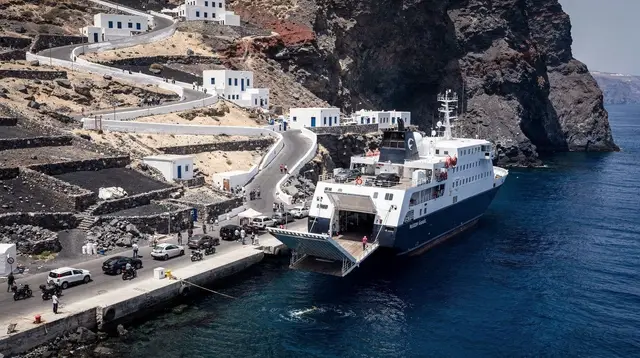
High-speed ferries leave Ormos Athinios, Santorini’s only ferry port, and cover the distance to Paros in roughly two hours. That is a comparable crossing time to reaching Naxos or Mykonos on the same route, and noticeably longer than the short hop over to Ios. Conventional (slower) ferries take longer again. Sailings are frequent from spring through autumn and thin out sharply in winter, so this is a route to book ahead in July and August rather than assume you can walk up and buy a ticket at Athinios that morning.
Because Athinios sits at the base of Santorini’s caldera cliff, plan the approach with the same care you would any ferry departure here: no left-luggage counter, a single steep access road, and a port that gets crowded in the twenty minutes either side of a ferry’s arrival. Our Santorini ferry guide covers the practical side of that departure in detail, and our broader island-hopping guide sets Paros against the other realistic connections from Santorini.
Some visitors reach Paros the other way around, coming down from Naxos rather than up from Santorini — the short connecting hop between the two islands is quick enough that a few operators sell it as a same-day transfer. a same-day boat transfer from Naxos to Paros is worth knowing about if your route runs Santorini → Naxos → Paros rather than a direct Santorini–Paros ferry.
Why This Isn’t a Day Trip
It is tempting to treat every Cycladic island within reach of Santorini as a candidate for a single long day out, the way many visitors do with Milos or Ios. Paros doesn’t fit that pattern. At roughly two hours each way, a there-and-back crossing already consumes four hours of a single day before you have set foot on a beach or in a village. Add the walk from the port to wherever you actually want to be, and a genuine day trip leaves you with only a handful of usable hours on the ground — enough to see the harbour and one church, not enough to reach the villages of the interior or a beach worth swimming at.
The honest recommendation, and the one this page is built around, is to treat Paros as a stop of its own inside a longer Cyclades route: a few nights here, folded into an itinerary that also covers Naxos, Mykonos, or both. Our Cyclades island-hopping routes guide and the ten-day Cyclades itinerary are built around exactly this kind of extension rather than a return ticket.
Parikia: The Island’s Working Heart
Parikia, the main town and port, is where almost every visitor arrives and where most practical business gets done — bus connections, car and scooter rental, banks, the ferry ticket agents. It is a working Cycladic town rather than a styled one: whitewashed lanes climbing back from the harbour, a Venetian-era kastro built partly from recycled ancient marble, and at its centre the Panagia Ekatontapyliani, one of the oldest continuously used churches in Greece, said to take its name — “of the hundred doors” — from a count of openings, real or legendary, in its stone.
Parikia’s own beaches are modest; most visitors base themselves here for the connections and travel out to the coast for the day. It is also the most straightforward base for anyone without a rental car, since the island’s bus network radiates from the harbour front.
The Marble Interior and the Old Capital
Paros’s history is written in stone before it is written anywhere else. Parian marble — pale, fine-grained, prized above almost any other in antiquity — was quarried here and shipped across the ancient world; it is the marble behind the Venus de Milo and a long list of other classical sculpture, even though the finished statues themselves ended up elsewhere. The old quarry galleries near Marathi, cut deep into the hillside, are one of the few places in the Cyclades where you can stand inside the material the ancient world built its statues from.
Inland, Lefkes was the island’s capital for centuries, chosen precisely because it sat back from the coast and out of sight of pirate raids. It remains the most atmospheric of Paros’s villages: marble-paved lanes, a hilltop position with views down both sides of the island, and a slower pace than anything on the water. A signed section of the old Byzantine path — a cobbled route that once connected inland villages before roads existed — runs near Lefkes and is walkable in under an hour for anyone who wants a short hike rather than a full day out.
Marpissa, closer to the east coast, is a smaller and less-visited version of the same thing: a hill village of narrow lanes and a monastery above it, easy to combine with an afternoon at one of the nearby beaches.
Beaches Away from the Harbour Villages
Paros’s coastline is flatter and sandier than Santorini’s, and considerably more varied than a single headline beach. Golden Beach (Chryssi Akti), on the island’s east-facing coast, is the best known and the one most associated with windsurfing and kitesurfing — steady wind, shallow entry, and enough beach clubs and schools to make it a genuine sports destination rather than just a wide sandy stretch. Further along the same coast, Piso Livadi is a smaller working harbour with beaches either side and a noticeably calmer, more local feel.
On the west and south, Pounta sits opposite Antiparos and doubles as the departure point for the short crossing to that island; the beach itself is unremarkable, but it’s a useful marker if you’re island-hopping within a single day. Aliki, near the airport in the island’s south, is a quieter fishing village with a shallow, family-friendly beach and considerably less traffic than the coast north of Parikia. Parasporos, a short drive from Parikia itself, is the easiest sandy option for anyone based in the port town without a car.
None of these carry the volcanic black sand or the burnt-feet warning that applies across Santorini’s beaches — Paros’s sand is pale and considerably cooler underfoot, one of the more understated differences between the two islands.
Getting Out on the Water
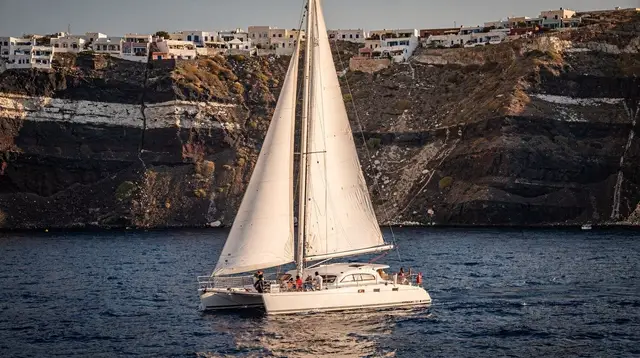
A boat is as much a part of visiting Paros as it is in Santorini, just for different reasons — here it’s about reaching quieter coves and neighbouring islands rather than viewing a caldera wall. a semi-private catamaran cruise around Paros’s coastline covers stretches of coast that are difficult to reach by road, with swim stops along the way, and works well as a first full day if you’ve just come off the ferry and want to see the island’s shape before deciding where to base yourself for the rest of your stay.
For evenings, a sunset cruise along the Paros coastline and a small-boat sunset tour around the island are both lower-key alternatives to Santorini’s crowded caldera-rim viewpoints — there’s no equivalent of the Oia crush here, just open water and a flatter horizon.
If your route includes Mykonos as well, a combined boat tour can cover both island hops in a single outing rather than separate ferry bookings: a combined island-hopping boat tour linking Mykonos, Paros and Antiparos is worth booking ahead if you know your dates, since it removes a leg of ferry planning from a route that already involves several islands.
Fitting Paros into a Longer Cyclades Trip
The most natural use of Paros is as the middle link in a route that starts in Santorini and continues north. A common shape is Santorini → Naxos → Paros → Mykonos, spending two or three nights on each of the middle islands before a flight home from Mykonos or a return south. Our Santorini-and-Naxos one-week itinerary and one-week-in-Santorini itinerary both assume this kind of onward movement rather than a single-base stay, and the Santorini-to-Naxos day-trip guide is a useful reference for the first leg even if you continue on to Paros afterward.
Travellers weighing Paros against a Milos-based extension instead — flatter beaches versus volcanic coastline — will find that comparison laid out in our Santorini-and-Milos itinerary; the two islands suit noticeably different trip styles despite sitting at similar distances from Santorini.
Practical Notes for a Paros Stopover
Buses run from Parikia to the main beaches and villages, including Lefkes and the east-coast resorts, on a schedule that thins out considerably in the evenings and off-season — check return times before setting out rather than assuming a late bus back. A rental car or scooter opens up the marble villages and the quieter southern beaches far more easily than the bus network does, and is the more practical choice for anyone spending more than a couple of nights.
Windsurfing and kitesurfing gear is rented directly at Golden Beach and a handful of other east-coast spots, with lessons available for beginners; conditions are consistent enough through the summer that it’s a realistic activity to plan a day or two around rather than a last-minute add-on. Payment across the island works the same way it does throughout the Cyclades — cards are widely accepted in Parikia and the resort beaches, but small tavernas and village kiosks still expect cash.
Visiting Paros from Santorini: Frequently Asked Questions
How long is the ferry from Santorini to Paros?
Roughly two hours on a high-speed ferry from Athinios, similar to the crossing time to Naxos or Mykonos on the same route. Conventional ferries take longer, and exact durations vary by operator and vessel, so treat any published time as an estimate rather than a guarantee.
Is Paros a good day trip from Santorini?
Not really. A return crossing alone takes roughly four hours out of the day, leaving little time on the ground once you add travel from the port to a beach or village. Paros works far better as a multi-night stop within a longer Cyclades route than as a same-day excursion.
Should I stay in Parikia or explore beyond it?
Parikia is the practical base — ferries, buses, car rental and the widest choice of accommodation all radiate from there. But the island’s best beaches and its most characterful village, Lefkes, sit away from the port, so plan on a car, scooter or bus trip out at least once during your stay. Naoussa, on the north coast, is covered on its own page rather than here.
What is Paros known for?
Ancient marble quarrying, a Byzantine-era church in Parikia among the oldest in Greece, the hilltop old capital of Lefkes, and some of the best windsurfing conditions in the Cyclades at Golden Beach. It is a flatter, sandier, generally calmer counterpart to Santorini’s cliffside villages.
Can I visit Antiparos from Paros?
Yes — Antiparos sits just off Paros’s west coast and has its own separate page on this site, since it has enough character and enough to see to stand on its own rather than as a side note here.
Is Paros good for families or beginner windsurfers?
Yes to both. The beaches are generally flatter and more sheltered than Santorini’s, several stretches of coast have gentle, shallow entry, and Golden Beach’s windsurfing schools cater specifically to beginners alongside more experienced riders.
What’s the best time to visit Paros?
Late April through June, and September into October, when the meltemi has eased from its midsummer peak and the beaches and villages are noticeably quieter than the July–August rush. Windsurfers specifically often prefer the stronger, more consistent wind of high summer.
How do I continue from Paros to Mykonos or back to Santorini?
Both routes run as regular high-speed ferry connections in season, and a handful of combined boat tours link Paros with Mykonos and Antiparos in a single outing rather than separate ferry bookings. Book ahead in July and August, when sailings fill up well before departure day.