Santorini and Milos in One Week: A Volcanic Coastline Itinerary
Two Volcanoes, One Week
Santorini and Milos are both children of the same volcanic arc, and they show it in almost opposite ways. Santorini is a caldera — a collapsed crater half-filled with sea, its cliffs rising 250 to 300 metres straight out of the water. Milos never blew its own centre out like that; instead, its coast has been carved, bleached and hollowed by wind, waves and mineral-rich rock into sea caves, white cliffs and a lunar shoreline. Put the two islands back to back and you get a single story about what a volcano does to a coastline, told two different ways.
This route is built for travellers who want that story more than they want village squares or wine lists. It skips Akrotiri and the inland villages covered in Three Days in Santorini: The Classic First Itinerary and Five Days in Santorini: Beyond the Caldera Villages, and it isn’t the wine-and-Naxos version you’ll find at Santorini and Naxos in One Week.
Instead it spends its time on the water: the caldera cruise around Nea Kameni and Palea Kameni, then the boat-only approach to Kleftiko and the walk across Sarakiniko’s white rock.
One planning note before Day 1: the ferry between the two islands runs a few hours, not a fixed number of minutes — it depends on the operator, the route (direct or via Ios and Sikinos) and the season. Check current timetables through the Santorini ferry guide once you have real dates, and book that leg as soon as you can, since the fastest boats sell out first in summer.
Day 1: Arrive on Santorini, get your bearings on the caldera
Fly or ferry into Santorini and settle into a base on the caldera rim — Fira, Firostefani or Imerovigli all work, and all three sit above open water rather than a beach; the The Santorini Caldera villages have no direct sea access, which surprises first-time visitors more than anything else on the island.
Spend the afternoon walking the caldera edge rather than chasing Oia’s sunset crowd — that’s a village-focused ritual this itinerary isn’t built around. Imerovigli and the Skaros Rock give an uncrowded view of the same cliffs and the same drop into the sea, and they set up the geology you’ll spend the next two days looking at from below. If you’d rather see the sunset from the water than fight for a rail spot, book an evening slot on the Santorini day cruise around the caldera instead — it runs the same route you’ll take properly on Day 2, so treat tonight as a preview.
Day 2: The caldera by boat — Nea Kameni’s crater and Palea Kameni’s hot springs
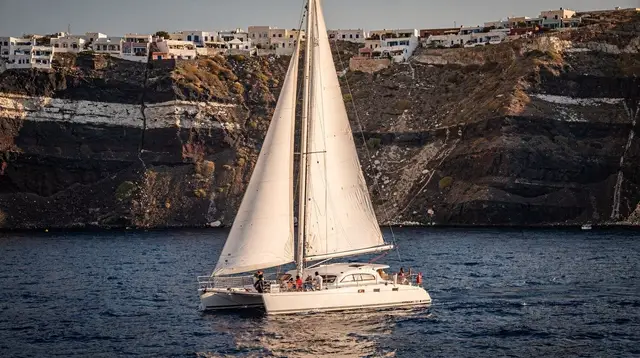
This is the day that explains what you saw from the rim. A caldera cruise crosses the water to Nea Kameni, the still-active cone at the centre of the bay, where a roughly 30-minute walk up a bed of black cinder reaches the crater rim. There’s a small entry fee, paid in cash on the island, and it’s almost never included in the price of the boat — bring a few euros. From there, most itineraries continue to Palea Kameni, where you swim from the boat to iron-tinted hot springs; the water is warm rather than hot, and it will stain light-coloured swimwear, so leave the white bikini at the hotel.
Book this as a half-day or full-day trip on the Santorini day cruise, or upgrade to the Santorini luxury day cruise if you want a smaller boat and more time at anchor. Either way, this single outing does more to explain the caldera’s origin than anything on land — you’re literally standing inside the crater that produced it.
Day 3: A second look at the caldera, then start moving toward the ferry
Use this day as a buffer. If the wind was up on Day 2 — the meltemi can cancel boat departures in July and August — this is your reschedule slot. If everything went to plan, spend the morning comparing cruise options for future trips (there’s a real difference between a catamaran and a sailing boat, and between a morning and a sunset departure), or simply relax before the crossing.
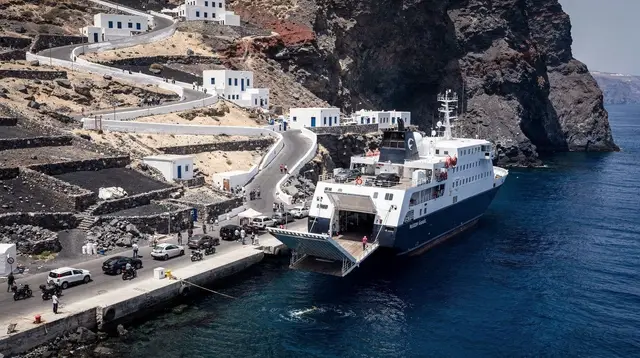
By early evening, head down to Ormos Athinios, Santorini’s only ferry port, at the base of a steep switchback road. It’s the single departure point for every boat off the island, so allow more time than feels necessary — traffic backs up fast before each sailing. If your ferry to Milos leaves the next morning instead, an overnight near Athinios or a taxi booked in advance saves the scramble; taxis on Santorini are scarce, and reserving ahead is normal here, not an indulgence.
Day 4: Ferry to Milos, settle in at Pollonia
Take the ferry from Athinios to Milos — a few hours depending on the route and the operator, and worth booking as soon as your dates are fixed, since Cyclades ferries fill up in season. For a full breakdown of the crossing and its alternatives, see the Island Hopping from Santorini: Which Cyclades Island to Choose guide.
Milos looks nothing like the island you just left. There’s no single dramatic cliff line — instead the coast breaks into dozens of small bays, sea caves and mineral-streaked headlands, a legacy of the same volcanic system working through softer, more varied rock than Santorini’s. Pollonia, a small fishing village on the north coast, makes a good base: it’s close to the boats that run to Kleftiko and within easy reach of Sarakiniko. Spend the rest of the day resting after the crossing — tomorrow is the day this whole itinerary is built around.
Day 5: Kleftiko by boat — the sea caves you cannot reach on foot
Kleftiko is Milos’s best-known landscape, and it needs saying plainly: there is no path to it, no dock, and no way to see it on foot. The white rock formations, sea arches and caves — once a hideout for pirates, hence the name — sit on a stretch of coast reachable only by boat, and swimming into the caves from the boat is the only way to actually be inside them. Anyone offering a walking route to Kleftiko is describing somewhere else.
A private boat gives you the most time in the water and lets the captain adjust for the day’s conditions — a private boat tour to the Kleftiko caves and Sykia is built for exactly that. If you’d rather keep the day shorter, a half-day morning cruise to Kleftiko and Sykia covers the same caves in less time, which also means calmer water before any afternoon wind picks up. For visiting the same coast on your own schedule and route, renting a boat without a licence is possible in the Cyclades generally, though most travellers find a skippered tour easier for a coastline this technical.
| Kleftiko option | Best for |
|---|---|
| Half-day morning cruise | Calmer seas, shorter day, still covers the main caves |
| Private boat tour | Flexible pace, smaller group, more swimming time |
| Speedboat tour (adds Polyaigos) | Covers more coastline in one day, less time at anchor |
Day 6: Sarakiniko’s white rock, then Kimolos and Polyaigos by boat
Sarakiniko couldn’t look more different from Kleftiko while sitting on the same island. Wind and sea have worn the volcanic rock here into smooth, bone-white folds that read more like a moonscape than a Greek beach — there’s little sand and less shade, so bring water and sun cover rather than a beach chair. It’s one of the few sights on this itinerary that’s genuinely walkable; the rock forms natural steps and inlets you can explore on foot before swimming off the ledges.
For an afternoon that goes further along the same volcanic coastline, the private boat tour to Sarakiniko, Kimolos and Polyaigos combines Sarakiniko’s white rock with the neighbouring islets of Kimolos and Polyaigos, both far quieter than Milos itself. If you’d prefer a single full day that ties the whole coastline together instead of splitting Kleftiko and Sarakiniko across two days, the full-day cruise on a traditional boat is the one-boat version of this itinerary’s two busiest days — worth considering if your week is tighter than seven days.
Day 7: A last swim, then the way home
Keep the final day loose. Milos has enough small bays near Pollonia and Adamas for a slow last swim without booking anything, or you can fit in one more short boat outing if your flight or ferry allows it. Milos connects onward to Athens by air and to the rest of the Cyclades and Piraeus by ferry — check the Santorini ferry guide and the wider Cyclades island-hopping routes if you’re continuing rather than flying straight home.
One factual note worth carrying into this trip rather than worrying about beforehand: in early 2025, a weeks-long earthquake swarm between Santorini and Amorgos led to a temporary local state of emergency and thousands of precautionary departures. No eruption followed, the swarm ended, and current research points to a deep magma intrusion rather than an imminent eruption. It doesn’t change anything about visiting either island today, but it’s the honest answer if the topic comes up — see Santorini safety and the 2025 earthquakes for the full picture.
Santorini and Milos: how the geology actually differs
| Santorini | Milos | |
|---|---|---|
| Volcanic feature | A collapsed caldera, cliffs to 300m | Eroded volcanic coast, caves and coves |
| Signature sight | Nea Kameni’s active crater | Kleftiko’s sea caves, boat-only |
| How you see it | Boat cruise into the caldera | Boat tour along the coastline |
| Walkable? | Caldera path along the rim | Sarakiniko’s rock, on foot |
| Last major activity | Eruption in 1950 | No historical eruption on record |
Planning this trip: Santorini and Milos in one week FAQ
Can you walk to Kleftiko?
No. Kleftiko has no path, no road and no dock — the sea caves and rock arches are reached only by boat, and swimming from the boat into the caves is the only way inside them.
How long is the ferry from Santorini to Milos?
A few hours, depending on the operator and whether the route runs direct or via other islands such as Ios or Sikinos. Timetables and durations change by season, so check current options once your dates are set rather than planning around a fixed time.
Is one week really enough for both islands?
Yes, if you split it roughly three to four days on Santorini and three to four on Milos. Trying to add a third island on top of this pairing usually means less time on the water, which is the point of this particular route.
Do I need a car on Milos for this itinerary?
Not for this route. Kleftiko and the Kimolos-Polyaigos coastline are accessed by boat, and Sarakiniko is a short taxi or bus ride from Pollonia or Adamas. A car matters more if you’re chasing Milos’s more remote beaches, which sit outside this itinerary’s focus.
Is swimming included on the Kleftiko boat tours?
Yes — stopping to swim into the sea caves and around the rock formations is the main point of the trip, not an add-on. Bring a swimsuit you don’t mind getting salty and reef-safe sunscreen.
What’s the best time of year for this route?
Late spring through early autumn gives the calmest seas for both the caldera cruise and the Kleftiko boat tours. The meltemi wind can disrupt sailings in July and August, so build a spare day into the schedule if you’re travelling then.
Should I book the Kleftiko boat tour in advance?
Yes. The boats that run into Kleftiko’s caves are small by design, and popular departures — especially private tours — sell out days ahead in July and August.
Does this itinerary cover Santorini’s villages or wineries?
No. Fira, Oia and the inland villages are covered in Three Days in Santorini: The Classic First Itinerary and Five Days in Santorini: Beyond the Caldera Villages; this route is built specifically around the volcanic coastline of both islands.
a Poliegos and Milos boat tour is also worth comparing if you want a single day that covers a broader stretch of coastline than Kleftiko or Sarakiniko alone.
tours.7 days
Verified deep-linked GetYourGuide tours. Book through these links and we earn a small commission at no cost to you.
GetYourGuide does not provide a product photo for this activity — the image shows the meeting point, photographed by us.