Where Firostefani sits on the caldera
Firostefani is the short, quiet stretch of clifftop path between Fira and Imerovigli, on the same unbroken line of villages that runs along the western rim of the Santorini caldera. Walk south from here for ten minutes and you’re in Fira’s main square; walk north for another ten and the path starts climbing toward Skaros Rock and Imerovigli’s higher, more expensive terraces. Firostefani itself barely registers as a separate stop to a lot of first-time visitors, who pass straight through it on the Fira–Oia caldera path without stopping. That’s the point of this page: to make the case for stopping.
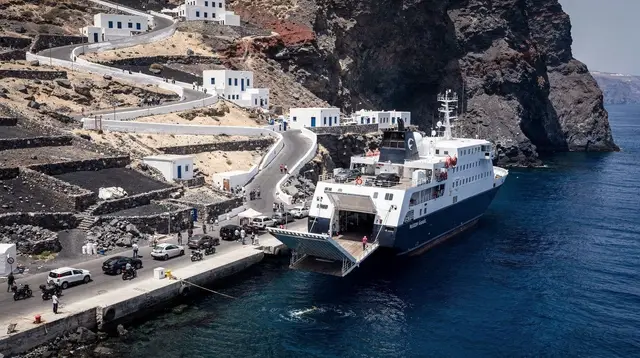
Like every village on this rim, Firostefani has no seafront. The caldera wall drops 250 to 300 m almost straight down to the water, and there is no path, road or cable car of any kind connecting Firostefani directly to the sea below. If you want a beach, you’re looking at Kamari or Perissa on the island’s east coast, not here — a fact worth stating plainly, because “caldera village” and “waterfront village” get confused constantly in trip planning, and Firostefani, Fira, Imerovigli and Oia are all, without exception, clifftop towns with a view of the water rather than access to it.
What Firostefani does have is a genuinely good version of that view, delivered without the theatrics that surround Oia. The whitewashed houses, blue-domed chapels and cave-style suites stack down the cliff face here exactly as they do in every postcard of the island — the difference is the number of people standing next to you while you look at them.
Firostefani, Fira and Imerovigli compared
These three villages run into each other along the same clifftop, and the boundaries aren’t always obvious on foot. Here’s the practical difference:
| Fira | Firostefani | Imerovigli | |
|---|---|---|---|
| Character | Capital: shops, bars, buses, cable car | Quiet residential stretch | Highest point, most exclusive |
| Noise at night | Can be loud, especially in high season | Generally quiet | Quiet |
| Walk to Fira center | — | 10–15 minutes | 20–25 minutes |
| Typical hotel style | Mixed, from budget to boutique | Boutique, caldera-view suites | Luxury caldera-view suites |
| Best known for | Museum of Prehistoric Thera, ferries, buses | A calmer alternative close to everything | Skaros Rock, panoramic sunsets |
| Direct beach access | None | None | None |
If Fira feels too busy and Oia too far, Firostefani and Imerovigli are the two answers people usually land on. Between those two, Firostefani is generally the more affordable and more convenient — closer to Fira’s restaurants and transport, at a small cost in elevation and drama compared with Imerovigli’s higher perches.
Sunset in Firostefani, without the fight for a rail
Oia’s sunset is the single most-searched thing about this island, and the Kastro viewpoint genuinely earns its reputation — but it also fills up 90 minutes to two hours before the sun goes down in July and August, turning a quiet moment into a shoulder-to-shoulder wait for a spot at the railing.
Firostefani’s caldera-facing terraces, tavernas and public viewpoints look at the same volcano, the same water, and much of the same light, from a stretch of path that rarely sees that kind of crowding. You won’t get the specific silhouette of Oia’s blue domes against the sky, but you will get an unhurried evening: a table you didn’t have to claim an hour early, and a walk home that doesn’t involve a slow-moving crowd on a narrow lane. For a longer list of alternatives beyond this one village, see our guide to the best sunset spots beyond Oia, which also covers Imerovigli, Skaros Rock and the view from Pyrgos.
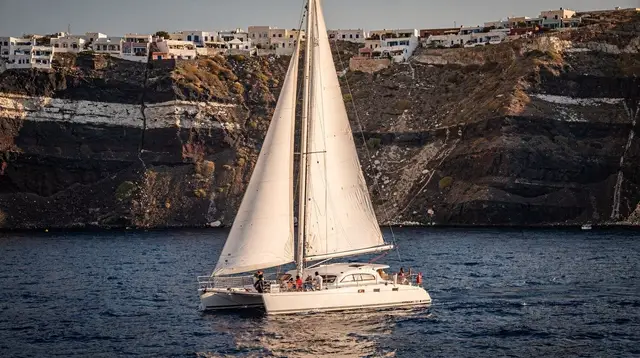
The most reliable way to see the caldera light up at sunset without picking a fixed spot at all is from the water. A number of catamaran and sailing trips time their return specifically around sunset:
a sunset cruise around the caldera spends the last hour of daylight on the water facing the cliffs — including Firostefani’s stretch of them — rather than competing for a place to stand on shore.
Sunset times swing hard across the year here — around 20:50 in late June, closer to 17:15 in late December — so check the date rather than assuming an hour.
Getting a feel for the village on foot
Firostefani has no major sights of its own in the way Fira has its museum or Oia has its castle ruins — its appeal is the quality of an ordinary walk. The paved section of the caldera path that runs through here is flat, easy, and lined with small chapels, whitewashed staircases and caldera-view cafés, which makes it a good introduction before the path gets rougher past Imerovigli. If you’re planning to walk further, our Fira to Oia caldera hike guide covers the full 10.5 km route, the lack of shade, and why arranging a bus or taxi back is worth doing before you set out rather than after.
For a short evening out that doesn’t require a car, a guided walk through Firostefani and neighboring villages built around food and drink stops is a low-effort way to see more than you would alone:
a local food and drink walking tour timed for sunset moves between small tavernas and viewpoints as the light changes, which suits this stretch of the caldera better than a single fixed dinner reservation would.
Firostefani also makes a workable base for day trips that combine it with Oia in a single outing, useful if you’re staying centrally and want to see both villages without renting a car:
a Firostefani and Oia sightseeing tour links the two on one itinerary, which is a reasonable shortcut if a full independent walk isn’t what you’re after.
Wine, boats and the rest of the caldera from here
Firostefani doesn’t have its own winery or archaeological site, but it’s close enough to both to use as a base rather than a destination in itself. The island’s wineries cluster inland around Pyrgos and Megalochori, a short drive or taxi from here, and cover the Assyrtiko-based whites and sweet Vinsanto the island is known for.
a winery and farm tour that includes a meal is a straightforward way to taste a few of these without arranging transport yourself.
For the volcano and hot springs at the center of the caldera — Nea Kameni’s crater hike and Palea Kameni’s iron-rich swimming — most boats depart from Fira’s old port or Athinios, both reachable from Firostefani by the same cable car or road used from Fira itself.
a morning cruise around the caldera typically combines both islets with a swim stop, and is worth booking ahead in July and August rather than turning up at the port.
Note that landing fees at Nea Kameni (in the order of a few euros, paid in cash on the island) and swimwear stains from Palea Kameni’s iron-rich water are common surprises that aren’t always spelled out in a cruise listing — worth knowing before you go rather than after.
Where Firostefani fits if you’re comparing villages
If you haven’t picked a base yet, the short version is this: choose Fira if you want to be in the middle of restaurants, buses and nightlife and don’t mind some noise; choose Imerovigli if budget allows and you want the highest, most panoramic terraces near Skaros Rock; choose Oia if the blue-domed view is non-negotiable and you’re prepared to book far ahead and share the sunset with a crowd; choose Firostefani if you want to be a short, flat walk from Fira’s convenience while sleeping somewhere quieter, at a price usually below Imerovigli’s.
Our fuller comparison of Oia versus Fira as a base covers the trade-offs in more depth, and the general where to stay in Santorini guide places Firostefani alongside every other village option on the island, including the ones away from the caldera entirely.
Practical notes for staying in Firostefani
Getting here from the airport or the ferry port at Athinios means a taxi or transfer into Fira first, then a short hop or walk along the rim — there’s no separate bus stop serving Firostefani specifically, since the KTEL bus network is built around Fira’s main station. Taxis on the island are few (around thirty for the whole of Santorini), so arranging a transfer ahead of arrival, especially late at night or early in the morning, saves a long wait rather than being an unnecessary precaution.
Water here, as everywhere on Santorini, comes from desalination rather than any natural source — it’s safe to drink but tastes noticeably of salt, and most visitors and locals alike stick to bottled water for drinking. Many of the smaller hotels and restaurants along this stretch of the caldera close for winter, roughly November through March, so if you’re visiting outside the June–September peak, it’s worth confirming opening dates before booking rather than assuming everything listed is running.
For a broader sense of how crowd levels and prices shift through the year, our month-by-month breakdown in the best time to visit Santorini guide is a useful companion to this page, and if you’re weighing a longer stay across several villages, the two-day Santorini itinerary shows how Firostefani, Fira and Imerovigli can be strung together on foot without a rental car.
Firostefani questions people actually ask
Does Firostefani have a beach?
No. Firostefani sits on the caldera rim, 250–300 m above the water, exactly like Fira, Imerovigli and Oia. None of the caldera-rim villages have direct beach access. The nearest sand and pebble beaches — Kamari and Perissa — are on the opposite, eastern side of the island, roughly a 15–20 minute drive away.
Is Firostefani better than Oia for sunset?
It depends what you want. Oia’s Kastro has the most famous view and the biggest crowd, filling up 90 minutes to two hours before sunset in high season. Firostefani’s viewpoints face the same caldera and volcano from a quieter, uncrowded stretch of path — you trade a little bit of postcard fame for elbow room and an easier walk home.
How far is Firostefani from Fira?
About 1–1.5 km, roughly 10 to 15 minutes on foot along a flat, paved section of the caldera path, or a five-minute taxi ride. It’s close enough to walk into Fira for dinner and walk back for a quiet night, which is the main reason people choose it.
Is Firostefani good for couples and honeymoons?
Yes. It’s one of the quieter stretches of the caldera rim, with small boutique hotels and infinity pools facing the volcano, and it avoids both Fira’s late-night noise and Oia’s daytime crowds. Many honeymoon travelers base here or in neighboring Imerovigli for exactly that balance.
Can I walk from Firostefani to Oia?
Yes, via the Fira–Oia caldera path, which passes through Firostefani and Imerovigli early on. The full walk to Oia is around 10.5 km and takes 3 to 5 hours with little shade, so most people either turn back after Imerovigli and Skaros Rock, or plan the full hike with a bus or taxi back.
Is Firostefani walkable, or do I need a car?
You don’t need a car to enjoy Firostefani itself — it’s a short, flat walk to Fira’s shops, restaurants, the Museum of Prehistoric Thera and the cable car down to the old port. A car or organized tour becomes useful once you want to reach the south coast beaches, Akrotiri, the wineries inland, or Oia by road rather than on foot.
What’s the difference between Firostefani, Fira and Imerovigli?
Fira is the island’s capital: shops, nightlife, buses, ferries by cable car and steps below. Imerovigli is the highest point on the rim, with Skaros Rock nearby and the most expensive caldera-view hotels. Firostefani sits between the two — quieter than Fira, less elevated and slightly less pricey than Imerovigli, and walkable to both.