Oia vs Fira: Where to Stay in Santorini
Should I stay in Oia or Fira in Santorini?
Stay in Oia for the island's most photographed sunset and a quieter village after dark; stay in Fira for a livelier, more central base near the old port, the cable car and the buses that reach the rest of the island. Neither village sits on the water, so a caldera view is never the same as beach access.
Two Villages, Two Different Trips
Every Santorini planning conversation eventually reaches the same fork: Oia or Fira. Both sit on the rim of the same volcanic caldera, both look west over the same water, and both show up in the same photographs of white cube houses against blue domes. Past that, they are built for different kinds of stay. Oia is a village that organizes itself around one thing — the sunset — and stays quiet and residential for the rest of the day. Fira is Santorini’s working capital: administrative offices, the main hospital, the bus terminal, the largest concentration of restaurants and shops, and the closest thing the island has to a nightlife strip.
Neither answer is wrong. The right one depends on what you actually want your evenings and mornings to look like, how much you plan to move around the island, and how you feel about walking past other people’s cameras to get to your own room.
What Oia Actually Offers
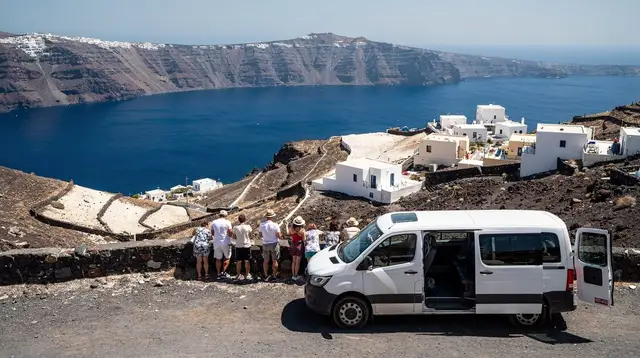
Oia’s whole layout points toward the Kastro, the ruined Byzantine castle at the village’s western tip, because that is where the caldera curves in a way that puts the setting sun directly over the water and the neighbouring cliffs. It is one of the most reliable sunset views in the Mediterranean, and Oia has arranged its cave houses, boutique hotels and blue-domed churches to face it. In the hour before sunset in July or August, the Kastro terraces and the surrounding lanes fill in — the site’s own reporting on the crowd puts arrivals at ninety minutes to two hours ahead of sunset in peak season, and by the time the sky actually turns colour there is very little open space left to stand in.
Staying in Oia means that crowd empties out of your own front door once the show is over. Day-trippers and cruise passengers who came in buses just for the sunset head back to Fira or to their ships, and Oia by 9 or 10pm becomes a genuinely quiet village of narrow lanes, small wine bars and restaurants with caldera tables. Below the village, a set of steps drops to Ammoudi Bay, a small working harbour with a cluster of seafood tavernas at the water’s edge — worth the walk down, though it is a real climb back up in the heat.
Oia’s trade-off is centrality. It sits at the island’s northern tip, which puts it furthest from Athinios, the only ferry port, and furthest from the airport. Bus connections from Oia to the rest of the island run less frequently than from Fira, and there is no cable car or equivalent shortcut in Oia itself — the steps to Ammoudi lead only to the harbour, not to any port that serves ferries.
What Fira Actually Offers
Fira is the island’s capital and its transport hub. Buses to almost every village and beach on Santorini depart from the Fira terminal, which makes it the easiest base for day trips that don’t involve a rental car. It is also the closest major village to Athinios, the port every ferry uses, and to the airport, which matters on arrival and departure days.
Fira has its own caldera-edge sunset, facing the same water as Oia from a lower angle, and it draws a real audience along the clifftop promenade — just nowhere near Oia’s numbers, so finding a spot to watch from is far less of a competition. What Fira does have that Oia doesn’t is the old port of Fira, known locally as Skala, at the foot of the cliff.
Cruise tenders and excursion boats — including caldera cruises and sunset sails — depart from there, and it connects to the town above by the cable car, by the 588 steps shared with mule traffic, or by donkey. The cable car ride takes about three minutes and covers roughly 220 metres of elevation; it runs to a price that sits somewhere in the order of a few euros each way, and it is worth checking the current fare and hours locally rather than assuming a fixed number, since both change from year to year.
The cost of that centrality is noise and density. Fira’s main pedestrian street and the lanes nearest the cable car station are the busiest on the island on any day a cruise ship is anchored offshore, with shops, tour touts and foot traffic that can feel closer to a small city than a Cycladic village. Travellers who want Fira’s location without its loudest streets typically look just north, toward Firostefani and Imerovigli — both an easy walk from central Fira, both on the same caldera rim, and both quieter after dark.
Getting Around From Each Base
| From | To Athinios ferry port | To the airport | To Fira old port |
|---|---|---|---|
| Oia | Furthest — roughly 30-40 minutes by road | Furthest on the island | No direct link; would need to reach Fira first |
| Fira | Closest of the two, a short drive | Short drive, closest major village | Cable car (about 3 minutes), the 588 steps, or by donkey |
Bus frequency mirrors this: Fira’s terminal is the hub the whole island’s bus network radiates from, so departures to Oia, the beaches and the villages are more frequent from Fira than the reverse. Staying in Oia and planning several day trips usually means one extra bus change through Fira, or booking a private transfer directly — taxis on the island are genuinely scarce, so pre-booking rather than hailing one is the norm everywhere, not just in Oia.
Price and Room Types
Both villages offer everything from simple double rooms to caldera-view suites carved into the cliff, but the mix skews differently.
| Oia | Fira | |
|---|---|---|
| Typical peak | Concentrated at the top of the market; caldera-view cave suites drive demand and price | Wide spread, from ordinary in-town rooms to premium caldera suites |
| Best value window | Shoulder season (late April-May, October) narrows the gap considerably | Easier to find mid-range rooms even in July-August |
| Room style | Cave houses, whitewashed suites, mostly boutique-scale | Everything from budget guesthouses to design hotels |
If budget matters more than the specific sunset backdrop, Fira and its immediate neighbours generally give more room to manoeuvre. If the caldera-facing terrace is non-negotiable and the trip is once-in-a-while, Oia is where that specific experience is concentrated — see the site’s broader where-to-stay guide for how both compare against Imerovigli, Firostefani and the south-coast beach towns.
Seeing Both Without Overcommitting
Plenty of visitors solve the Oia-versus-Fira question by not fully choosing: base in Fira for the transport convenience and spend an evening or a full day in Oia specifically for the sunset and the village itself, covered in more depth in the Oia village guide and in Fira’s own town guide. The two villages are close enough that a day trip between them is easy by bus, taxi, or on foot along the marked caldera path.
Walking it is its own activity rather than a shortcut: the Fira to Oia caldera path runs about 10.5 kilometres, takes three to five hours depending on pace and heat, and has real elevation past Imerovigli with almost no shade. Doing it with a guide adds context on the geology and the villages passed along the way — a guided walk along the Fira to Oia caldera path covers the route with someone who knows where to stop and where to keep moving before the heat sets in.
For a shorter, lower-effort way to get a feel for the capital itself before deciding whether to base there, a walking tour of Fira’s old town paired with a local wine tasting covers the layout, the viewpoints and a first taste of Assyrtiko in a couple of hours.
Fira’s Advantage: The Old Port
Because Fira connects directly to its own old port, it is also the easiest base for anyone planning a caldera cruise or a sunset sail without adding a long transfer to the day.
Boats departing from Skala reach Nea Kameni and Palea Kameni or simply circle the caldera for the evening light — a morning cruise departing from the old port of Fira is a straightforward way to see the volcano and the hot springs without an early transfer from Oia, and for the evening, a private sunset cruise leaving from the old port of Fira puts the boat itself between the crowd on the Oia Kastro and the view everyone is trying to photograph — watching the cliffs light up from the water rather than fighting for a railing spot on land.
The Trap to Avoid: Neither Village Touches the Sea
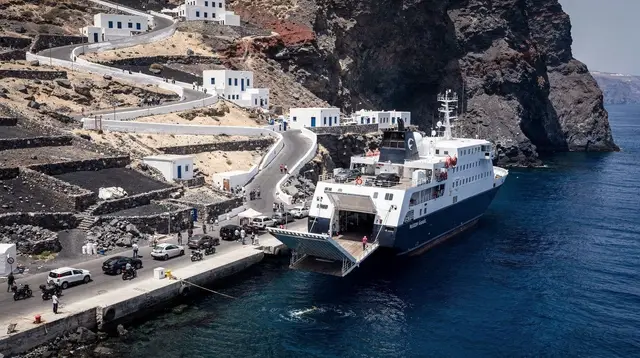
It is worth saying plainly, because listing photos rarely make it obvious: staying in Oia or in Fira does not put you near a beach. Both villages sit on top of the caldera cliff, tens of metres above the water, with no swimmable shoreline directly below either one. Ammoudi Bay under Oia is a small harbour with tavernas, not a beach, and the old port under Fira is a working boat dock.
Santorini’s actual beaches — Kamari, Perissa, Perivolos and the volcanic-sand coastline further south — are on the opposite side of the island, reachable by bus, taxi or rental car in twenty to forty minutes from either village. Anyone planning a trip built around beach time each day should weigh that distance into the choice, or consider splitting the stay, an approach covered in the site’s wider itinerary without a car.
Which One Fits Your Trip
A short, practical way to decide:
- Choose Oia if the sunset itself is the priority, you want a quieter village to return to after dark, and you don’t mind a longer transfer to the ferry port or airport on arrival and departure days.
- Choose Fira if you want the shortest routes to the rest of the island, easy access to the old port for cruises, and a wider range of room prices — and you’re comfortable with a busier main street, especially on days a cruise ship is anchored offshore.
- Choose neither, technically — Firostefani or Imerovigli — if you want Fira’s location without its loudest streets, or a calmer alternative sunset view; both are covered on their own pages rather than here.
- Base in Pyrgos or another inland village if neither caldera-front village’s price or crowd suits the trip; Pyrgos sits higher inland and offers one of the few spots from which the whole island is visible at once, at a different pace entirely.
Whichever village wins, book the room well ahead of the trip. Caldera-view rooms in both Oia and Fira sell out for peak-season dates months in advance, and the gap between what’s left close to arrival and what was originally available can be wide.
Oia vs Fira: Common Questions Before You Book
Should I stay in Oia or Fira for the sunset?
Oia has the reputation and the crowds to match: the Kastro fills up ninety minutes to two hours before sunset in high season. Fira also faces west over the caldera and gets a very good sunset with far less competition for a spot, just not the same postcard.
Which village is more central for getting around Santorini?
Fira. It sits closer to the middle of the island, next to Firostefani and Imerovigli, with the most frequent bus connections and the shortest run to Athinios ferry port. Oia is at the northern tip, roughly 30 to 40 minutes from Athinios by road.
Can I walk between Oia and Fira?
Yes, along the Fira to Oia caldera path, about 10.5 kilometres and three to five hours on foot with real elevation gain and no shade. Most people walk it one way in the morning or late afternoon and take a bus or taxi back rather than repeating it.
Do Oia or Fira have a beach?
No. Both sit on top of the caldera cliff, thirty metres or more above the water, with no direct beach access. Santorini’s sand and pebble beaches are on the east and south coasts, around Kamari, Perissa and Perivolos, a bus or taxi ride away from either village.
Is Fira too noisy to stay in?
The main pedestrian strip and the streets nearest the old port get loud and crowded, especially on cruise-ship days. Firostefani and Imerovigli, immediately north of central Fira, offer the same caldera views and easy walking access with a noticeably calmer street level.
Which is more expensive, Oia or Fira?
Oia’s caldera-view suites and cave houses generally sit at the top of the island’s price range, driven by the sunset demand. Fira has a wider spread, from simple in-town rooms to caldera-facing suites, which makes it easier to find something outside peak pricing.
How do I get down to the old port from Fira?
By the cable car, which takes about three minutes down 220 metres of cliff, on foot down the 588 steps shared with mules, or by donkey. The cable car is the practical option for luggage or heat; queues build fast when a cruise ship is in.
Is there a cable car or similar shortcut in Oia?
No. Oia has no cable car. Its own set of steps drops to Ammoudi Bay, a small fishing harbour below the village, but that path is unrelated to the ferry system and leads nowhere except the water and a handful of tavernas.
Trip-planning essentials on GetYourGuide
Verified deep-linked GetYourGuide tours. Book through these links and we earn a small commission at no cost to you.
GetYourGuide does not provide a product photo for this activity — the image shows the meeting point, photographed by us.