Why nobody sets foot on Palea Kameni
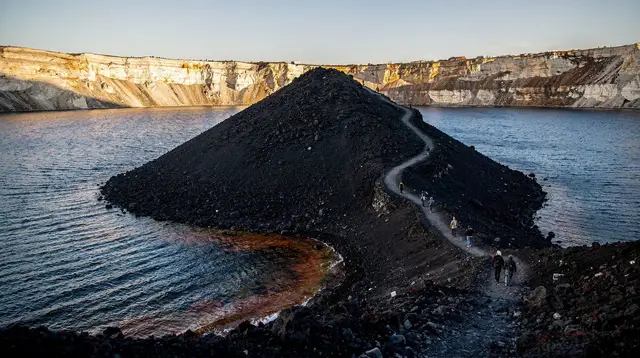
Every caldera cruise out of Santorini stops twice among the black islets in the middle of the bay. At Nea Kameni, passengers climb ashore and walk up a cinder path to an active crater. At Palea Kameni, nobody lands at all. There is no dock, no path, and nothing to see from land — the entire appeal is underwater, and the only way to reach it is to slip off the side of the boat and swim.
That single difference changes everything about how to plan for this stop. You don’t need closed shoes or cash for an entry fee here, the way you do on its neighbour. You need a swimsuit you don’t mind ruining, a plan for getting in and out of the water gracefully, and realistic expectations about what “hot springs” means when the water temperature barely rises above the sea around it.
This page covers only the swim at Palea Kameni: what the water feels like, why it stains, how boats handle the stop, and how to decide whether it’s worth getting in. For the crater walk and its entry fee, see the Nea Kameni volcano guide instead — the two islets sit a few hundred metres apart in the same crossing, but they are entirely different experiences.
What the water actually feels like
Set expectations before you jump: this is not a hot spring in the way a spa or a geothermal pool is hot. The warmth comes from volcanic vents on the seabed, diluted almost immediately by the open sea around them. In the warmest pockets, close to the rocky shoreline, the water is noticeably warmer than the surrounding caldera — pleasantly so, like a bath that’s cooling down rather than one freshly run. A few metres further out, it’s simply sea temperature. Nobody should board a cruise expecting to soak in something scalding; the springs are a curiosity to swim through, not a hot tub to lounge in.
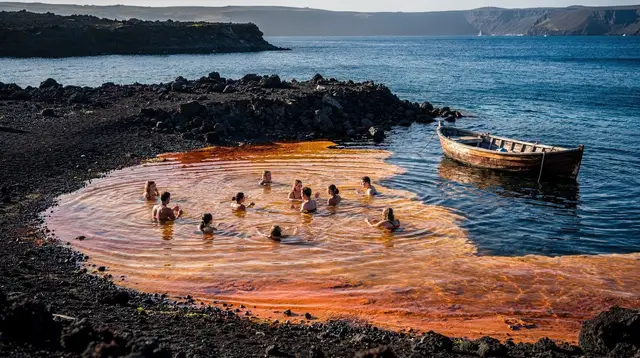
What is unmistakable is the colour and the smell. The shallows near the rocks run rust-orange to deep red, stained by dissolved iron oxide leaching out of the volcanic rock, and the whole area carries a faint sulphurous edge in the air — not unpleasant, just distinctly mineral. Swimming into the coloured water from clear blue sea is the moment most people remember: a visible line where the caldera’s usual deep blue gives way to a cloudy, rust-tinted patch a few dozen metres wide.
The water is shallow close to the rocks and deepens quickly further out, and most boats anchor a short swim away rather than right against the shoreline. Currents are generally mild inside the sheltered stretch of water where boats stop, but this is still open sea, not a pool — weaker swimmers should stay near the boat or the safety line most operators trail behind it, and children should wear a life jacket rather than rely on confidence alone.
The one thing every operator warns about: staining
If there’s a single piece of advice worth repeating before this stop, it’s this: do not wear your good swimsuit. The iron-rich water leaves a rust-coloured tint on light fabrics — white, pale pink, cream, anything pastel — and it does not wash out with a normal rinse or a run through the laundry. Dark colours (black, navy, deep red) hide it almost entirely; anything light comes out visibly discoloured, sometimes permanently.
The same goes for jewellery. Silver in particular can tarnish on contact with the sulphur in the water, so it’s worth leaving rings, chains, and watches on the boat rather than in the water with you. A cheap or dark-coloured swimsuit kept specifically for this swim is the standard workaround, and most crews will tell you so as you approach the stop — if yours doesn’t mention it, ask before you jump in.
Getting in and out
Because there’s no dock, entry and exit both happen directly from the boat. Most catamarans and larger cruise boats have a rear platform or ladder; smaller caiques may just have passengers step off the side. Neither requires strong swimming ability to manage safely, but it helps to know what to expect:
- Getting in: usually a ladder off the stern, or a jump for those who prefer it. Crew typically go first to show the entry point and stay in the water nearby.
- Getting out: this is the part people underestimate. Climbing back onto a moving boat from open water, wet and sometimes slightly rust-stained, takes more effort than the entry did. A ladder helps; without one, expect crew assistance.
- Non-swimmers: can usually still dip in the shallows near the boat with a life jacket, or simply stay aboard and watch — nobody is required to get in.
- Timing: stops typically run 15–30 minutes, folded into a longer stretch of the cruise that also covers Nea Kameni, a swim break in open caldera water, and often a lunch or drinks service.
If mobility is a concern, ask before booking — boats vary in how easy their ladder or platform is to use, and this is worth confirming rather than discovering at the anchorage. For a broader look at what to pack and expect across an entire caldera day, the guide to what to bring on a caldera cruise covers the rest of the checklist.
Palea Kameni vs Nea Kameni, side by side
The two islets are almost always visited on the same cruise, back to back, and it’s easy to confuse which one does what. Here’s the split:
| Palea Kameni | Nea Kameni | |
|---|---|---|
| What you do | Swim from the boat | Walk ashore to the crater |
| Landing | No dock — swim only | Dock and cinder path |
| Cost at the stop | None | Entry fee, paid in cash on arrival |
| Time needed | 15–30 minutes | 30–45 minutes round trip on foot |
| Footwear | None — you’re in the water | Closed shoes required |
| What you see | Rust-coloured, iron-rich shallows | An active volcanic crater |
| Effort | Low — a swim | Moderate — uphill walking on loose cinder |
Most full itineraries stop at both. If a cruise only mentions “the volcano” without specifying, it’s worth asking whether that means the Nea Kameni walk, the Palea Kameni swim, or both — wording varies by operator, and the two stops are easy to conflate when they’re marketed together.
Which cruises include this stop
Nearly every catamaran cruise around the caldera builds in a swim stop at Palea Kameni, usually paired with the Nea Kameni walk and at least one open-water swim break elsewhere in the bay. A few options that typically include it:
A half-day option built specifically around the swim stops and the volcanic islets is the 3-hour caldera catamaran cruise with drinks, which keeps the pace brisk if you want the swim without committing a full day.
For a longer version with a proper meal on board, the day-time catamaran cruise with swim stops and a barbecue lunch adds Thirassia and open-water swimming around the lunch break. Travellers who’d rather not compare boats themselves can book the more general full-day caldera cruise, which bundles the volcanic islets, a swim stop, and a village call into one itinerary.
For the sunset version — later start, same swim stops, dinner instead of lunch — the sunset catamaran cruise with swim stops and a barbecue dinner covers Palea Kameni earlier in the afternoon before turning toward open water for the light show. A shorter, simpler version without the full meal service is the sunset tour.
Whichever boat you pick, check the itinerary description for “hot springs,” “volcanic swim,” or “Palea Kameni” by name — a handful of shorter sunset-only routes skip the swim stops entirely and head straight to open water, which is worth knowing if the swim is the point for you. For a full comparison of what different boat types and cruise lengths actually include, see caldera cruises compared and catamaran vs. sailing boat.
Best time to go
The swim only makes sense when the sea is warm enough to want to be in it, which in practice means May through October. Outside that window, most operators either skip the swim stops or shorten them to a token dip, since few passengers want to get in a caldera that’s genuinely cold in December. July and August bring the warmest water and the meltemi wind at its strongest, which can add chop to the anchorage; the shoulder months of May, June, September, and October generally offer calmer water and a less crowded stop, since fewer boats are running at full capacity.
Morning cruises tend to reach the islets before the day’s heat peaks, while afternoon and sunset departures arrive when the light is better for photos of the rust-coloured water against the black cliffs. For a broader read on how the season shifts everything from crowds to water temperature, see Santorini weather month by month and morning vs. sunset cruise.
Practical notes before you jump in
- Swimsuit: dark or already-old, never your best one. See the staining section above.
- Jewellery: leave silver and anything valuable on the boat.
- Sunscreen: reapply before this stop specifically — you’ll be out of the water for a while afterward drying off on deck.
- Swimming ability: comfortable open-water swimming helps, but life jackets are standard for anyone who wants one, and nobody is required to swim.
- Camera: waterproof phone cases or a simple action camera are common here; the colour change in the water photographs well from just above the surface.
- What not to expect: don’t expect hot water, don’t expect a beach, and don’t expect to walk anywhere — everything happens from and in the boat.
None of this requires the volcanic history that comes with Nea Kameni’s crater — the springs at Palea Kameni are a swim, not a hike, and the whole stop is over in half an hour. For the wider picture of how the caldera itself came to look this way, how the Santorini caldera was formed fills in the geology without needing to set foot — or fin — on either islet.
If you’re building out a full caldera day around this stop, Thirassia and a walk along the Fira–Oia caldera path pair naturally with a morning cruise, while Oia and Ammoudi Bay suit an afternoon return timed for the Santorini sunset. For first-time visitors mapping out how a single day fits together, one day in Santorini is a useful starting point, and the The Santorini Caldera overview covers how all the villages along the rim relate to what’s happening in the water below them.
Palea Kameni hot springs: your questions answered
Is the water at Palea Kameni actually hot?
No. It’s warmed by underwater volcanic vents but stays lukewarm at best near the shoreline, and cools to normal sea temperature a short distance out. Treat it as a mineral-rich swim, not a hot spring soak.
Will the water stain my swimsuit?
Yes, if it’s light-coloured. The iron-rich water leaves a rust tint on white, pastel, or pale fabrics that doesn’t wash out reliably. Dark swimsuits hide it almost completely — wear one you don’t mind marking either way.
Can I walk ashore at Palea Kameni?
No. There’s no dock and no path — the entire stop happens in the water, swimming from the boat. Landing ashore is only possible at Nea Kameni, next door.
Do I need to pay an entry fee here?
No. The cash entry fee some travellers hear about applies to the crater walk on Nea Kameni, not to the swim stop at Palea Kameni, which has no separate charge beyond the cruise ticket.
How long does the swim stop usually last?
Most cruises allow 15 to 30 minutes at Palea Kameni, often as part of a longer swim break that also includes open caldera water away from the coloured shallows.
Is it safe for weak swimmers or children?
Yes, with a life jacket. The water near the boat is manageable for most people, and crew typically stay nearby, but this is open sea rather than a pool — anyone unsure of their swimming should stay close to the boat or the safety line.
What season is best for the swim?
May through October, when the sea is warm enough to make getting in appealing. Outside those months, some boats shorten or skip the swim stops altogether.
Is Palea Kameni worth it if I’ve already done Nea Kameni?
They cover different things — Nea Kameni is a walk to a crater, Palea Kameni is a swim through iron-rich water — so most people find them complementary rather than repetitive when both are on the same cruise.