Santorini Caldera Cruise: Nea Kameni, Hot Springs and What to Expect
What actually happens on a Santorini caldera cruise?
Most boats sail from the old port or Ammoudi Bay into the caldera, stop at Nea Kameni for a walk up the active cone, then anchor off Palea Kameni so passengers can swim to the tepid, iron-rich hot springs. Many add Thirassia or a sunset leg. The Nea Kameni entrance fee is usually paid separately, in cash, on the island itself.
What a Santorini caldera cruise actually covers
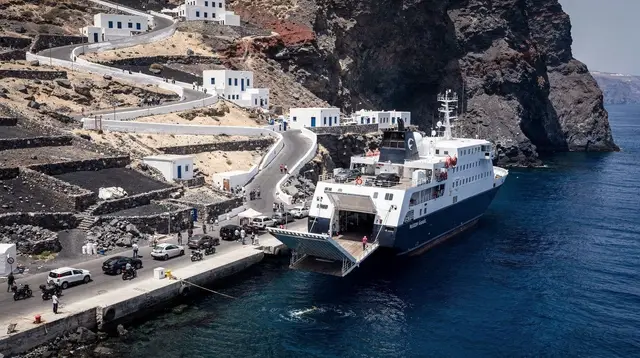
Almost every boat that leaves Santorini’s water for a half-day trip is selling some version of the same route: out into the flooded volcanic basin at the centre of the Santorini caldera, a stop at the active cone of Nea Kameni, a swim off Palea Kameni, and often a look at the cliffs below Oia or Fira on the way back.
The names get marketed differently — caldera cruise, volcano tour, sunset sail, catamaran cruise — but the three fixed points are almost always the same two islets and the cliff line itself. Understanding what happens at each stop, and what costs extra, is more useful than comparing boat names.
This guide is the overview. For the details that actually change which ticket to buy, we send you on to dedicated pages: which kind of boat suits you (catamaran versus sailing boat), what time of day to go (morning versus sunset), whether to pay for a private boat (semi-private versus shared cruises), what to actually pack (what to bring on a caldera cruise), and whether to add Thirassia to the itinerary.
The stop at Nea Kameni: walking the active cone
Nea Kameni is the black, treeless islet sitting almost dead centre in the caldera, and it is the youngest land in the Cyclades — built up in stages by eruptions as recently as 1950. Boats anchor offshore and tender passengers to a small jetty, from where a marked path climbs through loose volcanic cinder to a viewpoint near the main crater. The walk takes roughly half an hour each way at an easy pace, longer if the group stops often for photos of the caldera opening out behind them.
There is no lava to see — the last eruption was in 1950, and nothing has flowed since — but the ground itself is the attraction: cracked, reddish-black, still faintly warm in places, and littered with volcanic bombs thrown out over past eruptions. Sturdy shoes matter more here than almost anywhere else on the island; sandals on loose cinder are a genuinely bad idea.
The detail that catches people out is the entrance fee. Access to Nea Kameni’s path is managed separately from the boat ticket, and it typically runs to the order of five euros, paid in cash on the islet itself. Most cruise operators state this clearly if you read the fine print, but it is easy to miss when comparing prices at a glance, and it is the single most common source of “but I already paid for the tour” surprise on caldera cruises. Bring small notes and coins specifically for this stop; card machines are not the norm on a volcanic cone.
The swim at Palea Kameni: warm water, not hot water
From Nea Kameni, boats motor a short distance to Palea Kameni, the older and smaller of the two central islets. There is no landing here — passengers swim directly from the boat’s platform to a cove where underwater vents warm the seawater and stain it a rusty orange-brown with dissolved iron.
Set expectations correctly: this is not a hot spring in the sense of a thermal spa. The water is tepid at best, noticeably cooler than the temperature the name implies, and the warmth is patchy — some pockets feel mild, others barely different from the surrounding sea. What is consistent is the colour and the mineral content, both of which will mark anything pale you’re wearing. Light-coloured swimsuits, white t-shirts, and pale rash guards can pick up a stain that does not always wash out. Bringing a dark or already-worn swimsuit for this specific stop, rather than a favourite one, is the practical move, and a lot of first-timers only learn this after the fact.
The swim itself is short — most people are in the water for ten to twenty minutes — and life jackets are usually available for anyone who wants one, since the water here is deep close to the boat.
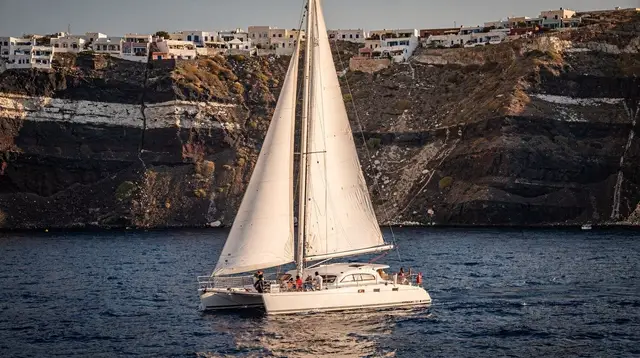
a five-hour sailing cruise through the caldera that covers both the volcano walk and the hot springs swim is the version most first-time visitors book, precisely because it does not force a choice between the two.
Morning, sunset, or both
Caldera cruises run at several points in the day, and the choice changes the experience more than the route does. Morning departures avoid the worst midday heat on Nea Kameni’s shadeless path and tend to have calmer water before the meltemi wind builds. Afternoon and evening cruises trade the volcano stop, or shorten it, for a slow return past the cliffs of Oia or Imerovigli timed to the Santorini sunset — watching the caldera wall light up from the water, rather than competing for a spot on land.
an evening cruise into the caldera timed around sunset is built specifically for the light rather than the geology, and it is worth being clear with yourself about which one you actually want before booking, since a few operators try to promise both in the same short window.
| Format | Typical length | Main focus | Nea Kameni included |
|---|---|---|---|
| Standard sailing cruise | 4-5 hours | Volcano walk + hot springs swim | Usually yes |
| Express cruise | ~2 hours | Highlights, faster pace | Sometimes |
| Evening / sunset cruise | 3-5 hours | Caldera views at golden hour | Varies by operator |
| Private cruise | Set by charter | Flexible, own schedule | Usually yes |
For the fuller comparison of what each format skips or adds, see our Santorini volcano tours compared and morning versus sunset cruise guides.
Private, semi-private, or shared
Shared cruises fill a larger boat with several parties and are priced accordingly — they are the cheapest way to see both stops, but you move on the group’s schedule and the swim window at Palea Kameni can feel rushed on a full boat. Semi-private and fully private charters cost more per person but let you set the pace, skip a crowded jetty, and often add extras like a longer swim stop or a detour toward Thirassia.
a four-hour private caldera cruise departing from the cruise port is a middle-ground option for people who want a private boat without the scheduling of a full charter. The trade-offs between these formats are covered in depth in our semi-private versus shared cruises guide, which is worth reading before comparing prices, since the per-person cost only makes sense once you know what it buys.
The short version, if time is tight
Not everyone has half a day. Cruise passengers with a few hours in port, or travellers squeezing the volcano into a packed one day in Santorini plan, often look for a condensed version instead.
a two-hour tour covering the best of Santorini’s caldera highlights compresses the format without cutting the two central stops entirely, though the time on Nea Kameni’s path and in the water at Palea Kameni will both be shorter than on a full cruise. It suits a tight schedule better than a longer one; it is not a substitute if the volcano walk is the actual reason for the trip.
Adding Thirassia, or not
A number of caldera cruises extend the standard route with a stop at Thirassia, the quiet island facing Santorini across the caldera, usually for lunch at its small port. It is a genuinely different experience from Nea Kameni and Palea Kameni — inhabited, green in patches, almost entirely untouristed — but it is not part of every itinerary, and adding it usually extends the trip by an hour or more. If Thirassia is the actual draw rather than a bonus stop, a dedicated Thirassia boat trip built around that island, rather than a caldera cruise that happens to pass near it, gives more time ashore.
What to actually bring
The single biggest planning mistake on a caldera cruise is packing for a boat trip and forgetting the two land stops. A full checklist of what belongs in the bag — footwear for volcanic cinder, a spare dark swimsuit, cash for Nea Kameni, sun protection with no shade available on the walk — is covered in our what to bring on a caldera cruise guide, but the short version is: closed shoes, small euro notes, and nothing pale that you’d mind staining.
Wind, water and the 2025 earthquakes
Two separate things sometimes get confused when people ask whether a caldera cruise is “safe”: weather and seismic activity. The meltemi, a strong seasonal north wind that peaks from July into August, is the actual operational risk — it is the reason cruises get shortened, rerouted, or cancelled outright in high season, and it has nothing to do with the volcano.
Nea Kameni’s own activity is a separate matter again: its last eruption was in 1950, and the strong earthquake swarm recorded near Amorgos and Santorini in early 2025 — tens of thousands of tremors over about six weeks — ended without any eruption and is understood by researchers as magma movement at depth rather than a precursor to one. Cruise operations resumed and have continued normally since. Neither fact should be the deciding factor in booking a cruise; the wind forecast for your actual date is the one worth checking.
Booking around the caldera
Most operators sell caldera cruises from the old port of Fira, from Ammoudi Bay below Oia, or directly from Athinios near the cruise terminal, and pickup points vary by tour. For wine paired with the same volcanic landscape, several cruises route past or stop near the island’s vineyards on the way back — worth checking if a caldera cruise combining the hot springs with an Oia sunset finish is on your shortlist, since a few versions add a short wine-tasting leg. If wine is the actual priority rather than the volcano, our Santorini wine tasting guide is the better starting point.
For the wider picture of how the caldera itself came to exist — the eruption that carved this basin around 1600 BCE — see how the Santorini caldera was formed. And for a full menu of everything bookable under this category, browse caldera cruises directly.
Caldera cruise FAQ: Nea Kameni, hot springs and prices
Is the Nea Kameni entrance fee included in the cruise price?
Usually not. The roughly 5 euro entrance fee to walk up to the crater is collected on Nea Kameni itself, in cash, and most cruise operators price it separately from the boat ticket. Bring small euro notes and coins.
How hot are the hot springs at Palea Kameni?
Tepid, not hot. The water is warmed by underwater volcanic vents but rarely feels more than mildly warm, and it is heavily tinted with iron oxide, which gives it a rust-brown colour near the source.
What should I wear or bring for the swim at Palea Kameni?
A dark or old swimsuit, since the iron-rich water stains light colours permanently. Water shoes help on the rocky entry, and a change of clothes for afterwards is worth packing separately from your day bag.
How long is a typical caldera cruise?
Most standard cruises run four to five hours including the Nea Kameni walk and the Palea Kameni swim. Shorter express versions exist at around two hours, and full evening cruises that add a sunset leg can run longer.
Should I choose a morning or sunset caldera cruise?
Morning cruises are cooler for the crater walk and calmer on the water; sunset cruises trade the volcano stop for the view of the caldera cliffs at golden hour. Some itineraries combine both. See our morning versus sunset comparison for the full trade-offs.
Is a private cruise worth it over a shared one?
It depends on group size and budget: private boats set their own schedule and skip crowded landing points, while shared cruises cost less per person and still cover the same three stops. Our semi-private versus shared guide breaks down when each makes sense.
Can I visit Thirassia on the same trip?
Some caldera cruises add a stop at Thirassia, usually for lunch at the small port of Riva, but not all itineraries include it. Check the specific tour description, or book a dedicated Thirassia boat trip if that island is the priority.
Is the caldera cruise affected by wind, or is it safe after the 2025 earthquakes?
The meltemi wind, strongest from July to August, is the main reason cruises get cancelled or rerouted, not seismic activity. The early-2025 earthquake swarm near Amorgos ended without an eruption, and cruise operations have run normally since.
Caldera Cruises on GetYourGuide
Verified deep-linked GetYourGuide tours. Book through these links and we earn a small commission at no cost to you.
GetYourGuide does not provide a product photo for this activity — the image shows the meeting point, photographed by us.