What to Bring on a Santorini Caldera Cruise
What should I pack for a Santorini caldera cruise?
Bring cash for the Nea Kameni entrance fee, which is on the order of 5 euros and rarely included in the cruise price, plus closed shoes for the volcanic ash trail and a dark-coloured swimsuit, since the iron-rich water at Palea Kameni's hot springs stains light fabrics.
Packing for the Boat, Not for the Beach
Once you have picked a boat and a time slot, the questions change shape. They stop being about which company to book and start being about what actually goes in the bag the morning of the trip. A caldera cruise is not a beach day: you spend most of it moving between a moored boat, a volcanic island with no shade, and open water that stains what you swim in.
This page is only about the contents of that bag. It does not compare a catamaran to a sailing boat, it does not weigh a morning departure against a sunset one, and it does not settle whether a private cruise is worth the extra cost over a shared one. Those decisions happen before you pack. This is what happens after.
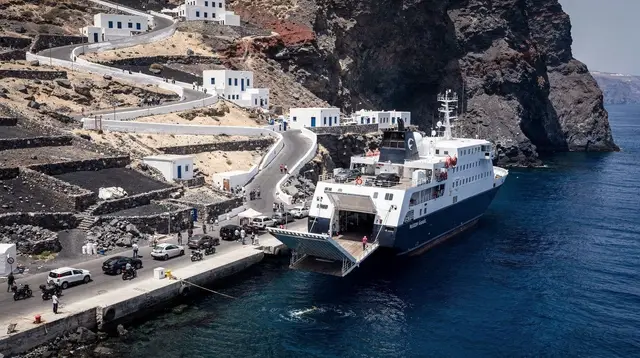
Most itineraries out of Ammoudi Bay, Fira’s old port or Athinios follow the same rough shape: a stop at Nea Kameni to walk up to the active crater, a swim at Palea Kameni for the hot springs, sometimes a call at Thirassia for lunch, and a return timed either for midday sun or a sunset over the caldera. Three details recur across almost every version of that route, and they are the three things people forget.
Cash: The One Thing Almost Everyone Forgets
The single most common surprise on a caldera cruise has nothing to do with the boat. It is the landing fee on Nea Kameni, the black volcanic islet at the centre of the caldera where most cruises let passengers off to walk up to the crater rim. This fee is set and collected locally, in cash, at the point of entry — not by the cruise operator, and in most cases not included in whatever you paid for the boat ticket.
Treat the number as an order of magnitude rather than a fixed price: it sits around 5 euros per person, in coins or small notes. Card machines are not a given on a small volcanic island with no permanent buildings, so arriving without cash means either missing the crater walk or scrambling to borrow from someone else on the boat. Neither is a good start to the stop everyone came for.
A related point worth planning around: cash is also the safer bet for anything else improvised along the way, from a drink at a beach bar on Thirassia to a tip for the crew. None of this needs to be a large amount of money — a small, dedicated stash of euros in a dry pouch covers it.
If your itinerary includes the springs and the sunset together, the Santorini Caldera cruise combining the hot springs with an Oia sunset option follows this same pattern: crater stop first, cash needed there, swim afterwards.
Footwear for the Volcano Trail
Nea Kameni has no paved path. The walk from the landing point to the active crater rim is around half an hour on foot, uphill, over loose volcanic ash, gravel and small rocks that shift underfoot. It is not a difficult hike by any technical measure, but it punishes the wrong shoes badly. Flip-flops slip on the ash, sandals let grit in with every step, and bare feet are simply not an option on ground that can be uncomfortably hot in the middle of a summer afternoon.
Closed shoes with some grip on the sole are the right call — trainers, light hiking shoes, anything you would not mind getting a layer of grey-black dust on, because you will. There is no cleaning station at the top, and the dust travels: expect it on your ankles, in your shoe seams and eventually inside the boat if you do not brush off before stepping back aboard.
This applies whichever boat brought you there. A shorter outing like The Best of Santorini in 2 Hours still includes the same climb in a tighter window, which makes the right shoes even more useful — there is less time to recover from a slow, uncomfortable walk in the wrong footwear.
What to Wear Swimming: Why Dark Beats Light
The swim stop at Palea Kameni is the other half of the volcano visit, and it comes with its own packing quirk. The water around the hot springs there is naturally tinted by dissolved iron in the volcanic rock, giving it a faint rust-orange colour close to the source. Swimming in it, especially a light-coloured swimsuit, tends to leave a stain that does not reliably wash out afterwards.
The fix is simple and worth deciding before you leave the hotel: pack a dark or already-patterned swimsuit for this stop, and keep anything white, pale or new for a beach day instead. It is a small decision that saves a favourite swimsuit, and it is one of those details that never comes up until someone has already ruined a bikini finding it out the hard way.
Manage expectations on the water itself too. It is warm rather than genuinely hot, more like a mild bath than a natural jacuzzi, and the heat fades quickly as it mixes with the surrounding sea. There is also a faint sulphur smell that some people notice more than others. None of this is a problem — it is simply not what the phrase “hot springs” tends to promise.
A quick-drying towel earns its place in the bag here too, since boats vary in whether they supply one, and a swim followed by an ash-covered crater walk (or the reverse, depending on your itinerary’s order) means getting wet more than once.
Sun, Wind and the Rest of the Bag
Beyond cash and footwear, the rest of the packing list is closer to what any day on open water in the Aegean asks for, with a couple of local specifics layered on top.
Sun protection matters more here than the temperature alone suggests. There is no shade on Nea Kameni’s crater trail, and a boat deck reflects as much sun back up as it absorbs, so reef-safe sunscreen, a hat that will not blow off, and sunglasses are worth packing even on a cloudy-looking day. The meltemi, the strong seasonal north wind that picks up through July and August, can make an otherwise warm afternoon feel noticeably cooler once the boat is moving, so a light long-sleeved layer or windbreaker is worth having even in high summer — and becomes more important on any cruise timed for sunset, when the temperature drops as the light does.
If seasickness is a concern, deal with it before boarding rather than during: the caldera itself is usually calm, but the open stretch toward Thirassia or back from a longer route can have a swell, and motion-sickness tablets work far better taken in advance. A dry bag or a simple zip-lock for phones and cash is cheap insurance against spray and the swim stop alike. Bring a printed or downloaded copy of your booking confirmation in case connectivity at the port is patchy, and carry a portable charger if photographing the caldera itself or the crater walk is part of the plan — there are no charging points on Nea Kameni.
Snacks and water are worth a mention too. Some cruises, particularly the longer sailing and catamaran trips, include food and drink on board as part of the package; others, especially shorter or budget options, do not. A refillable water bottle covers the gap either way, and it matters more than it sounds on a hot deck with a half-hour uphill walk built into the day.
What Cruises Usually Provide
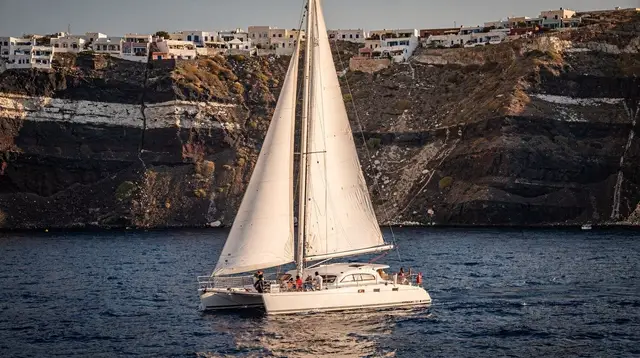
It helps to know what you are not responsible for bringing, and this is where cruises differ most from each other. Longer sailing and catamaran trips, including options like the Dreamcatcher 5 Hour Sailing Cruise in the Caldera, often build in food, drink, and sometimes snorkelling gear or floating mats as part of the ticket price. Shorter or more budget-oriented outings, and some private charters focused purely on transport between stops, may supply none of that.
A private option such as the Santorini Cruise Port 4 Hour Private Caldera Cruise is worth checking individually on this point, since a private charter can sometimes mean fewer inclusions rather than more — the value there is usually flexibility and pace, not necessarily a fuller packing list taken off your hands. Whatever you book, the booking confirmation is the one document that actually answers whether towels, snorkel gear or lunch are included; assuming either way is how people end up either overpacking or caught short.
A Quick Packing List
| What to bring | Why | Priority |
|---|---|---|
| Cash (small notes and coins) | Nea Kameni’s landing fee is collected on-site, in cash, and usually not included in the ticket | Essential |
| Closed shoes | The crater trail on Nea Kameni is loose volcanic ash, uphill, with no paved surface | Essential |
| Dark or patterned swimsuit | Palea Kameni’s iron-rich water stains light fabric | Essential |
| Reef-safe sunscreen and a hat | No shade on the crater walk or most boat decks | Essential |
| Light layer or windbreaker | The meltemi and evening air cool the deck quickly, especially on sunset cruises | Recommended |
| Quick-drying towel | Not every boat supplies one for the hot-spring swim | Recommended |
| Refillable water bottle | Inclusion of drinks varies by boat and cruise length | Recommended |
| Dry bag or zip-lock pouch | Protects phone and cash from spray and the swim stop | Recommended |
| Motion-sickness tablets | Taken in advance, not once the boat is already moving | If needed |
| Portable charger | No charging points on Nea Kameni or most tender boats | Optional |
Packing Questions for a Santorini Caldera Cruise
Do I need cash on a Santorini caldera cruise?
Yes. Most cruises stop at Nea Kameni, and the landing fee there is collected on the island itself, in cash, and is almost never bundled into the ticket you bought online or from your hotel.
How much does it cost to land on Nea Kameni?
Budget on the order of 5 euros per person, paid in coins or small notes at the entrance. Treat this as a rough figure rather than a fixed price, since it is set locally and not by the cruise operator.
What shoes should I wear on the volcano trail?
Closed, sturdy shoes with a decent sole. The path to the Nea Kameni crater is loose volcanic ash and small stones, uphill for roughly half an hour, and flip-flops or sandals make the climb slow and uncomfortable.
Why does everyone say to bring a dark swimsuit?
The hot springs at Palea Kameni are naturally coloured by dissolved iron, and swimming there leaves a rust-orange tint on fabric that does not always wash out. A dark or already-coloured swimsuit hides it; a white or pastel one usually does not survive unmarked.
Is the water at Palea Kameni actually hot?
It is warm rather than hot, closer to a mild bath temperature that fades quickly as it mixes with the surrounding sea. Go in expecting pleasantly tepid water with a faint sulphur smell, not a natural jacuzzi.
What should I pack differently for a sunset cruise versus a morning one?
A light layer for the cooler evening air and the boat’s motion, since the temperature drops once the sun is low. The choice between a morning and sunset departure is covered separately in our guide to morning versus sunset cruises; this page only covers what goes in the bag.
Do caldera cruises provide towels and snorkelling gear?
It varies by operator and boat size. Some sailing and catamaran trips include towels, snorkel masks and floating mats as part of the package; smaller or budget boats often do not. Check your specific booking rather than assuming either way.
What should I leave at home?
Anything you would mind losing overboard, valuables with no dry storage, and light-coloured swimwear you care about. Heavy tripods and stiff-soled dress shoes are also dead weight on a boat with limited deck space.
Caldera Cruises on GetYourGuide
Verified deep-linked GetYourGuide tours. Book through these links and we earn a small commission at no cost to you.
GetYourGuide does not provide a product photo for this activity — the image shows the meeting point, photographed by us.