Most people looking at Santorini from a sunset terrace in Oia are looking, without quite realizing it, at the other half of the same island. Before the Bronze Age eruption blew out the center of the caldera, Thira and Thirassia were joined. What the eruption left behind was a ring of cliffs with a body of water where a landmass used to be — and Thirassia is the largest surviving fragment on the far side of that ring, separated from Santorini by roughly two kilometers of open caldera. If you want the short version of how that shape came to exist, the guide to how the caldera was formed covers it without turning it into a geology lecture.
The other half of the caldera
It helps to picture Thirassia not as a separate destination in the way Naxos or Milos are separate destinations, but as the quiet, unfinished-looking twin of the island everyone photographs. It faces Santorini’s caldera cliffs from the west, so from its shoreline and its rim village you get the view that most visitors never think to ask for: Oia and the caldera wall seen from across the water, rather than stood on top of it.
There is no airport, no cruise terminal, and — this is the point of the whole page — very little built for tourism at all. A few tavernas, a small port, one village strung along the cliff top, and paths that go nowhere in particular. People who come here are not coming for a sight. They are coming for the absence of a queue.
Thirassia has a small resident population that has never grown the way Santorini’s has, largely because there is no deep-water port capable of handling ferries the size that dock at Athinios, and no flat land for an airstrip. That isolation, which would be a problem for a working island, is the whole appeal for a visitor with half a day to spare.
Getting there: Ammoudi’s little ferry or a stop on your cruise
There are two practical ways to reach Thirassia, and neither of them is complicated.
The first is the small local ferry that runs from Ammoudi Bay, the tiny harbor below Oia best known for its tavernas and its role as the departure point for boats up toward the town along the cliff steps. The crossing to Thirassia takes roughly 20 to 30 minutes depending on the boat and the sea.
It is not a scenic cruise in itself — it is a short, functional hop across the caldera — but it drops you somewhere almost nobody else bothers to go. The full mechanics of timetables, tickets, and what to expect on the water are covered in the Thirassia boat trip guide, and if you want the wider picture of inter-island ferries from Santorini, the Santorini ferry guide is the reference page.
The second way is as part of a caldera cruise. Not every cruise stops at Thirassia — many focus entirely on the volcanic islets and the hot springs — so it is worth checking the itinerary rather than assuming. One option built specifically around this stop: an all-inclusive catamaran cruise that adds a stop on Thirassia to its usual caldera route pairs the island with the swim stops and onboard lunch that make up most of a typical Santorini catamaran day.
If your priority is specifically the volcano and its hot springs rather than Thirassia itself, the mechanics of choosing between the various cruise formats are laid out in the caldera cruise guide.
A different kind of day, aimed more squarely at the volcanic side of the caldera with Thirassia folded in as one stop among several, is this option: a port cruise that combines the volcano, the hot springs, and a Thirassia stop in one outing which suits anyone trying to see the whole caldera — active crater, warm springs, and the quiet rim island — without arranging three separate trips.
What Thirassia is not
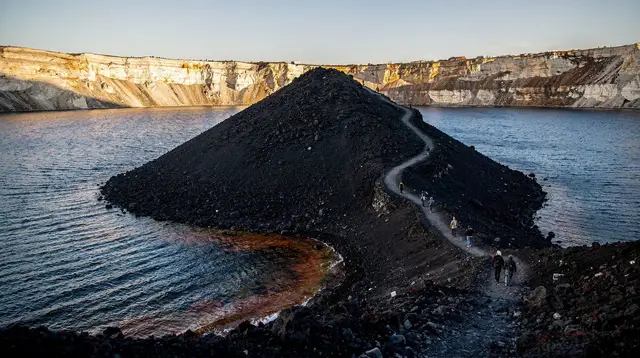
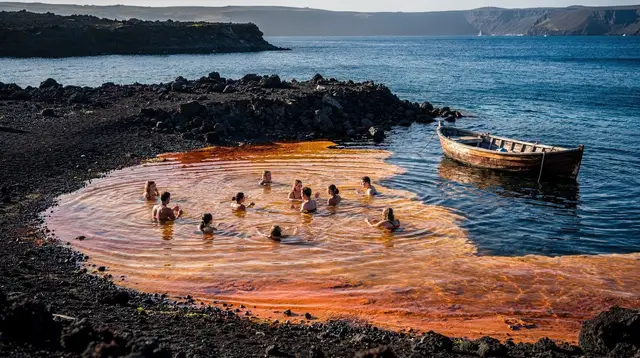
It is worth being precise here, because the names get mixed up constantly. Thirassia is not Nea Kameni, the black volcanic cone in the middle of the caldera where cruise passengers climb a cinder path to an active crater — that trip, and the entry fee that catches people off guard, is covered separately in the Nea Kameni volcano guide. It is also not Palea Kameni, the neighboring islet where boats stop so passengers can swim to iron-red warm springs rather than walk ashore.
Both of those are small, uninhabited, purely volcanic features at the center of the caldera. Thirassia is a real, inhabited island on the caldera’s outer rim, with soil, a village, and people who live there year-round. If your day is built around the volcano and the springs, this page is not the one you need — go to the volcanic islets guides instead. This page is for the other kind of day: the one where nothing in particular is scheduled.
Manolas and the walk up from the port
Boats land at a small port at the base of the cliff, from which a path and a run of steps climb up to the main settlement on the rim — a short, steep walk in the same spirit as the far busier route between Fira’s old port and the town above it, without the crowds, the donkeys, or the cable car. Anyone who has done that climb, or read about the alternatives to it in the guide to the cable car and the 588 steps, already has the right mental picture, just scaled down and quieter.
At the top, the village sits along the cliff edge with a straight, unobstructed view across the caldera toward Oia and the northern tip of Santorini. It is a strange, useful vantage point: the same white-and-blue architecture people cross the world to photograph from the Santorini side is, from here, something you look at from a distance rather than stand inside. A short walk along the rim lanes takes you past whitewashed houses, a church or two, and views that change slightly with every turn, without ever demanding a plan.
What to actually do for a few hours
The honest answer is: not much, on purpose. A taverna lunch with a caldera view, unhurried and usually far cheaper than the equivalent table in Oia or Fira, is the main event for most visitors. After that, walking the lanes of the rim village and the paths just beyond it is the whole itinerary. Photographers tend to like Thirassia precisely because the crowds that make the best photo spots elsewhere on Santorini so hard to shoot cleanly simply aren’t here — you can stand at the cliff edge for ten minutes without anyone stepping into frame.
There is no equivalent of Akrotiri’s excavation site, no wine estate, no diving center, and no equipped beach. That is not an oversight in this guide; it is an accurate description of the island. If a full slate of activities is what you’re after, almost anywhere else covered on this site will serve you better. If a few hours of quiet, a view, and a plate of food are what you’re after, Thirassia does that better than almost anywhere else on the site.
Comparing the two ways in
| Route | Duration | Typical cost | What you get |
|---|---|---|---|
| Ferry from Ammoudi | ~20–30 min each way | Low — a simple ticket price | Flexibility on timing, a quieter crossing, easy pairing with Ammoudi and Oia |
| Stop on a caldera or volcano cruise | A portion of a longer day | Included in the cruise price | No separate booking, paired with the volcano and hot springs, less time on Thirassia itself |
| Half-day charter or private boat | Flexible | Higher | Control over how long you stay and where you land |
Neither route is objectively better — the ferry suits anyone basing their day around Ammoudi and Oia, while a cruise stop suits anyone who wants Thirassia folded into a bigger caldera day rather than treated as its own outing.
Practicalities: cash, tavernas, and no rush
Card machines and ATMs are not something to rely on here, so bring enough cash for lunch and any small purchases. There is no real network of shops, no supermarket in the way Santorini’s larger villages have one, and no reason to expect the pace of service to match a busy restaurant in Fira — that slowness is generally the point of coming. Comfortable shoes matter more than anything else you pack, since the walk from the port to the village involves an incline. If you are traveling with anyone who has difficulty with steps, it is worth asking in advance whether your chosen ferry or cruise offers an easier landing option, since the standard route to the village is not step-free.
For a wider view of what things cost across the island and how to budget a trip that includes small excursions like this one, the Santorini budget guide is the reference page; the practical basics for planning any day off the main island are also gathered on the travel tips hub.
Who Thirassia suits — and who should skip it
Thirassia rewards travelers who have already done the obvious things on Santorini — walked Oia, watched a sunset, seen the caldera from a boat — and are looking for a few hours that feel different rather than more of the same. It also suits caldera cruise passengers who get the island as part of a route they were already taking, since almost no extra effort is required.
It is a poor fit for a first, short visit to Santorini. Anyone working through a tightly packed one-day itinerary is better off spending that day on the caldera side of the island itself; the first-time visitor’s guide is a better starting point than this page if Santorini is new to you and time is short. Thirassia is an addition for a second day, or a second visit, not a substitute for the highlights.
Thirassia and the 2025 earthquake swarm — a quick note on safety
Between late January and early March 2025, an earthquake swarm centered in the sea between Santorini and Amorgos produced tens of thousands of small tremors and led to a temporary local state of emergency, school closures, and the departure of thousands of residents as a precaution. It did not result in an eruption, and the scientific consensus since has pointed to a deep intrusion of magma rather than an imminent volcanic event. The swarm ended months ago and has no bearing on the routine ferry crossing to Thirassia today. If you want the full, sourced account rather than the short version, it’s covered in the safety guide to Santorini and the 2025 earthquakes.
Cruising past instead of landing
Not every visitor needs to set foot on Thirassia to appreciate it — plenty of caldera cruises simply pass along its coastline en route to the volcanic islets or a sunset viewpoint, which is a perfectly reasonable way to see its cliffs without adding a stop to the day. A standard half-day option built around exactly that kind of caldera loop is: a three-hour caldera catamaran cruise with drinks included which covers the main caldera views, Thirassia’s coastline among them, without committing a full day to it. For travelers with more time who want swim stops and a barbecue lunch built in around the same stretch of coast, a longer format is:
a full day-time catamaran cruise with swim stops and a barbecue lunchEither works as a way to see Thirassia from the water on the same day you might otherwise spend entirely on the volcanic islets.
Frequently asked questions about visiting Thirassia
Is Thirassia worth visiting from Santorini?
Yes, if what you want is a few quiet hours rather than a list of sights. Thirassia has one small rim village, a tiny port below it, and caldera views back toward Oia, reached by a short ferry from Ammoudi or as a stop on some caldera cruises. There is very little to do there on purpose, which is exactly the point.
How do you get to Thirassia from Santorini?
Two ways: a small local ferry from Ammoudi Bay, below Oia, which takes about 20 to 30 minutes, or a stop built into some caldera catamaran cruises that already circle the volcanic islets. There is no bridge and no direct road link — every visit starts and ends on the water.
Is Thirassia the same as Nea Kameni or Palea Kameni?
No. Nea Kameni and Palea Kameni are the small black volcanic islets in the middle of the caldera, one with an active crater you can walk up to, the other with warm iron-tinted springs you swim to. Thirassia is a separate, much larger and greener piece of land on the western rim of the caldera, with its own small village and population.
How much time do you need on Thirassia?
Most visitors are happy with two to three hours: enough to land at the small port, walk or take a path up to the rim village, sit at a taverna with a caldera view, and head back. A full day only makes sense if you want to walk beyond the village at an unhurried pace.
Is there anything to buy or do on Thirassia?
Very little, and that is the appeal. A handful of tavernas serve simple grilled and local dishes, there are a few small shops, and the main activity is walking the rim lanes for the view back toward Oia and the caldera. Bring cash, since card machines and ATMs are not reliable there.
Can you stay overnight on Thirassia?
A small number of rooms exist, but almost nobody treats Thirassia as a base — most hotels and restaurants on Santorini’s own caldera side close for the evening rush that Thirassia never has. It works far better as a half-day or day excursion from Santorini than as a place to sleep.
Does the 2025 earthquake swarm affect visiting Thirassia?
The swarm that began in January 2025 between Santorini and Amorgos lasted about six weeks, produced tens of thousands of small quakes, and ended without an eruption. It is over. It does not make Thirassia, or the ferry crossing to it, any less routine to visit today than it was before.
Is Thirassia suitable for a day trip with kids or limited mobility?
The crossing itself is short and easy, but the path up from the small port to the rim village involves steps and some incline, similar in spirit to the walk up from Santorini’s own old port. Anyone who struggles with stairs should ask in advance whether a cruise stop offers an easier landing point.