The Best Photo Spots in Santorini You Can Find Yourself
Where can I get great Santorini photos without booking a photographer?
The caldera rim at Skaros Rock and Imerovigli, the Pyrgos kastro, Akrotiri Lighthouse and the ash cliffs of Vlychada all reward a self-guided visit with nothing more than a camera and an early start. Go in the first light of morning or the hour before sunset, and skip the Red Beach cliff path, which remains only partly restricted in 2026.
Four Views Worth Finding on Your Own
Most of what gets photographed in Santorini happens in one square kilometre of Oia, in the last two hours before sunset, from a spot someone else has already claimed. That is not the only way to come home with good pictures of the island. This guide is for anyone composing their own photo route rather than booking a session: it covers four viewpoints you reach yourself, on your own schedule, with your own camera or phone, and no one directing where to stand.
It does not cover working with a professional photographer, styling a shoot, or arranging a flying dress or a proposal — those are their own subjects, with their own logistics, and belong on other pages. What follows is simpler: where to go, when to be there, and what each place actually gives you that the others don’t.
Skaros Rock and the Terraces of Imerovigli
The single best free viewpoint on the caldera rim sits above Imerovigli, the quietest of the four villages that line the cliff. Skaros Rock is a bare volcanic outcrop that once carried a Venetian fortress, long since collapsed; today it’s an unmarked path up loose ground with no railing and no signage, and it should be treated as a scramble rather than a walk. Most people get a nearly identical view — the crescent of the caldera, the ring of white villages, the drop to the sea — from the paved terraces at the edge of Imerovigli itself, standing safely on someone’s church roof or a public lookout rather than clinging to the rock.
What makes this stretch different from Oia isn’t the geology, which is the same collapsed volcano everywhere along the rim — see how the Santorini caldera was actually formed if the shape of the thing interests you. It’s the absence of people. Imerovigli has a fraction of Oia’s hotels and almost none of its day-trip traffic, so the same blue domes and whitewashed walls that get fought over in Oia are often empty here at seven in the morning. Firostefani, the next village along toward Fira, offers a similar deal: caldera views, church domes, narrow lanes, and room to actually frame a shot without someone else’s arm in it.
Sunset here is real but different from Oia’s. You don’t get the sun dropping directly into the sea from most of Imerovigli’s angles — the coastline curves away — but you get the whole caldera lit gold at once, which is arguably a better photograph than a single disc of light. If the famous sunset spot is what you’re chasing anyway, the best sunset spots beyond Oia goes through the alternatives village by village, including this one.
For a genuinely different angle on the same cliffs, several boats spend the sunset hour on the water below the rim rather than on top of it, looking up at the villages instead of out to sea. The Santorini sunset cruise runs that route most evenings and is worth considering if you’d rather photograph Imerovigli and Skaros Rock from below than fight for a place on the terraces above them.
Pyrgos: The One Village That Shows You the Whole Island
Pyrgos sits inland, on a hill well back from the caldera, and for photography that’s exactly its value. Every other well-known viewpoint on Santorini looks at part of the island — a stretch of cliff, a bay, a crater. Climb through the stacked lanes of Pyrgos’s kastro to the ruined fortress at its summit and you get the only spot from which nearly all of Santorini is visible at once: the caldera villages along the northwest rim, the vineyards spreading out in their low woven kouloura shapes, Profitis Ilias rising behind at 567 metres, and open sea on both the caldera side and the ordinary Aegean side to the south and east.
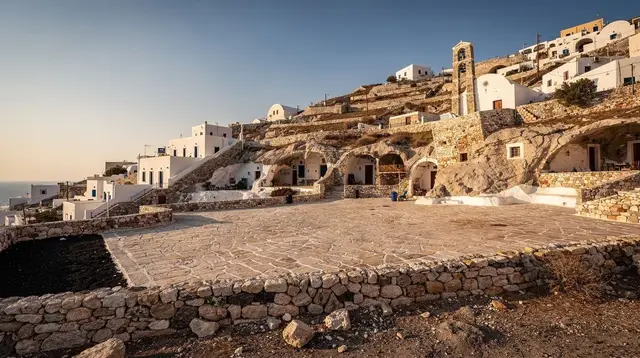
It photographs completely differently from Oia or Imerovigli. Instead of white cubes against blue sea, Pyrgos gives you a maze of stone, blue-domed churches wedged between houses, cats on doorsteps, and — from the top — a landscape shot rather than a postcard close-up. It’s also nearly empty most of the day; the village has a handful of tavernas and wine bars rather than a cruise-ship crowd, and the climb to the kastro filters out anyone not willing to walk. Late afternoon light works best here, since the hilltop catches the sun later than the west-facing caldera villages do. For the walk itself, including which lanes actually lead to the top, the Pyrgos village guide has the detail.
Photographers who want several inland and caldera villages covered in one outing without planning their own driving route sometimes take the hidden gems photo tour by private car, which strings together spots like Pyrgos with less-visited corners of the island in a single afternoon.
Akrotiri Lighthouse and the South Coast Light
At the southwestern tip of the island, well away from the caldera villages, the Akrotiri lighthouse sits on a bare headland above the water where the caldera’s collapsed rim meets the open sea. It’s a genuinely different kind of Santorini photograph: no white cubic houses, no blue domes, just a stone lighthouse, cliffs, and a long unobstructed view west over open water — the same direction the sun sets, but from a spot with essentially no other visitors even in August.
The approach is on foot along a dirt track from the village of Akrotiri, which is otherwise known for the excavated Bronze Age town buried by the eruption around 1600 BC — worth combining in one trip, since the Akrotiri excavations sit under a roof and make a sound backup plan if the wind or heat makes the lighthouse walk unappealing. The two sites share a name but nothing else: one is archaeology under cover, the other is an open headland with nothing between you and the wind.
Because it faces roughly the same direction as Oia’s famous view without any of Oia’s crowd, the lighthouse has become a known alternative for sunset photography — arrive with enough daylight left to find your footing on the uneven path, since there’s no lighting and no handrail once the sun is down.
Vlychada’s Sculpted Ash Cliffs
The south coast holds one more photograph that has nothing to do with sunsets or villages at all. Behind the beach at Vlychada, wind and rain have carved the pale volcanic ash cliffs into ridges, folds and hollows that look closer to a desert canyon than anything else on the island. It’s the most abstract, least postcard-like landscape Santorini offers, and it photographs well at almost any hour, since the interest is in the texture and shadow of the rock rather than a particular quality of light at a particular minute.
That makes Vlychada the most forgiving stop on this list for anyone planning a route around other obligations — a midday flight, a boat that leaves at a fixed hour, a wine tasting booked for four o’clock. Come whenever the schedule allows, walk the base of the cliffs, and use the marina at one end, with its lined-up yachts against the pale rock, as a second, more conventional frame if the raw cliffs alone feel too austere. The full walking route and access points are covered in the Vlychada beach guide.
What About Red Beach?
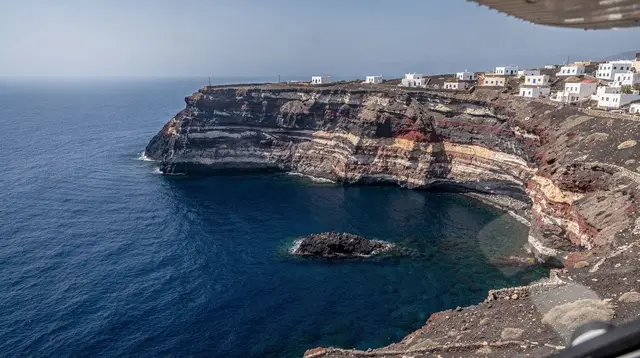
Red Beach is one of the most photographed spots on the island, and it deserves a specific warning rather than a blanket recommendation. Its cliff-face path has been closed and reopened repeatedly following rockfalls in 2018, 2023 and again in December 2025, and as of this review access remains only partly restricted — not the open scramble down to the sand that older photos and guides suggest.
Do not plan a trip around walking onto Red Beach itself; check current conditions locally before you go, and treat the water as the more reliable vantage point. Several caldera and coastal boat trips pass close enough to the cliffs to get the same striking colour without setting foot on unstable ground, which is the honest recommendation here rather than a workaround. The Red Beach access and safety guide tracks the current status in more detail than fits on this page.
Putting a Route Together
None of these four spots are near each other, and none of them are on the standard Fira-to-Oia loop that most first-time visitors follow. A realistic plan treats them as two separate half-days rather than one long circuit:
| Pairing | Spots | Best timing |
|---|---|---|
| Caldera morning | Imerovigli, Skaros Rock | Sunrise to mid-morning, before the terraces fill |
| Inland afternoon | Pyrgos | Late afternoon, before the last light leaves the hilltop |
| South coast half-day | Akrotiri Lighthouse, Vlychada | Any time; pair with the Akrotiri excavations if the weather turns |
A car or scooter makes the second and third rows far easier — Pyrgos, Akrotiri and Vlychada all sit outside the busiest bus routes, which run mainly between Fira, Oia and the main beaches. If you’d rather not drive, Imerovigli and the caldera path are walkable from Fira and reachable by the regular bus network; the Fira to Oia caldera hike covers that stretch on foot in full, including the point past Imerovigli where the paved path gives way to open ground.
For anyone assembling a photography-focused day or two rather than a single spot, the dedicated Santorini photography itinerary sequences these locations against the rest of the island’s schedule — ferries, wineries, the volcano boats — so a photo stop doesn’t collide with something booked in advance.
None of this replaces working with someone who knows the light and the access points personally. If a self-guided route sounds like more logistics than you want to handle, the Highlights of Santorini five-hour photo tour and the best spots tour through Oia, Firostefani and Imerovigli cover several of the same caldera viewpoints with someone else doing the routing and the waiting for the light — the trade-off being a fixed schedule instead of your own.
For anyone who wants the planning and the eye but not the guide, this page’s four spots remain reachable, free, and — outside of August afternoons in Oia — nowhere near as crowded as the postcards suggest.
Photo Spots in Santorini: Common Questions
Is Skaros Rock hard to reach?
The rock itself is an unmarked scramble up loose volcanic ground with no railing, best left to sturdy shoes and steady footing. Most visitors get almost the same view from the paved terraces of Imerovigli just below it, which is the easier and just as photogenic option.
What is the best time of day for photos in Imerovigli and around Skaros Rock?
Early morning gives soft light on the caldera cliffs with almost no one else around. The hour before sunset is more dramatic but shares the terraces with people who came for the view rather than a photo.
Why is Pyrgos worth a stop if I’ve already seen Oia and Fira?
Pyrgos sits inland on a hill and is the only village on the island from which you can see nearly all of Santorini at once, including the caldera villages, the vineyards and the sea on both sides. It has almost none of the crowds of the caldera rim.
Can I still photograph the Red Beach cliffs in 2026?
The cliff path has been closed and reopened repeatedly since rockfalls in 2018, 2023 and December 2025, and access remains only partly restricted rather than fully open in 2026. Check local conditions before planning a visit, and treat a view from a boat as the more reliable option.
What makes Akrotiri Lighthouse different from the caldera villages?
It stands alone on the southwestern tip of the island, away from the built-up caldera rim, with open sea on one side and the cliffs of the caldera entrance on the other. It photographs well at sunset without the density of people found at Oia’s castle.
Is Vlychada worth visiting if I’m not planning to swim?
Yes. Its interest is the wind-carved ash cliffs behind the beach, not the water, and they photograph well at almost any time of day because they don’t depend on a clear sunset.
Do I need to rent a car to reach these four spots?
A car or scooter makes the day far easier, since Pyrgos, Akrotiri and Vlychada sit outside the bus network’s busiest routes. Imerovigli and Skaros Rock are reachable by bus from Fira or on foot along the caldera path.
Photoshoots on GetYourGuide
Verified deep-linked GetYourGuide tours. Book through these links and we earn a small commission at no cost to you.
GetYourGuide does not provide a product photo for this activity — the image shows the meeting point, photographed by us.