Pyrgos: The Hilltop Village With Santorini's Best View
What makes Pyrgos worth a visit?
Pyrgos is a medieval hilltop village in the interior of Santorini, and its ruined kastro is the only point on the island from which you can see the whole of it at once. It has no caldera view and no beach, but it has quiet stone lanes, working churches, and vineyards on every side.
A village that turns its back on the caldera
Almost every famous view on Santorini looks the same way: out over the caldera, toward the sunset, from a village built along the western rim. Pyrgos does something different. It sits inland, on one of the highest hills on the island, and its best view looks in every direction at once. This is the one spot on Santorini from which you can actually see the shape of the whole island — not a slice of it, all of it.
That inland position is the first thing to understand about Pyrgos. It was once the island’s capital, before the seat of local government moved to Fira in the 19th century, and it was built where it was for a reason that had nothing to do with tourism: height and distance from the coast kept it safer from the pirate raids that shaped so much of the Cyclades. The result today is a village with no sea view, no beach, and none of the caldera crowd — and a kastro that gives you something the caldera villages can’t.
If you’ve come from Fira or Oia expecting whitewashed cliffside terraces over blue water, recalibrate. Pyrgos is stone-built, inward-facing, and quiet even in August. That’s the appeal.
Climbing to the kastro
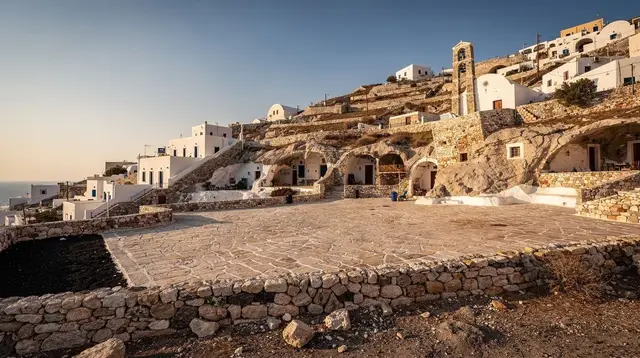
The kastro at Pyrgos isn’t a single building you buy a ticket for — it’s the fortified summit the whole village was built to defend, a knot of narrow stepped lanes climbing between stone houses to a ruined tower and a scatter of small churches at the top. The climb itself is short, maybe fifteen to twenty minutes from the main square if you don’t stop, but you will stop, because the lanes double back on themselves constantly and every turn opens a new angle on the village below.
At the top, the payoff is the view: the caldera rim and its string of villages away to the west, the lower farmland and the ridge above Kamari to the east, Profitis Ilias rising just to the south with its monastery visible on the peak, and on a clear day the outline of neighboring islands out at sea. No other viewpoint on Santorini shows you the island’s whole shape this way — the caldera villages show you the caldera, and only the caldera.
Wear shoes with grip. The stone underfoot is smooth from centuries of use and can be slick after rain, and there are no railings on most of the route up.
Walking the lower village
Below the kastro, Pyrgos is a proper village to wander rather than a monument to photograph. The lanes were laid out, like much of the older Cycladic building tradition, as a defensive maze — narrow, twisting, and confusing on purpose, so that anyone raiding the village on foot would get lost before reaching the top. That same maze now makes for a genuinely enjoyable half-hour with no particular direction in mind: whitewashed passages open onto small squares, blue-domed chapels appear where you don’t expect them, and there are said to be more churches per resident in Pyrgos than almost anywhere else on the island.
The main square at the base of the climb has a handful of tavernas and cafés, busier around lunch and again toward evening, but nothing like the density of Fira or Oia. This is a village people still live in year-round, not a set built for visitors, and it reads that way.
a guided walk through Pyrgos combined with a winery stop and tastings is the easiest way to see both halves of the village properly and understand what you’re looking at, especially the older churches, without having to piece the history together yourself.
Pyrgos, Megalochori, and Emporio: three inland villages, three different stories
Pyrgos isn’t the only village on Santorini that sits away from the caldera, and it’s worth being precise about how it differs from the other two most often mentioned alongside it, because they solve the same problem — how to live safely inland, away from raiders and away from the crowds — in different ways.
Megalochori is built low and compact around its old wine houses and canava cellars; it’s the village that leans hardest into the island’s wine identity, with more wineries within easy walking distance than anywhere else. Our separate Megalochori village guide covers that side of it in full.
Emporio has a kastro too, but a genuinely different kind: a walled fortress-village where the houses themselves form the outer wall, built as a single defensive unit with narrow gated entrances rather than a hilltop settlement with a fortified summit above it. It’s the most intact example of that building style on the island. The guide to Emporio’s kastro goes into how it worked.
Pyrgos sits between the two in character: it has Emporio’s defensive hill-village logic and Megalochori’s proximity to good wine country, but its real distinction is the kastro’s summit view — the one thing neither of the other two offers in the same way. If you want the fuller island-wide comparison of all of Santorini’s villages side by side, that’s covered in the Santorini’s Villages Compared; this page sticks to what makes Pyrgos itself worth the drive up.
Wine country on the doorstep
Pyrgos sits right in the middle of Santorini’s main wine belt, and several of the island’s best-known producers are a short drive — or in some cases a walk — from the village. This is one of the most efficient bases on the island for a wine afternoon: you can climb the kastro, then be tasting Assyrtiko within ten minutes.
Nearby villages worth combining with a Pyrgos stop include Exo Gonia, home to one of the island’s small independent art-and-wine spaces, and the broader stretch of Santorini’s wineries spread across the inland plateau between Pyrgos, Megalochori, and Vothonas. The vines here are trained low, in the coiled kouloura basket shape unique to the island, grown without irrigation on nothing but sea mist and morning dew — a detail worth looking for as you drive between tasting rooms.
For background on what you’re actually tasting, our wine tasting guide explains the difference between dry Assyrtiko, the sweet Vinsanto worth bringing home, and the lesser-known Nykteri.
a combined tour taking in Pyrgos, a winery stop, and sunset in Oia packs a full day of the island’s two very different faces — inland stone village and cliffside coast — into one outing.
Sunset from the kastro
Oia’s sunset gets the reputation, and rightly, since it’s the most photographed in the Cyclades — but the kastro at Emporio isn’t the only quiet alternative, and neither is Imerovigli. Pyrgos works too, and for the same reason it works for the daytime view: because it faces every direction at once, the summit gives you the caldera and the sunset over it without needing to fight for a rail-side spot in a village built for exactly that purpose.
Because Pyrgos is inland and gets a fraction of Oia’s visitor numbers, arriving even thirty minutes before sunset is usually enough to find a good spot on the kastro steps — a real contrast to the Kastro area of Oia, which starts filling ninety minutes to two hours ahead in high season. If you want to weigh Pyrgos against the other under-the-radar sunset spots on the island, our guide to sunset spots beyond Oia lays them out together.
Exact sunset time shifts a great deal across the year — well after 8:30pm in late June, closer to 5:15pm in late December — so check the time for your dates rather than assuming.
Getting to Pyrgos
Pyrgos sits roughly in the geographic center of the island, which makes it an easy add-on to almost any inland itinerary but means it isn’t somewhere you stumble into on a caldera walk.
| Starting point | Approx. distance | Best way there |
|---|---|---|
| Fira | ~4 km | Taxi, rental car, or KTEL bus |
| Oia | ~13 km | Rental car or organized tour |
| Kamari beach | ~6 km | Rental car or taxi |
| Athinios port | ~7 km | Taxi or transfer |
By car or scooter, Pyrgos is a straightforward ten-minute drive from Fira with parking near the main square. KTEL buses run from Fira’s central station, but services thin out in the evening, which is the detail that catches people planning a sunset visit — check the return schedule before you climb, or book a taxi ahead, since Santorini has very few taxis for the whole island and they can’t always be flagged down on short notice.
For visitors without their own transport who want the kastro at a fixed time of day without transit logistics, a guided option removes the guesswork: a private tour through Pyrgos and the island’s traditional villages, with lunch included handles the timing and the driving both.
Combining Pyrgos with the rest of inland Santorini
Because Pyrgos sits close to the island’s geographic and historical center, it pairs naturally with several other inland sites that don’t get the caldera villages’ attention. Profitis Ilias, the island’s highest point at 567 meters, is visible from the kastro and reachable by a short drive or a longer walk; our guide to Profitis Ilias and Mesa Vouno covers the monastery and the ridge walk down toward Ancient Thira.
For a single outing that ties the mountain, the ancient site, and the village together, a walking tour from Profitis Ilias mountain down to Ancient Thira is built for exactly this stretch of the island, and it’s easy to add a Pyrgos detour either side of it.
Travelers building a longer inland day sometimes also fold in Akrotiri’s excavated Minoan site and the archaeological museum in Fira; a private tour combining the traditional villages with the Akrotiri excavations covers that broader ground in one booking if you’d rather not self-drive between all of them.
If you’re mapping out a multi-day plan and want to know where an inland afternoon like this fits against the caldera walk and the boat trips, our three-day Santorini itinerary slots a village-and-wine day in alongside the bigger-ticket experiences.
Practical notes for a Pyrgos visit
A few things worth knowing before you go, none of them dramatic, all of them the kind of detail that saves an afternoon:
- No shade on the climb. The kastro’s stepped lanes are stone and mostly uncovered — visit early morning or late afternoon in July and August rather than midday.
- No beach, no caldera view from the village itself. Don’t plan a Pyrgos stop expecting either; pair it with Kamari or Perissa for the beach half of the day.
- Footwear matters. The stone steps are smooth and can be slippery, especially after rain in shoulder season.
- Evening transport thins out. If you’re staying for sunset, arrange your way back before you climb.
- It’s a lived-in village. Pyrgos has far fewer souvenir shops and tour buses than the caldera villages — treat it as a residential place, not a stage set.
Frequently asked questions about visiting Pyrgos
Is Pyrgos on the caldera?
No. Pyrgos sits inland, on one of the island’s highest hills, well back from the caldera rim. There is no sea view from the village itself — for that, go to Fira, Firostefani, Imerovigli or Oia.
What do you actually see from the kastro?
From the summit of the kastro you look out over the whole shape of Santorini at once: the caldera rim to the west, the flatter farmland and Kamari’s ridge to the east, and Profitis Ilias rising just to the south. No other viewpoint on the island shows the full outline this way.
How is Pyrgos different from Megalochori?
Both are inland villages away from the caldera crowds, but Pyrgos is built up a hillside around a fortified summit, while Megalochori is flatter and built around its old wine houses and canava cellars. Pyrgos is the view; Megalochori leans further into the wine trail. See our separate guide to Megalochori for that side of it.
How is Pyrgos different from Emporio?
Emporio also has a kastro, but a different kind: a walled fortress-village where the settlement itself sits inside the defensive perimeter, built as a unit against pirate raids. Pyrgos grew up around and above its kastro rather than entirely inside it, and its kastro’s value today is the view, not the walls. They’re worth visiting as two different examples of the same defensive instinct.
Can you watch the sunset from Pyrgos?
Yes, and it’s a genuine alternative to Oia. The kastro faces west across the island toward the caldera, and because Pyrgos is inland and less visited, you won’t be competing for a spot the way you would in Oia’s Kastro area in high season.
Is there a beach in Pyrgos?
No. Pyrgos is inland with no coastline of its own. The nearest beaches are Kamari and Perissa, both a short drive down from the village.
How do you get to Pyrgos without a car?
KTEL buses from Fira serve Pyrgos directly and the ride is short, but schedules thin out by early evening, which matters if you’re staying for sunset. A taxi or a pre-booked transfer is the more reliable option for a sunset visit, since Santorini has very few taxis for the whole island.
How long do you need in Pyrgos?
An hour or two covers the kastro climb and a walk through the lanes below it. Add a winery stop nearby and it’s easily a half-day, especially if you time the visit to end at the kastro for sunset.
Villages and Culture on GetYourGuide
Verified deep-linked GetYourGuide tours. Book through these links and we earn a small commission at no cost to you.
GetYourGuide does not provide a product photo for this activity — the image shows the meeting point, photographed by us.