Emporio and Its Kastro: Santorini's Hidden Fortress Village
What is special about Emporio's kastro in Santorini?
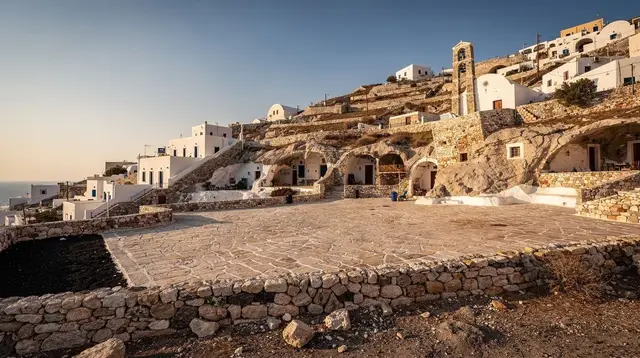
Emporio's kastro is the most intact fortified settlement on Santorini, a tight maze of stone houses, arched passages and a central watchtower built to shelter villagers from pirate raids. Unlike Pyrgos or Oia, it has no caldera view — its interest is the defensive layout itself, not a panorama.
A Village Built to Be Defended
Most visitors who make the effort to leave the caldera rim go inland for a view: the panorama from Pyrgos, the vineyards around Megalochori, or the wide horizon from the monastery on Profitis Ilias. Emporio offers none of that. It sits on the flatter ground of the island’s southeast, away from the caldera edge, and its kastro was never built to be looked at from a distance. It was built to be lived inside, in a way that made it hard for anyone hostile to get in.
That single fact separates Emporio from almost every other stop on a typical Santorini villages tour, and it is worth understanding before you go, so you arrive looking for the right thing. If you come expecting a viewpoint, you will leave unimpressed. If you come to see how a Cycladic community solved the problem of defence with nothing but houses and geometry, Emporio is the clearest lesson on the island.
For centuries, the Aegean islands lived with the recurring threat of pirate raids, a danger that shaped where and how people built long before it shaped where tourists now point their cameras. Settlements moved away from open coastlines, huddled inland, and where they could not move far enough, they fortified themselves by design rather than by walls alone.
Emporio’s kastro is one of the most complete surviving results of that instinct on Santorini, and its village, with its outlying farmland around Exo Gonia, Vothonas and Messaria, was historically among the wealthier and more populous on the island — a status the density of its fortified core still hints at today.
Inside the Labyrinth: How Emporio’s Kastro Works
Step off the village’s outer streets and into the kastro, and the logic becomes physical almost immediately. There is no single main street. Instead, narrow lanes fork, dead-end, and double back, often no wider than the span of your arms, and frequently roofed over by an arch or the upper floor of the house next door. Windows facing outward are small and set high; the real openings, the doors and courtyards, all face inward, toward the interior of the block.
This was not decoration. In a genuine kastro, the outer ring of houses forms the fortress wall itself — there is no separate defensive perimeter to man or repair, because the housing stock and the fortification are the same structure. An attacker reaching the edge of the village met a continuous, largely blank wall of stone, broken by only a handful of narrow, defensible entrances. Once inside those entrances, the maze of alleys made it just as hard to move quickly or find a way through, which is exactly the effect it still has on visitors today, minus the danger.
Walking it now, that same layout produces something closer to disorientation than dread: an intimate, almost domestic warren where laundry lines cross overhead, cats sit in doorway shade, and the scale never opens up the way it does elsewhere on the island. There is little sense of Santorini’s scale or light here — no wide caldera view breaking the pattern, no sea in sight. That absence is precisely the point: Emporio’s kastro rewards attention to the built fabric itself, not to what surrounds it.
The Goulas and the Church at the Centre
At the heart of most Cycladic kastro settlements sits a goulas, a tower built as the last line of retreat if the outer ring of houses was breached. Emporio’s goulas still stands near the centre of the fortified quarter, taller and more solidly built than the housing around it, and it is the easiest fixed point to navigate toward and from if you find yourself turned around in the lanes, which most visitors do at least once.
Around and beneath the goulas, small churches and chapels are folded into the urban fabric rather than set apart in a square, another feature typical of Cycladic kastro settlements: sacred space embedded inside the defensive one, so that shelter and worship shared the same walls. Some of these interiors are closed outside of services, since Emporio’s kastro remains inhabited and in use, not preserved as a museum piece. That lived-in quality is worth respecting: quiet footsteps, no loud conversation late in the day, and no assumption that every door is open to a visitor simply because it is old.
Three Kastro, Three Logics: Emporio, Pyrgos and Oia
Santorini’s guidebooks and itineraries use the word “kastro” loosely, and it is easy to conflate three genuinely different places. Each rewards a different kind of visitor.
| Kastro | Village | What it actually is | Best for | Typical crowd level |
|---|---|---|---|---|
| Emporio | Emporio | A dense, still-inhabited fortified quarter, houses forming the outer wall, no caldera view | Visitors interested in defensive layout and everyday village life | Low, even in peak season |
| Pyrgos | Pyrgos | A fortified hilltop core plus the island’s widest all-round panoramic view | Visitors who want both history and a view, without Oia’s crowds | Moderate, rising at sunset |
| Kastro of Oia | Oia | A small Venetian structure at the village tip, now mainly a sunset viewpoint | Visitors chasing the Oia sunset specifically | Very high before sunset |
If your interest is architecture and atmosphere rather than a view, Emporio is the one to prioritise. If you want a view with a genuine fortified core beneath it, Pyrgos does both at once — our full pyrgos-village-guide covers that combination in detail. If you are chasing the sunset itself, Emporio has nothing to offer you; look instead at the alternatives to Oia covered elsewhere on this site.
Walking Emporio: A Practical Route
There is no single official route through the kastro, which is part of its character — getting slightly lost is normal and not a problem, since the fortified quarter is compact enough that you will always find your way back out within a few minutes. That said, a workable approach is to enter from one of the village’s main streets, head toward the goulas as a central landmark, and let the lanes fork from there before doubling back the way you came or finding a different exit on the opposite side.
Outside the kastro itself, the rest of Emporio is an ordinary, functioning Santorini village: a few tavernas, small shops, and streets that see far less foot traffic than Fira or Oia. Combining a walk through Emporio with a stroll through central Pyrgos or a stop at a nearby winery — the island’s wine country wraps around this part of the interior — makes for a fuller half-day than the kastro alone; see santorini-wineries-compared for how the nearby estates differ from one another.
For visitors who prefer a structured introduction rather than navigating village layouts alone, guided village tours typically pair Emporio-style stops with Pyrgos and a winery visit in one outing.
a guided village and winery day that pairs Pyrgos with a tasting stop, useful context before or after exploring Emporio independentlyTravellers who want the fortified villages folded into a broader day of traditional Santorini life, alongside the excavated site at Akrotiri, have a private option built around exactly that theme.
a private tour combining Santorini’s traditional villages with the Akrotiri excavationsEmporio in Everyday Life, Not Just for Visitors
It is worth repeating, because it changes how you should behave inside the kastro: Emporio is not a preserved historical site, it is a place people live. Doors that look ancient are someone’s front door. Courtyards you glimpse through an archway are private space. The absence of ticket booths, opening hours, or a marked entrance is not an oversight — it reflects the fact that the kastro has never stopped being residential, unlike some of the fortified quarters elsewhere in the Cyclades that have been fully converted into visitor attractions.
That also means Emporio has resisted, more than most of Santorini, the pressure that reshapes villages once they become fixtures on a tour itinerary. There is no equivalent here of Oia’s queue for a sunset photo spot, no row of matching gift shops. What you find instead is closer to how Pyrgos or Megalochori might have felt before either became a regular stop on organised tours — worth knowing if you are choosing between inland villages and want the quieter end of that spectrum. Our broader santorini-villages-guide sets Emporio in context against the island’s other historic settlements, though it does not repeat the kastro detail covered here.
Getting to Emporio and When to Go
Emporio lies inland, roughly midway between Fira and the beaches of Kamari and Perissa, close enough to the ridge of Profitis Ilias that the two are sometimes combined in a single outing. There is no dramatic approach road or viewpoint signalling your arrival, which suits the village’s low profile.
| Getting there | Approximate travel time from Fira | Notes |
|---|---|---|
| Rental car or scooter | 15–20 minutes | Most flexible; parking near the village is limited but manageable |
| Local KTEL bus | Variable, limited outside peak hours | Check current timetables before relying on this option |
| Taxi | 15–20 minutes | Book ahead — Santorini has very few taxis for the whole island |
| Guided village tour | Included in itinerary | No self-navigation required |
Because Emporio’s appeal has nothing to do with light or a sunset direction, it is one of the few Santorini stops that genuinely works at any hour of the day. Late morning avoids both the harshest midday heat in the shade-starved alleys and the afternoon groups moving between Pyrgos and the wineries. Winter visitors will find the kastro just as walkable as in summer, since indoor sites and view-dependent stops are what close down for the season here, not a maze of outdoor stone lanes.
Combining Emporio with the Rest of the Island
Emporio works best as one stop within a half-day of the interior rather than a destination in its own right — few visitors would drive out solely to see it, and that is fine. Reasonable pairings include Pyrgos for the contrast between a viewpoint kastro and a landlocked one, a nearby winery for a tasting break, or the archaeological site of Ancient Thira on the ridge above Kamari, which shares the same general area without sharing any of Emporio’s medieval history — the two sites are separated by well over two thousand years and should never be confused. Our ancient-thira-guide covers that separate, much older site in full.
For visitors building a walking-focused day around the island’s interior rather than the caldera path, a route that threads Profitis Ilias and Ancient Thira together with a stop in one of the inland villages makes efficient use of the terrain.
a walking route linking Profitis Ilias mountain to Ancient Thira, through the same inland landscape as EmporioIf your interests run wider than any packaged itinerary allows — say, an afternoon built specifically around fortified villages and the vineyards between them — a fully private, customisable tour is the more efficient way to see Emporio alongside exactly the stops you choose, without carrying the fixed stops of a group itinerary.
a fully customisable private tour that can be built around Emporio, Pyrgos, and the inland wine villages on your own scheduleThose staying longer than a single day inland can see how a village-and-wine focused route fits into a broader trip in our santorini-wineries-compared guide and in the wider planning resource at /itineraries/three-days-in-santorini/, which sequences the interior alongside the caldera and the coast.
Walkers interested in the island’s inland paths more generally, beyond the well-known Fira-to-Oia caldera trail, will find Emporio a useful reference point for how the villages sit relative to one another — covered further in walking-tours-santorini, and in the fuller walk through Fira’s own old town at fira-old-town-walk for comparison with a caldera-side settlement rather than an inland one.
The Piece Emporio Adds to the Picture
Santorini’s popular image is almost entirely a caldera image: a crescent of white villages above a blue void, best seen at sunset from Oia or Pyrgos. That image is accurate, but it is only one half of the island. The other half is inland, agricultural, and defensive in its bones — vineyards trained low against the wind, and villages like Emporio built not to be admired from outside but to keep the outside out. Seeing both halves, rather than only the postcard one, is the difference between visiting Santorini and actually understanding how it was built to survive on it.
Emporio’s kastro will not give you a sunset photograph or a caldera panorama. What it gives instead is a direct, walkable answer to a question most visitors never think to ask: how did a small Aegean community, with no walls beyond its own houses, keep itself safe for centuries. Few places on the island answer that question as clearly, or as quietly, as the lanes inside Emporio’s kastro.
Emporio Kastro FAQ: Visiting Santorini’s Fortress Village
What exactly is a kastro, and why does Emporio have one?
A kastro is a fortified settlement built during the centuries when the Cyclades were exposed to pirate raids, particularly under Venetian and later Ottoman-era rule. Villagers built their houses wall-to-wall in a closed ring, with few and narrow openings to the outside, so that the outer walls of the houses themselves formed the fortress. Emporio’s kastro is one of the clearest surviving examples of this logic on Santorini.
How is Emporio’s kastro different from the one in Pyrgos?
Pyrgos sits on a hill and pairs its fortified core with sweeping views over most of the island, which is why it draws sunset crowds. Emporio sits on flatter ground with no equivalent panorama, so its kastro is visited purely for the density and intricacy of its stone alleys rather than for any view. See our dedicated pyrgos-village-guide for that comparison in full.
Is Emporio’s kastro the same as the Kastro of Oia?
No. They are three separate fortifications: Emporio’s kastro, Pyrgos’s kastro, and Oia’s Kastro, a smaller Venetian structure at the tip of the village used today mainly as a sunset viewpoint. Confusing the three is the most common mistake visitors make when planning which village to prioritise.
How long does it take to visit Emporio’s kastro?
Walking the core lanes of the kastro on foot takes roughly 45 minutes to an hour at an unhurried pace, longer if you stop to look at doorways, the goulas tower and the churches tucked inside. Most visitors combine it with Pyrgos or another inland village in the same half-day.
Is Emporio worth visiting if I’ve already seen Pyrgos?
Yes, for a different reason: Pyrgos rewards you with a view, Emporio rewards you with a layout. If you are interested in how Cycladic villages defended themselves rather than in another lookout point, Emporio is the more informative stop of the two.
How do I get to Emporio without a rental car?
Emporio is served by local buses from Fira, though schedules are limited outside peak hours, and by taxi, which is the more reliable option given how few taxis operate on the island. Many visitors reach it as part of a guided villages tour that already includes Pyrgos or Megalochori.
Is there an entrance fee for Emporio’s kastro?
No. The kastro is a living residential quarter, not a ticketed monument, so you can walk its lanes freely at any hour. Some interior points, such as small chapels, may be closed to the public since they remain in use by the community.
What is the best time of day to visit Emporio?
Late morning or mid-afternoon works well, since Emporio does not depend on sunset light the way Oia or Pyrgos does. Visiting outside the midday heat also makes the narrow, shade-starved alleys more comfortable to walk.
Villages and Culture on GetYourGuide
Verified deep-linked GetYourGuide tours. Book through these links and we earn a small commission at no cost to you.
GetYourGuide does not provide a product photo for this activity — the image shows the meeting point, photographed by us.