Walking Fira's Old Town: Caldera Rim to the Port
What is the best walking route through Fira's old town?
Start at the caldera-rim path near the cathedral, walk the pedestrian lanes north toward the old port viewpoints, then go down to Skala by the 588 steps, the cable car, or a donkey. Do the descent early morning or after sunset, and plan the return trip separately since it costs more effort or money than the way down.
A route, not a checklist
Most pages about Fira describe the town. This one gives you a direction of travel: where to start, which way to walk, how long each stretch takes, and what your three options are for getting down to the water. It assumes you are already in Fira and want a walk with a shape to it, not a list of things that happen to be there. For the town’s history and its role as the island’s capital, see Fira: Santorini’s Cliff-Top Capital; for how Fira compares to the other caldera villages, see Santorini’s Villages Compared.
The walk below has two parts. The first is a level stroll along the caldera rim through the pedestrian core of Fira. The second is a descent of roughly 220 metres to Fira Old Port: Skala, the Cable Car and the 588 Steps, known locally as Skala, by one of three methods. Together they take under two hours at an unhurried pace, including the way back up.
Starting point: the cathedral end of the rim path
Begin near the Orthodox Metropolis Cathedral, at the point where Fira’s clifftop path is at its widest and least crowded. From here the route runs north, with the caldera and the volcanic islets of Nea Kameni and Palea Kameni & the Hot Springs sitting below and to the west for most of the walk. Keep the drop on your left as you head north; that orientation is the whole navigation problem solved.
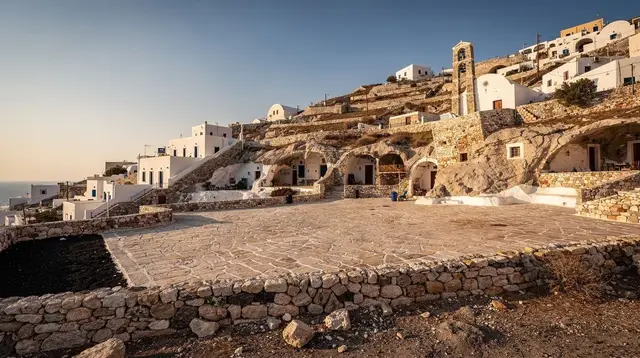
The lane narrows almost immediately into the pedestrian spine that most visitors picture when they think of Fira: whitewashed walls, blue-domed chapels wedged between jewellery shops and terrace cafés, and a steady procession of people moving in both directions. There is no single “main street” sign to follow — the route is simply whichever paved lane keeps the rim on your left. Side alleys peel off to the right into quieter, less commercial pockets of town; take a few of these as short detours if the main lane feels congested, then rejoin it.
This stretch is flat and shaded in patches, which makes it one of the few comfortable places to walk through the middle of the day, unlike the exposed The Fira–Oia Caldera Path further north. It is not, however, a beach or a swimming spot: none of the caldera-rim villages have direct sea access, which is exactly why the descent to Skala exists as a separate, deliberate leg of this walk.
Where the rim path is heading
As you continue north, the lane climbs gently before the town gives way to firostefani and, further on, imerovigli and the outcrop of Skaros Rock. You do not need to walk that far for this route — the old-port descent is reached from within Fira itself — but it is worth knowing that the same rim path keeps going, eventually becoming the multi-hour trail to Oia described in The Fira to Oia Caldera Hike: Full Trail Guide. That is a different, longer undertaking; this walk turns back toward the water well before it.
Watch for the point where the lane opens onto a wider viewing terrace with a cluster of donkey pens and signage pointing down the cliff face. This is the top of the descent to Skala, and it is unmistakable: it is the only place along this stretch of rim where the path splits into a staircase, a cable-car station, and a fenced area of pack animals, all within a few metres of each other.
Three ways down to Skala
At the top of the cliff you have three options for the roughly 220-metre drop to the old port. None of them is objectively correct; each trades time, cost and effort differently.
| Method | Approx. time | Approx. cost | Notes |
|---|---|---|---|
| Cable car | About 3 minutes | Low single-digit euros, one way (fares vary by season and year — check the board on site) | Fastest and least tiring; can have a queue at peak cruise-ship hours |
| 588 steps on foot | 20 to 40 minutes down | Free | Uneven stone, shared with donkeys and mule handlers; slippery after rain |
| Donkey | 20 to 30 minutes | A set fare paid on the spot | No outright ban exists; a weight limit applies, and welfare rules were under discussion for the 2026 season — ask locally for current terms |
For the fare on the cable car, treat any number you see, including the range above, as an approximation. It has moved before and will likely move again; the reliable source is the ticket board at the top station on the day you travel. For the wider mechanics of the system and the history behind why Fira has a cable car at all, see Santorini Cable Car and the 588 Steps: Getting Up From the Old Port; for a first-person account of what the steps actually feel like underfoot, Climbing the 588 Steps to Fira is a useful companion read.
If you plan to walk down, wear closed shoes with grip — the stone is polished smooth in places by generations of hooves and sandals, and it is not the place for flip-flops. If you would rather not think about any of this and just want someone to lead you through the lanes with commentary along the way, a guided option folds the walking route into a fixed itinerary: this Fira town walking tour pairs the same lanes with a wine tasting stop, which removes the guesswork about which alley leads where.
What you pass on the descent
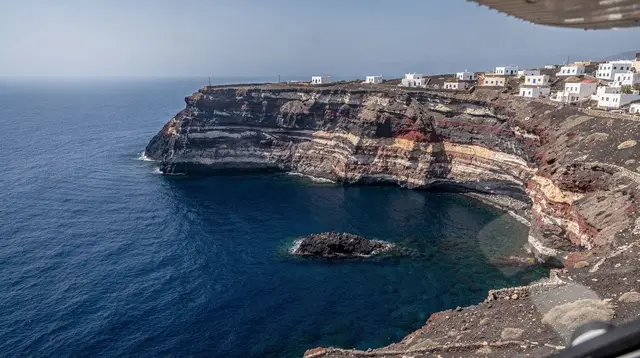
The staircase itself is the attraction on the way down as much as the destination at the bottom. You get a close view of the cliff’s layered geology — bands of pumice and ash from successive eruptions, the same material that shaped the whole caldera as explained in How the Santorini Caldera Was Formed — and, depending on the time of day, a very different crowd than the one up on the rim. Donkey handlers work the path constantly during cruise-ship hours, moving animals and occasionally supplies up and down; step to the uphill side of the path when one passes.
Partway down, small landings offer a chance to stop and look back up at Fira perched on the rim, which is a genuinely different photograph than anything taken from the top. This is one of the better under-used angles for The Best Photo Spots in Santorini You Can Find Yourself, largely because most visitors are moving too quickly through this stretch to stop.
Arriving at Skala, the old port
At the bottom, the old port of Fira is a working quay, not a resort waterfront. It exists to receive tender boats from cruise ships anchored in the caldera and to send out excursion boats, including the caldera cruises that circle past Nea Kameni and stop for swimming at Palea Kameni & the Hot Springs. There is a small row of tavernas and a strip of pebble beach, but this is not a swimming destination in its own right, and it is not where ferries from Athinios Port: Santorini’s Only Ferry Gateway dock — that is a separate port entirely, on the other side of the island’s cliff line, and the two are sometimes confused by first-time visitors.
If your reason for coming down to Skala is to board a boat, arrive with time to spare: the quay gets congested at the changeover between cruise-ship tender runs, and the staircase above fills with people moving in both directions at the same moment. For a fuller picture of how the port fits into a cruise-ship day here, see Santorini Cruise Port Guide: From the Ship to Fira and, if you are visiting on a single shore day, One Day in Santorini from a Cruise Ship: An Hour-by-Hour Plan.
Timing the whole walk
The single biggest factor in how this walk feels is timing, not distance. Cruise ships typically run tenders into Skala through the middle of the day, which is when both the staircase and the rim lanes in central Fira are at their busiest. Early morning, before the first tenders start, and the couple of hours after sunset are calmer on both counts.
| Time of day | Rim lanes in Fira | 588 steps / old port |
|---|---|---|
| Early morning (before 9am) | Quiet, shops still shuttered | Quiet, good light for photos |
| Midday to late afternoon | Busy, shared with day-trippers | Busiest — tender and donkey traffic overlap |
| Evening after dinner | Moderate, restaurant crowds | Quiet, but the cable car may have stopped running |
Check the cable car’s last departure time before committing to an evening descent — unlike the steps, it does not run around the clock, and being stuck at the bottom after the last car has left means a walk back up in the dark.
Making the return trip painless
The most common planning mistake on this route is deciding how to get down without deciding how to get back up. Walking down the 588 steps is manageable for most people; walking back up them in the same visit, often in full sun, is considerably harder and is the single detail that turns a pleasant morning into an exhausting one. Decide before you descend: either budget for the cable car fare on the way back, arrange for a donkey, or accept the climb as part of the plan and pace it with water and shade breaks.
If you would rather have the whole loop handled without managing tickets or timing yourself, a few tours build this walk into a guided format. a Fira walking tour that ends with a plate-smashing show keeps things light if you want the lanes covered with some theatre attached, while a guided foodie walk through Fira with tastings along the way turns the same stretch of lanes into a series of stops rather than a single push to the port.
Travellers combining this with a longer day across the caldera villages sometimes prefer a private walking tour covering both Fira and Oia with local stories and photo stops, which extends the rim walk well past the old-port turnoff described here.
Fira’s old town walk: your questions answered
How long does the walk through Fira take?
The lanes between the cathedral and the cable-car station cover under a kilometre and take 20 to 30 minutes at a slow pace with stops. Add the descent to Skala and you are looking at 30 to 60 minutes more, depending on the method.
Should I take the cable car or walk down the 588 steps?
The cable car is faster, roughly three minutes for about 220 metres of descent, and spares your knees on the way back up. Walking the steps is free and lets you stop for photos, but the steps are uneven, shared with pack animals, and slippery when wet.
Is it true there is no fixed price for the cable car?
Fares are set locally and have varied by season and year, generally in the low single-digit euros each way. Treat any figure you read, including here, as an order of magnitude and check the current fare board at the top station before you queue.
Can I ride a donkey down to the old port?
Yes, donkeys still work the 588-step path alongside walkers, and there is no ban on riding them. A weight limit was introduced in 2018, and animal-welfare rules were being discussed for the 2026 season, so ask locally if you want current terms rather than assume anything printed here still applies.
What is actually at the bottom, at Skala?
Skala is Fira’s old port, a small quay used by cruise-ship tenders and excursion boats, not by ferries. There is little to do there beyond boarding a boat or watching the traffic on the steps above; it is a passage point, not a destination in itself.
When is the best time to walk down to the old port?
Early morning, before the day’s cruise tenders start running passengers up and down, or after the evening rush has thinned out. Midday sun on bare rock steps with donkey traffic is the least comfortable combination on the island.
Do I need to arrange the return trip in advance?
No advance booking is needed for the cable car or the steps, but decide before you go down: walking back up the 588 steps in the heat is the single most common regret of this route, so budget for the cable car fare or a donkey on the way back if you go down on foot.
Walking Tours on GetYourGuide
Verified deep-linked GetYourGuide tours. Book through these links and we earn a small commission at no cost to you.
GetYourGuide does not provide a product photo for this activity — the image shows the meeting point, photographed by us.