Santorini Cable Car and the 588 Steps: Getting Up From the Old Port
How do you get from the old port of Fira up to Fira town?
Three ways: the cable car (about 3 minutes, roughly 6 to 10 euros depending on the season and source), the 588 stone steps on foot (30 to 45 minutes), or a donkey ride up the same steps. This only applies to the old port (Skala), not the ferry port of Athinios, which has no cable car at all.
Three Ways Up From the Water, One Cliff to Climb
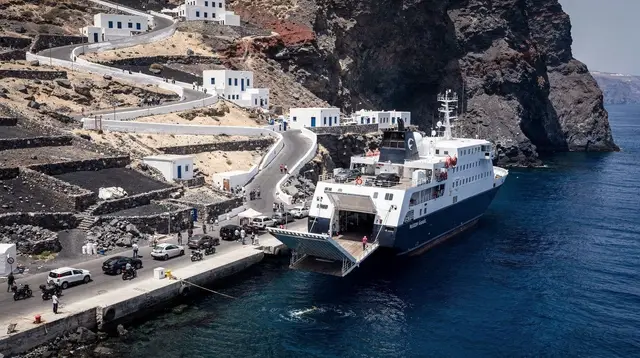
Every visitor who arrives at Santorini by tender, excursion boat, or small ferry from Thirassia lands at the same place: the old port of Fira, a narrow strip of quay locally called Skala, wedged at the base of the caldera cliff. From there, Fira town sits about 220 metres straight up, and there is no road down to the water for private cars. Getting from the boat to the town happens in exactly one of three ways: the cable car, the 588 stone steps on foot, or a donkey.
This is a different problem from arriving by ferry at Athinios, the island’s only ferry port, which sits on the opposite, western side of the caldera and is connected to Fira by a paved switchback road served by taxis, transfers, and the KTEL bus. Athinios has no cable car and no historic staircase — see the Athinios port guide and transfers guide for that side of the island. This page is specifically about the old port at Skala, which is where cruise tenders, caldera cruises, and excursion boats bring you.
The Cable Car
The Santorini cable car (teleferik) runs on a fixed line between a lower station at the old port and an upper station in Fira, a ride of roughly three minutes covering the 220-metre climb. It operates in both directions, so it also works for going down to catch a boat, not only for coming up.
Pricing is one of those details that shifts by season and by whoever is quoting it, so treat any figure as a working estimate rather than a fixed number. Expect something in the region of 6 to 10 euros for a one-way ride, payable at the kiosk before boarding — bring cash as a backup even if cards are usually accepted, since queues move faster when people aren’t fumbling with a terminal.
What actually slows the cable car down is not the ride itself but the queue. Each cabin holds a limited number of passengers, and on a day when two or three cruise ships are anchored off the caldera at once, the line at the bottom (and sometimes the top) can stretch well past half an hour around midday. The operating hours generally track the cruise and ferry schedule with a break overnight, but the useful rule is simpler: early morning and after the bulk of the day’s excursion boats have returned tend to move fastest.
A few practical points that matter more than the exact fare:
- Luggage is fine. The cable car is the only one of the three options that handles wheeled suitcases or heavy backpacks without drama.
- It can close in high wind. The caldera funnels strong gusts, and on the rare day the meltemi is especially fierce, service can be suspended — the steps and donkeys become the only options.
- It only serves Skala. There is no cable car anywhere near Athinios, and none between Fira and other caldera villages like Oia or Imerovigli — those are a bus, taxi, or the Fira-to-Oia caldera path, a separate and much longer walk covered on its own page.
The 588 Steps
Long before the cable car existed, the only way up from the old port was a switchback staircase carved into the cliff, and it is still there, still open, and still the free option. The count — 588 steps — is the number most commonly cited, though depending on how you count landings and short paved sections, other figures circulate; nobody meaningfully disputes that it is a long, steep climb.
Expect 30 to 45 minutes on foot, more if you stop to look back at the caldera view, which improves with every switchback. The steps are uneven stone, worn smooth in places, and there is no shade at all — this is the detail that catches people out more than the elevation. Midday sun on white stone with no cover is genuinely unpleasant, and the island’s volcanic surfaces already run hot underfoot; the same caution that applies to the black-sand beaches applies here in spirit, if not in temperature.
The steps are shared with donkeys, which changes the walking experience more than the incline does. The animals go up and down the same staircase carrying riders and, occasionally, goods, and they leave droppings behind as they go. Walkers should expect to step carefully, particularly near the bottom and top where the traffic is heaviest, and this is one of the more consistent complaints from people who choose to walk rather than ride or take the cable car.
Reasons people still choose the steps: it costs nothing, it doesn’t queue the way the cable car does on a busy ship day, and for some travellers descending is genuinely more appealing than climbing — going down, gravity does most of the work and the caldera view opens up ahead of you rather than behind.
The Donkeys
Riding a donkey up from the old port is the oldest way to make the climb and remains a working option today, run by local handlers who wait at the bottom of the steps. It is worth being precise about the facts here, because this is one of the more debated topics connected to the island.
There is no ban on donkey rides in Santorini. What exists is a weight limit for riders, introduced in 2018 after welfare concerns about the animals working a steep, repetitive route in island heat. Riders above the threshold are turned away rather than the service being withdrawn. Beyond the weight rule, further tightening of animal welfare regulation was under discussion heading into the 2026 season, though nothing amounts to a prohibition on the practice itself.
Where this site lands on it: the facts above are the facts, and travellers can weigh them for themselves. If riding a donkey up a hot, uneven staircase for the animal’s entire working day doesn’t sit well with you, the cable car and the steps both get you to the same place without that question attached. If you do choose to ride, expect the same shared traffic and mess on the steps that walkers encounter, from the other side.
Comparing the Three Options
| Option | Time | Approximate cost | Best for |
|---|---|---|---|
| Cable car | About 3 minutes | Roughly 6–10 € (varies) | Luggage, mobility limits, speed outside peak queue times |
| 588 steps on foot | 30–45 minutes | Free | No queue, no cost, don’t mind sharing the path with donkeys |
| Donkey ride | 20–30 minutes | Set by handlers at the port | Riders under the weight limit who want the traditional route |
None of these three options connects to Athinios. If your itinerary has you arriving on a car ferry from Piraeus, Crete, or another Cycladic island, you will land at Athinios and need a taxi, pre-booked transfer, or the KTEL bus instead — see the Athinios port guide for that route in full.
Timing It Around a Cruise Call
Anyone visiting on a cruise ship shore excursion is working against a fixed return time, which makes the queue at the old port the single biggest variable in the day. A few notes specific to that situation:
- Tender queues cluster the cable car queue. Ships release passengers in waves, so the crowd at the lower cable car station tends to arrive in surges rather than a steady trickle. If your tender lands during a lull between waves, the line can be short even at midday.
- Build in slack for the return. Whichever option you plan to use going back down, assume it will be busier than your morning trip up, since most excursion groups return to their ships in the same two- or three-hour window in the afternoon.
- Walking down is often the fastest fallback. If the cable car line is long and you’re tight on time, the 588 steps going down move faster than most people expect, since it’s a descent rather than a climb.
For a full walk-through of spending a single cruise day on the island, see one day in Santorini from a cruise ship or the Santorini cruise port guide, and for a broader look at what a single day here can realistically include, one day in Santorini lays out a sample itinerary.
Beyond the Climb: What Waits at the Top
Once you’re up, Fira itself is compact enough to explore on foot — the Fira old town walk covers the caldera-view lanes, the cathedral, and the Museum of Prehistoric Thera in a loop that takes an hour or two. Many visitors who land at the old port are actually there for a caldera cruise rather than a ferry connection, and those cruises typically depart from the same old port you’ve just climbed away from — worth remembering if your boat leaves later the same day.
a caldera cruise with a meal, swim stop, and snorkelling departs from this same old port, so if you’re heading down for a boat rather than up from one, budget the queue time in the other direction too. For evening plans, a sunset cruise that stops at the volcano and hot springs also loads and returns here.
Travellers who would rather skip the steps and the cable car queue altogether for the rest of their stay sometimes book a private driver-led tour of the island’s highlights, which picks up from your accommodation instead. For a lower-key way to see the villages inland once you’re past the port climb, an e-bike tour through the villages is a popular next step.
Cable Car, Steps, or Donkey: Your Questions Answered
Does the cable car go from Athinios to Fira?
No. The cable car only connects the old port of Fira (Skala), where cruise tenders and excursion boats dock, to Fira town, 220 metres above. The ferry port of Athinios is a separate harbour further south with no cable car; travellers arriving there move on by taxi, transfer, or the KTEL bus.
How much does the Santorini cable car cost?
Expect somewhere in the region of 6 to 10 euros for the roughly three-minute ride, though the exact figure varies by season and by which source quotes it. Treat any number you see, including this one, as an estimate rather than a fixed fare, and confirm at the kiosk before boarding.
Is climbing the 588 steps hard?
It is a steep, uneven stone staircase with a real change in elevation, so it suits reasonably fit walkers more than a leisurely stroll. The bigger obstacle is usually not fitness but sharing the steps with donkeys and their droppings, plus midday heat with no shade.
Are donkeys banned in Santorini?
No, there is no ban. A weight limit for donkey riders was introduced in 2018 after welfare concerns, and further tightening of animal welfare rules was under discussion for the 2026 season. Riders above the limit are turned away rather than the practice being banned outright.
Is it cruel to ride the donkeys up the steps?
Opinions differ, which is exactly why the weight limit and further rule discussions exist. What is factual is that the animals work a repetitive, steep route in the heat; travellers who would rather not be part of that debate can simply take the cable car or walk instead.
How long is the wait for the cable car?
It depends entirely on how many ships are in port. On a day with several cruise ships anchored offshore, queues at both ends can run well past 30 minutes around midday; early morning and early evening are calmer.
Can you take luggage on the cable car or up the steps?
The cable car handles luggage without issue and is the practical choice for anyone with wheeled bags. Carrying luggage up 588 uneven steps, or trying to balance it on a donkey, is not recommended.
What is the closest alternative if the cable car line is too long?
Walking down is usually faster than queuing, since the line for going up is normally the longer one; if you are short on time before a ship departs, factor in whichever of the three options queues fastest that day rather than assuming the cable car is automatically quickest.
Transfers and transport passes on GetYourGuide
Verified deep-linked GetYourGuide tours. Book through these links and we earn a small commission at no cost to you.
GetYourGuide does not provide a product photo for this activity — the image shows the meeting point, photographed by us.