Santorini Ferry Guide: How Athinios Port Works
Where do ferries leave from in Santorini, and is there a proper station?
All ferries use Athinios (Ormos Athiniou), on the caldera's west side, reached by a steep hairpin road from Fira. There is no station building, no left-luggage office and no ticket counter beyond a couple of agency booths — just a working commercial harbour, so plan transfers and tickets in advance.
Why Athinios Isn’t A Bus Station With Boats
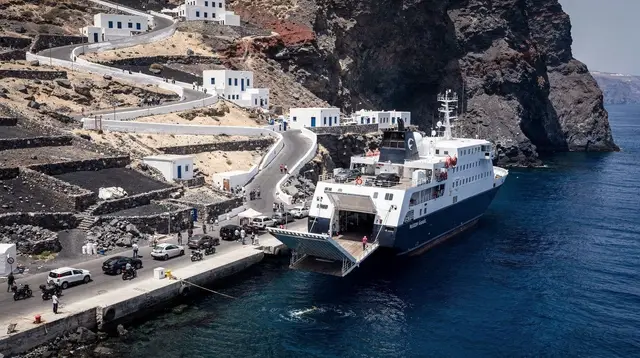
Santorini has one ferry port, full stop. Every boat that isn’t a cruise-ship tender or a private caldera cruise loads and unloads at Ormos Athiniou — usually just called Athinios — on the western face of the caldera, below the ring of villages everyone photographs. It is easy to picture something like a small airport: a terminal, a departures board, somewhere to leave a bag. Athinios isn’t that.
It is a working commercial harbour cut into the cliff, with a ramp for vehicles, a row of ticket booths run by different companies, and very little else. There’s no left-luggage office, no waiting hall with seating for hundreds, and no staff roaming to answer questions in six languages. That isn’t a flaw in the island’s infrastructure; it’s simply what a small-island cargo-and-passenger port looks like, and knowing it in advance is most of what you need to have a smooth departure.
This guide is about the mechanics of getting through Athinios — the road down, the timing, the tickets, what exists at the port and what doesn’t — not about which island to pick or how to string a route together. If you’re still deciding where to go next, island hopping from Santorini and Cyclades island-hopping routes cover that groundwork, and the Mykonos-specific guide handles that one popular leg in detail. Here, the destination is already decided; the job is getting you and your luggage onto the right boat without drama.
Getting Down To The Port
Athinios sits below Fira, reachable by a steep, switchbacking road carved into the caldera wall. There’s no shortcut and no alternative approach — every vehicle and every bus funnels down the same set of hairpin bends, which is the single biggest reason the port feels chaotic exactly when a ferry is due. Three ways to get there matter in practice:
- KTEL buses run scheduled services timed loosely around ferry departures, picking up from the bus station in Fira. They’re inexpensive and reasonably reliable outside the very busiest weeks, though in high season buses can fill before everyone waiting has boarded. Details on routes and frequency are in the Santorini buses guide.
- Taxis are the dependable option if you’re not confident cutting it close, but the island’s entire taxi fleet is small. Book ahead rather than expecting to flag one down, especially early in the morning or late at night — see Santorini taxis and transfers.
- Driving yourself, in a rental car or scooter, is straightforward if you’ve already spent a day or two on the island’s roads. The descent itself is well paved but narrow in stretches, with coaches and other cars converging at the same time you are. First-timers on two wheels should read car and scooter rental in Santorini before attempting it after dark.
None of this connects to the cable car or the 588 steps up from the old port in Fira — that’s a separate, much smaller harbour used by cruise tenders and excursion boats, not ferries. If you’re weighing that climb for a different reason, the cable car and steps guide is the right page; it has nothing to do with catching a ferry to Piraeus.
Where The Ferries Actually Go
Athinios connects Santorini to four broad directions: the mainland via Piraeus, the rest of the Cyclades, Crete, and — less frequently — Rhodes and the Dodecanese. Durations vary by company, vessel type and sea conditions, so treat every figure below as an order of magnitude to check against your specific sailing, never a timetable.
| Route | Approximate duration | Notes |
|---|---|---|
| Piraeus (Athens) | ~4.5–5 h high-speed, ~7–9 h conventional | Several sailings daily in summer, far fewer in winter |
| Ios | ~35 min | Shortest hop, several times daily in season |
| Naxos | ~1 h 30 | Frequent in summer |
| Paros | ~2 h | Multiple daily sailings in high season |
| Mykonos | ~2 h 15 | See the dedicated Mykonos guide for that leg |
| Milos, Folegandros, Sifnos | Variable, often 2–4 h | Fewer sailings, check the specific day |
| Amorgos | Variable, often with a stop | Not every day in shoulder season |
| Heraklion (Crete) | ~2 h | Regular in summer, thinner in winter |
| Rhodes | Long, seasonal | Not a daily route; usually via other islands |
If you’re building a full route across several of these rather than checking one leg, Cyclades island-hopping routes is the better starting point. Day-trip specific guides exist for the shorter, more common hops: Santorini to Ios, Santorini to Naxos, Santorini to Milos and Santorini to Crete.
Checking In, Boarding, And What Genuinely Isn’t There
This is the part worth repeating because it trips up first-time visitors more than anything else: Athinios has no left-luggage service, no indoor departure lounge with rows of seating, and no single unified ticket counter. What it does have is a line of separate booths, each representing one or two ferry companies, open in the run-up to their own departures and often closed the rest of the time. If your ferry company’s booth is shut when you arrive, it usually means you’re either very early or your ticket was already issued elsewhere (a travel agency in Fira, or online) and you don’t need the booth at all.
Boarding itself has two separate flows. Foot passengers queue and walk on close to departure time, ticket or boarding pass in hand. Vehicles — cars, scooters, quads — queue on the ramp in a separate lane and load first, which is why the port can look like a solid wall of traffic exactly when a ferry is due: everyone with a car is idling in one place at once. If you’re on foot, you can usually sidestep the worst of that congestion by walking down rather than driving, but you still need to be at the correct pier gate, since Athinios often has more than one vessel loading around the same time.
Timing It Right
The single most common mistake is treating the port like an airport, where earlier is automatically safer. In reality, arriving too early just means standing in the sun with no seating and nowhere to leave your bags. The more useful habit is to time your descent — whether by bus, taxi or rental car — to land you at the port 45 to 60 minutes before a foot-passenger departure, and 90 minutes or more if you have a vehicle to check in or you’re travelling in the first three weeks of August, when queues lengthen fastest.
Ferry schedules also thin out noticeably outside the June–September stretch. From November to March, some companies suspend routes entirely and others cut daily sailings back to two or three a week, occasionally cancelling on short notice in poor weather — a genuine consideration if you’re island-hopping in winter, not a sign of anything wrong with the port itself. If your dates fall in that window, confirm the specific day’s sailing rather than assuming a summer frequency still applies.
If You’re Driving Yourself Down
Taking your own rental down to Athinios is entirely normal, but two details matter. First, the road is a proper set of hairpins with a real gradient — comfortable in a car driven at a sensible pace, less comfortable on a scooter if you’re inexperienced or it’s already dark. Second, if you plan to put the vehicle on the ferry itself rather than just parking near the port and walking on, you need a vehicle ticket booked in advance and you should check your rental agreement: not every company permits inter-island travel with their cars and scooters. The driving in Santorini guide covers the rental side of that in more depth.
Buying Tickets And What Sells Out
Tickets can be bought at Athinios itself, but relying on that in July or August is a gamble — the busiest high-speed sailings to Ios, Naxos and Paros, and the Piraeus overnight routes, do sell out, sometimes days ahead. Booking online through a ferry aggregator, or through a travel agency in Fira, before you ever go near the port is the safer habit, and it also means you skip hunting for the right booth on departure day. What else sells out early on the island — tours, sunset cruises, popular restaurant tables — is covered separately in booking ahead: what sells out, which is worth a read if this is your first time on the island.
Combining The Ferry With A Guided Transfer
If the logistics above sound like more coordination than you want to handle solo, several operators bundle the ferry crossing into a guided day, which removes the ticket-booth guesswork entirely. Travelling between Crete and Santorini, for instance, one option covers the whole run as a single package: a guided bus-and-ferry transfer between Crete and Santorini, with someone else handling the boarding queue. A similar boat-based version runs the other direction as a guided day trip between Crete and Santorini by boat.
For a short island-hopping loop rather than a one-way crossing, a guided island-hopping trip from Santorini to Ios handles the short Athinios crossing as part of the day. And for visitors building a longer trip from Athens outward through the Cyclades, a multi-island hopping route linking Santorini, Naxos and Mykonos from Athens folds several of the port logistics above into one planned itinerary, which can be worth the premium if ferry timetables and vehicle queues aren’t how you want to spend your holiday.
Ferry Departures From Athinios: Common Questions
Is there a train station or bus station at Athinios port?
No. Athinios is a working harbour with a car queue, a handful of ticket booths and a taverna or two — not a terminal building. KTEL buses and taxis stop at the top of the ramp, not inside a station.
Can I store luggage at Athinios while I explore?
There is no left-luggage office at the port. If you need to store bags before a late ferry, arrange it with your hotel in Fira or Oia, or a luggage-storage shop in town, before you head down.
How early should I arrive before a ferry from Santorini?
For a foot-passenger ticket on a high-speed catamaran, 45 to 60 minutes before departure is usually enough. If you are bringing a rental car or scooter, or travelling in the first weeks of July and August, allow at least 90 minutes for the vehicle queue.
Do I buy ferry tickets at the port or in town?
Both are possible, but booking online or through an agency in Fira in advance is safer. Athinios has only a small number of booths, they serve one or two companies each, and popular July and August sailings sell out days ahead.
Is the road down to Athinios difficult to drive?
It is a steep series of hairpin bends cut into the caldera cliff, well paved but narrow in places, with coaches, taxis and rental cars converging around each arrival. It is manageable in a car at a careful pace, and best avoided by inexperienced scooter riders in the dark.
How long does the ferry to Piraeus take?
Roughly 4 to 5 hours on a high-speed catamaran and 7 to 9 hours on a conventional overnight ferry, depending on the company, the vessel and the season. Treat any duration as an order of magnitude and check the specific sailing when you book.
Can I take a rental car or scooter on the ferry?
Yes, most Athinios routes carry vehicles, but you must book a vehicle ticket in advance, arrive earlier than foot passengers, and check with your rental company whether inter-island travel is allowed under the contract.
Which ferries run from Athinios in winter?
Service drops sharply from November to March, with far fewer daily departures and some routes suspended entirely in bad weather. Always confirm a winter sailing a day or two ahead rather than assuming the summer timetable still applies.
Transfers and transport passes on GetYourGuide
Verified deep-linked GetYourGuide tours. Book through these links and we earn a small commission at no cost to you.
GetYourGuide does not provide a product photo for this activity — the image shows the meeting point, photographed by us.