First Time in Santorini: What to Know Before You Go
What should a first-time visitor to Santorini know before arriving?
Santorini is officially called Thira; the island runs on desalinated water sold in bottles; and the main ferry port, Athinios, sits at the bottom of a steep switchback road with no left-luggage or train station. Plan your first days around the caldera villages, not the beaches, which lie on the opposite coast.
Thira or Santorini? Both names are correct
The island most people call Santorini has an official Greek name: Thira. It is also the name of the local municipality, the dimos of Thira, and you will see it on ferry tickets, road signs and government paperwork right alongside the name you already know. Santorini is the Venetian name, taken from Saint Irene, and it is the one that stuck internationally. Neither name is more correct than the other; they simply belong to different centuries of the island’s history, and locals move between them without thinking twice.
What sits inside that name is an archipelago, not a single island. The crescent-shaped main island is what everyone pictures, but facing it across the water is Thirassia, barely inhabited and reached only by small boat. In the middle of the flooded caldera are two black islets, Nea Kameni and Palea Kameni, and to the southwest a bare rock called Aspronisi. All of them are pieces of the same volcanic rim, blown apart by an eruption in the Bronze Age, somewhere around 1600 BC — the exact date is still debated between radiocarbon and archaeological dating, so treat any more precise figure with suspicion.
The water problem nobody mentions in advance
Santorini has no river, no spring, and no groundwater worth drawing on. Every drop of tap water on the island comes from desalination plants. It is safe to brush your teeth with and safe to cook with, but it tastes distinctly brackish, and almost nobody on the island drinks it straight. Bottled water is sold everywhere, costs very little, and is what locals themselves keep in the fridge. If you are booking a longer stay, or reading about the island’s environmental pressures, this is the fact that explains most of it: a dry volcanic rock supporting an enormous seasonal population runs on water shipped or desalinated, not water that falls from the sky.
Getting in: the airport, the port, and the road in between
Most first-time visitors arrive one of two ways. Santorini’s airport, JTR, sits about six kilometres from Fira and has year-round connections to Athens plus direct seasonal flights from several European cities — the full rundown is on the airport guide.
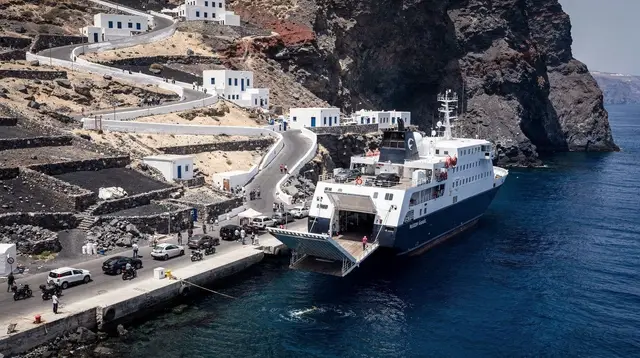
The other route is by ferry into Athinios, the island’s only working ferry port. This is the detail that catches people out: Athinios is not a town, it is a working harbour cut into the base of the caldera cliff, reached by a steep, winding switchback road with no train station, no left-luggage office, and a queue of taxis and buses every time a boat comes in. If you are arriving with luggage and no pre-booked transfer, expect a short wait and a walk uphill to where the vehicles gather. The port guide and the wider ferry guide go through timings and connections in more detail than belongs here.
Once you are on the island, taxis are scarce — there are only around thirty for the whole of Santorini — so booking ahead is the norm rather than a backup plan. The taxis and transfers guide covers what to expect and when to book.
How long to stay, and where to base yourself
This page will not repeat the day-by-day math; that lives on its own page, how many days in Santorini, which walks through what fits into two days versus a full week. As a rough first-time steer, three to five days lets you see the caldera villages properly, take one boat trip, and still have a slow beach day without racing the clock.
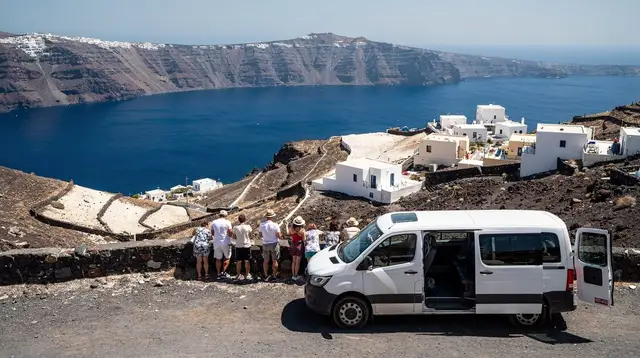
Where you sleep matters more here than on most islands, because the caldera villages and the beach towns are genuinely different trips. Fira is the capital, with the old port and cable car below it; Oia is the postcard end of the island and the busiest at sunset; Imerovigli and Firostefani sit quieter between the two, both perched on the same cliff. None of the caldera villages has direct beach access — the sand and pebble beaches are on the opposite, eastern side of the island, around Kamari and Perissa. The full comparison of where to stay is on where to stay in Santorini and, if it comes down to two names, Oia versus Fira.
When to come
Santorini has a real high season, real shoulder seasons, and a real winter, and each one changes what the island feels like. Rather than repeating the month-by-month detail here, the short version is: June through September is hot, dry, windy and full; late April, May and October are the best value for a first visit; and winter closes a large share of the caldera’s hotels, restaurants and boats. The complete breakdown, including the meltemi wind that can cancel boat trips in midsummer, is on best time to visit Santorini and Santorini weather month by month.
The villages you’ll actually walk through
A first visit tends to orbit a handful of places. Fira is the working capital, with the Museum of Prehistoric Thera, the old port below, and the cable car and the famous 588 steps connecting the two — a choice worth reading up on before you arrive with suitcases, on the page about the cable car and the steps. Oia is quieter by day and the busiest single spot on the island in the ninety minutes before sunset, when its castle ruin fills shoulder to shoulder. If that crowd doesn’t appeal, Imerovigli and Skaros Rock, a short walk from Oia, offer a similar view of the caldera without the queue.
Away from the cliff, the villages of the interior — Pyrgos, Megalochori, Emporio — see far fewer visitors and are worth an afternoon if the caldera towns start to feel crowded. And the beaches, on the east and south coasts around Kamari, Perissa and Perivolos, are a different island entirely: black volcanic sand that gets hot enough to need shoes by midday, and none of the cliffside views.
The volcano, the hot springs, and the Atlantis question
Santorini’s caldera is the result of one of the largest eruptions of the ancient world, and the volcano at its centre is not extinct, just quiet: its last eruption was in 1950. Boat trips out to Nea Kameni let you walk up the black cone on a short cinder path, and most continue on to Palea Kameni, where you swim rather than land, reaching iron-rich hot springs that stain light swimwear.
Neither stop involves visible lava — there is none to see, and no tour will show you any. The mechanics of how the caldera itself came to exist, and what is and isn’t still active, are explained on how the Santorini caldera was formed and the dedicated Nea Kameni volcano guide.
It’s worth being precise about one more thing: the idea that Santorini is the lost city of Atlantis is a hypothesis, not a fact. It was popularised in the twentieth century by writers connecting Plato’s account to the island’s Bronze Age eruption, and it remains an interesting theory rather than an established finding. The full story, and where the theory does and doesn’t hold up, is on Santorini and the Atlantis myth.
On the subject of the ground itself: in early 2025, a seismic swarm between Santorini and Amorgos produced tens of thousands of small tremors over about six weeks, prompted school closures and some departures, and then ended without an eruption. It is a real event worth knowing about before you travel, not a reason for alarm on a 2026 visit — the details are laid out plainly on Santorini safety and the 2025 earthquakes.
What’s actually worth booking on a first visit
Two things dominate what people come to Santorini to do: seeing the caldera from the water, and watching the sun go down over it. Both are better experienced on a boat than fought for on land. A relaxed way to ease into the island on arrival day, without committing to a long itinerary, is a gentle private walk designed for your first day on the island.
For the caldera itself, a day cruise around the volcano and hot springs covers Nea Kameni, Palea Kameni and usually Thirassia in one outing, while a sunset cruise along the caldera solves the Oia crowd problem entirely by watching the cliffs turn colour from the water instead of a viewpoint. If you’d rather have the boat to yourselves, there’s also a private yacht charter around the caldera. None of these need to be decided before you land — they’re worth booking a few days out once you’ve settled on your dates.
Wine is the other thing worth setting time aside for: the island’s Assyrtiko grape is grown in low, basket-shaped vines called kouloura, with no irrigation at all, relying on sea mist instead of rain. The full picture, including which wineries to visit, is on the wine tasting guide.
The practical odds and ends
A short list of things that trip up first-time visitors more than anything scenic:
| Situation | What to know |
|---|---|
| Paying at Nea Kameni | The landing fee is paid in cash, on the island, usually not included in the cruise price |
| Currency | Euro; cards work almost everywhere, but keep small cash for tavernas and entry fees |
| Getting around without a car | KTEL buses run from Fira to the main villages and beaches, cheap but crowded in season |
| Quad and scooter rental | A valid licence is checked and required; quad accidents are the leading cause of tourist injury on the island |
| Sunset in Oia | The castle viewpoint fills 90 minutes to two hours before sunset in high season |
None of this needs to be memorised before you land — it’s here so nothing on day one comes as a surprise.
First-time Santorini questions
Is Santorini the same as Thira?
Yes. Thira is the official Greek name and the name of the local municipality; Santorini is the Venetian name, from Saint Irene, and the one used internationally. Both appear on signs, ferries and maps, sometimes on the same page.
Can you drink the tap water in Santorini?
It is safe but not pleasant. The island has no river or usable groundwater, so tap water comes from desalination and tastes brackish. Locals and visitors alike drink bottled water, which is sold everywhere and cheaply.
How do you get from the ferry port to Fira or Oia?
Athinios port sits below the caldera cliff and is reached by a steep, winding road. There is no train station and no left-luggage office, so arrange a transfer, taxi or rental car in advance, or take the KTEL bus that meets arriving ferries.
Is the Atlantis story about Santorini true?
It is a popular hypothesis, not an established fact. Some researchers have linked the island’s Bronze Age eruption to Plato’s Atlantis, but no evidence confirms it, and the connection dates only from twentieth-century writing on the subject.
How many days should a first visit to Santorini last?
Most first-time visitors are comfortable with three to five days, enough for the caldera villages, a boat trip and a beach day without rushing. The full breakdown by day count lives on its own page, linked above.
Is Santorini dangerous because of the 2025 earthquakes?
No. A seismic swarm between Santorini and Amorgos in early 2025 caused disruption but no eruption, and it has since ended. It is worth knowing about, not worth being alarmed by.
Do the caldera villages have beaches?
No. Fira, Firostefani, Imerovigli and Oia sit on top of the caldera cliff with no direct sea access. The sand and pebble beaches are on the island’s east and south coasts, around Kamari, Perissa and Perivolos.
Trip-planning essentials on GetYourGuide
Verified deep-linked GetYourGuide tours. Book through these links and we earn a small commission at no cost to you.
GetYourGuide does not provide a product photo for this activity — the image shows the meeting point, photographed by us.