The Best Time to Visit Santorini
When is the best time to visit Santorini?
June to September is hottest, windiest, busiest, and most expensive. Late April, May, and October offer warm weather with far fewer crowds, though the sea is still cool in May. November to March is quiet, but many caldera hotels, restaurants, and boats close for the season.
Every guide to Santorini eventually runs into the same question: when should you actually go. The honest answer is that there is no single correct month, only a trade-off between heat, wind, crowds, and what stays open. This page lays out that trade-off in one place, so the choice gets made before a flight is booked rather than after.
Three Very Different Versions of the Same Island
Santorini in July and Santorini in January are close to two different destinations sharing one coastline. The island runs on three broad windows: a hot, windy, crowded high season from June to September; a shoulder season in April, May, and October that most repeat visitors quietly prefer; and a winter from November to March when a large share of the caldera’s hotels, restaurants, and boats close entirely. None of these is objectively “best” — each suits a different kind of trip, and the sections below go through what each one actually delivers.
For the month-by-month detail behind these three windows — average temperatures, sea conditions, daylight hours — see Santorini Weather, Month by Month. This page stays at the level of the decision itself: which window fits the trip you want.
High Season: June to September
This is when most of the world pictures Santorini — white walls against a deep blue sea, terraces packed for sunset, restaurants full past midnight. It is also the hottest, driest, windiest, and most expensive stretch of the year.
Daytime heat is dry and manageable for most travellers, especially with a midday break built in. The bigger friction is volume: The Santorini Caldera villages like Fira and Oia are busiest from roughly 10am to 5pm, when cruise-ship arrivals overlap with day-trippers from neighbouring islands. Santorini and Mykonos both apply a per-passenger cruise levy that peaks at €20 in summer specifically to manage this pressure, and a daily cap of 8,000 cruise passengers is in effect — useful context, but not something that changes what a visitor experiences on the ground on a busy day.
Wind is the other summer variable. The meltemi, a strong seasonal wind from the north, is most frequent and most forceful in July and August. It can cancel or reroute caldera cruises and boat excursions on short notice, so summer visitors who have a boat day at the top of their list should build in flexibility rather than a single fixed date. The mechanics of the wind itself are covered in The Meltemi Wind in Santorini, Explained.
What high season does deliver reliably: the warmest sea of the year, the longest daylight, the fullest calendar of restaurants and wineries open, and every boat operator running near-daily departures. For swimming, Perissa vs Kamari: Which Santorini Beach Should You Choose? and the island’s other black-sand beaches are at their best from June through September — sand that burns underfoot by midday, but water that is genuinely warm.
Shoulder Season: Late April, May, and October
Ask people who have visited more than once, and a large share will point to late April through May or September into October as the better trip. The trade is straightforward: slightly less certain weather in exchange for noticeably thinner crowds and lower prices.
May sits at an odd point in the calendar — air temperature is often already summer-like, but the sea is still cool from winter, since water warms more slowly than land. Travellers set on serious swimming may prefer to wait for June. October reverses that: the sea has spent all summer warming and is often more comfortable than in May, even as air temperatures start to ease.
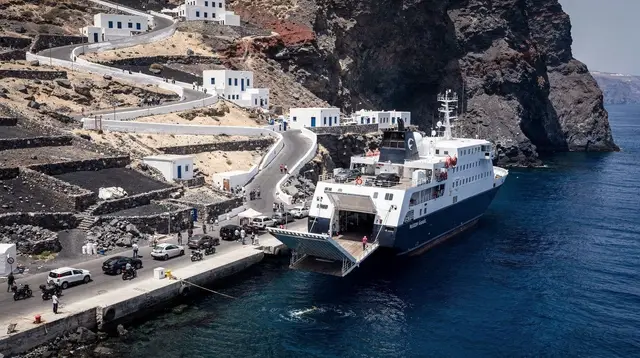
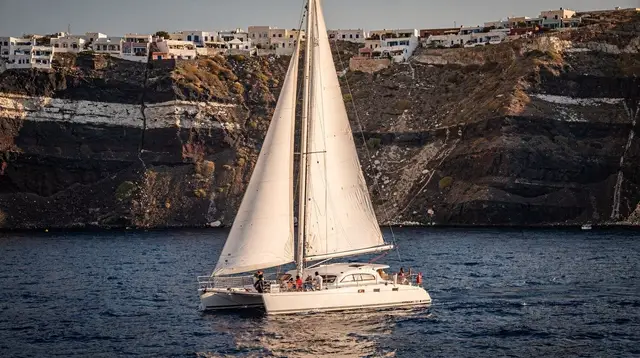
Both shoulder windows benefit from the meltemi being less frequent than in July and August, which makes caldera cruises and day trips to nearby islands more dependable — worth knowing if Island Hopping from Santorini: Which Cyclades Island to Choose or a sunset sail from the water is a priority. Villages are calmer, the The Fira to Oia Caldera Hike: Full Trail Guide is more comfortable without peak-summer heat, and hotel rates typically sit well below June-through-September levels. Almost everything that operates in high season is still open, which is the key difference from winter. For a closer look at this window specifically, see Santorini in the Shoulder Season: Late April, May and October.
Winter: November to March
Winter Santorini is not a quieter version of the same trip — it is a different one. A substantial share of hotels, restaurants, and the boats that run caldera cruises close from November until March, particularly around the cliffside villages. Ferry schedules thin out, and a caldera sunset cruise that runs several times a day in July might not run at all in January.
What remains is a genuinely calm island: near-empty lanes in oia and fira, low hotel prices, and a version of the caldera view without a single tour group in the frame. It suits travellers after atmosphere and a lower budget over swimming, boat trips, or a wide choice of open restaurants. It is not a fit for anyone whose trip depends on beach days or a caldera cruise. The specifics — what stays open, what to expect from the weather, how to plan around the closures — are covered in Santorini in Winter: What Actually Stays Open.
Season at a Glance
| Season | Months | Weather | Crowds | Prices | Best for |
|---|---|---|---|---|---|
| High season | June–September | Hot, dry, windiest | Heaviest, peak midday crowding | Highest of the year | Warm sea, full restaurant and boat calendar, nightlife |
| Shoulder season | Late April–May, October | Mild to warm; sea cool in May, mild in October | Noticeably lighter | Below high season | The best overall balance for most first-time visitors |
| Winter | November–March | Cool, rainy spells, quieter light | Lightest by far | Lowest of the year | Budget travel, quiet villages, photography without crowds |
Matching the Season to the Trip
Rather than asking for the single best month, it helps to ask what the trip is actually built around.
Chasing the caldera sunset and boat life. Late spring through early autumn keeps every operator running and the meltemi at its calmest outside peak summer. Shoulder-season months (May and October) usually offer the most reliable combination of open boats and manageable crowds; see Santorini Sunset Guide: Oia and Beyond for how to see it well in any season.
Wine and food. Grape harvest happens early on Santorini, often from late July into August, ahead of most of Europe — a detail worth knowing if visiting a working vineyard during harvest matters. Outside that narrow window, tastings run year-round; a wine-focused day works in any season.
a wine and olive oil tasting with a farm visit is one of the few Santorini experiences that holds up equally well whether it is booked for a June afternoon or an October one.
Diving and water sports. These depend directly on sea temperature and wind, which makes June through September the practical window; conditions before or after that are marginal for most visitors.
a guided diving tour is best booked for the warmer months, when both water temperature and visibility are at their most forgiving.
Budget-driven trips. Winter delivers the lowest prices outright, but with the most closures. For low prices with more of the island actually open, late April–May and October are the more practical budget window; see Santorini on a Budget: What It Actually Costs for what that trade-off looks like in real numbers.
A first, short trip. Anyone visiting once, for a few days, generally gets the best return from shoulder-season timing: warm enough weather, a full calendar of open restaurants and boats, and crowds that make Walking Fira’s Old Town: Caldera Rim to the Port and the caldera path actually pleasant rather than a shuffle. First Time in Santorini: What to Know Before You Go and How Many Days Do You Need in Santorini? cover the rest of that planning; One Week in Santorini Without Leaving the Archipelago lays out a full week’s structure once dates are set.
A trip that includes wider Cyclades exploration. Ferry connections to nearby islands run most reliably from late spring through early autumn, thinning noticeably in winter. If island-hopping is part of the plan, that narrows the realistic window toward April through October.
a half-day tour covering the island’s highlights works well as a first orientation in any season the boats and sites it covers are open, and a similar option, a guided sightseeing tour of the island’s key sights, suits travellers who prefer a slightly different pace or route through the same territory.
Arriving from Athens or Crete rather than flying direct. Ferry connections run year-round but are far more frequent from spring through autumn.
a day trip to Santorini from Athens is realistic mainly outside winter, when ferry timetables and boat excursions on the island itself are both running at full frequency.
A Note on the 2025 Earthquake Swarm
Between late January and March 2025, a seismic swarm affected the sea between Santorini and Amorgos, producing thousands of small tremors and prompting local precautionary measures. It did not lead to an eruption, and the swarm ended months before this page was reviewed. It has no bearing on choosing a season today — it belongs in the island’s recent history, not in a packing or booking decision. For a fuller account, Santorini Safety and the 2025 Earthquakes covers what happened and what it did and did not change.
What to Book Ahead, Whatever Season You Choose
High season sells out fastest — hotels with a caldera view, popular sunset cruises, and dinner reservations in Oia often need booking weeks or months ahead. Shoulder season gives more room to decide closer to the date, though the more popular boat trips and view-facing rooms still move quickly. Winter is the most forgiving for last-minute planning, largely because there is simply less running.
What to Book Ahead in Santorini (and What Sells Out First) goes through exactly what needs early action and what can wait. Where to Stay in Santorini: Caldera Villages or Beach Towns is worth reading before booking a room, since location matters more in Santorini than in most destinations — a caldera-view room in Oia during a windy week is a very different stay from the same room in June.
Choosing a Season in Santorini: Frequently Asked Questions
What is the single best month to visit Santorini?
Late September and early October are the most common answer: the sea has warmed all summer, the meltemi has usually eased, and the peak crowds of July and August have thinned. Late April and May are a close second, trading a slightly cooler sea for lower prices and even lighter crowds.
Is Santorini too hot in July and August?
It gets hot and dry, but the bigger issue is usually wind and crowding rather than heat alone. The meltemi can blow hard enough to cancel caldera cruises and boat trips, and Fira and Oia are busiest from mid-morning to late afternoon.
Is Santorini worth visiting in winter?
It is a genuinely different island rather than a lesser version of summer. Many hotels, restaurants, and cruise boats around the caldera close from November to March, so it suits travellers after quiet villages and low prices, not swimming or nightlife.
Is the sea warm enough to swim in May?
It is swimmable but still cool, since the Aegean lags behind air temperature. Most visitors find the water comfortable from June onward, with July through September the warmest window.
Does the 2025 earthquake swarm affect when I should visit now?
No. The seismic swarm between Santorini and Amorgos ran from late January into March 2025 and ended without an eruption; it is not a reason to avoid any current season. It is worth reading about for context, not for planning around.
When are flights and hotels cheapest?
Prices bottom out from November through March, when demand is lowest and many businesses are closed anyway. Among months when most things are actually open, late April, May, and October are noticeably cheaper than June through September.
Should I plan my trip around the meltemi wind?
It is worth knowing about rather than building a trip around, since it is strongest and most frequent in July and August but can appear in any warm month. If a caldera cruise or boat trip is a priority, building in a spare day gives room to reschedule around it.
Seasonal experiences on GetYourGuide
Verified deep-linked GetYourGuide tours. Book through these links and we earn a small commission at no cost to you.
GetYourGuide does not provide a product photo for this activity — the image shows the meeting point, photographed by us.