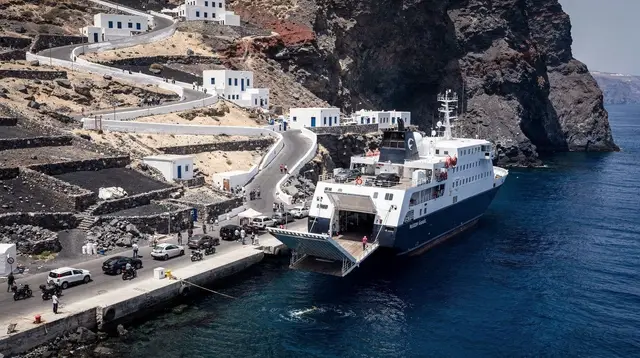
A crater you live on top of, not next to
Every terrace photo taken in Santorini looks down into the same thing: a flooded volcanic crater roughly 12 km long and 7 km wide, with an inner cliff that drops 250 to 300 metres straight to the water. That bowl is the caldera, and it is the reason the island looks nothing like its Cycladic neighbours. Villages such as Fira, Oia and Imerovigli sit on its rim; this page is about the bowl itself — how it was made, what’s still inside it, and how to see it properly instead of just photographing its edge.
The caldera is not a static ruin. Its centre holds two dark islets, Nea Kameni and Palea Kameni, which are the visible parts of a volcanic system that is still monitored today. Understanding the difference between “still active” and “erupting” matters here, because the two get confused constantly, including by tour operators trying to sell drama.
How the basin was made
The prevailing story is a single, catastrophic collapse: during the Late Bronze Age, a massive eruption emptied the magma chamber beneath the island fast enough that the ground above it caved in, swallowing what had been a more complete, roughly circular island. What was left is the crescent of Thira, the sliver of Thirassia across the water, and the small rock of Aspronisi — all fragments of the caldera’s rim.
The date of that eruption is genuinely unsettled. Radiocarbon evidence points to around 1600 BCE; conventional archaeological cross-dating with Egypt suggests closer to 1500 BCE. Neither side has fully convinced the other, so the honest answer is “around 1600 BCE, with the exact year still argued among specialists” — not a fixed date. For the fuller version of this story, including what the eruption did to the wider region, see how the Santorini caldera was formed.
The eruption is also tied to one of the island’s favourite pieces of folklore: the idea that Santorini is Atlantis. It’s a genuinely old and popular hypothesis, tracing 20th-century scholars who linked Plato’s account to a Bronze Age island catastrophe — but it remains speculation, not established history. Treat any confident claim otherwise as marketing. The dedicated page on Santorini and the Atlantis myth goes through the argument and its holes in more detail.
What the eruption buried is easier to date with certainty, because it left physical proof. At Akrotiri, a Minoan-era town was sealed under ash and pumice and excavated intact from 1967 onward, now protected under a bioclimatic roof. Strikingly, no human remains have been found there, suggesting residents had enough warning to leave before the worst of it. It sits south of the caldera proper and has its own page — this one stays focused on the crater and its water.
What’s actually still active
Here is the point most souvenir-shop t-shirts get wrong: there is no lava to see anywhere in the Santorini caldera today. The last eruption was in 1950, a modest event compared to the Bronze Age collapse, and before that the volcano was active in 1939-1941, 1925-1928 and 1707. “Active volcano” in this context means monitored and geologically alive, not currently erupting.
The visible evidence of that activity sits in the middle of the water:
- Nea Kameni is the younger, larger islet — a black cone built up by the post-Bronze Age eruptions, with a walkable crater rim reached by a roughly 30-minute path over cinder and ash. Boats stop here on almost every caldera cruise. There’s a landing fee, in the order of €5, paid in cash on the island — and it is very often not included in the price of the cruise ticket. That single detail causes more onboard confusion than anything else about the caldera. The full walkthrough is at the Nea Kameni volcano guide.
- Palea Kameni, the older islet, is where boats stop for swimming rather than walking — nobody lands here. Passengers jump straight from the boat into rust-coloured water heated by underwater vents. It’s warm, not hot, and iron-rich enough to permanently stain light-coloured swimwear; bring a suit you don’t mind discolouring. Details and what to expect are in the Palea Kameni hot springs guide.
- Aspronisi, the fourth remnant, is an uninhabited rock with no facilities and no scheduled landings — it’s part of the caldera’s story geologically, not part of anyone’s itinerary.
A five-hour sail that loops past both islets and mixes a crater walk with a swim in the hot springs is the standard way to see this side of the caldera in one outing — the Dreamcatcher 5 Hour Sailing Cruise in the Caldera covers exactly that route.
The 2025 earthquake swarm, briefly
Any page about Santorini’s geology has to address this honestly rather than avoid it. Starting on 27 January 2025, an earthquake swarm between Santorini and Amorgos lasted around forty days and produced more than 28,000 recorded tremors, some reaching magnitude 5.2. It triggered a local state of emergency, school closures, and a temporary departure of several thousand residents.
Published research since has attributed the swarm to a magma dyke intrusion rising from a deep reservoir — not a build-up toward eruption. Crucially, there was no eruption, and the swarm has ended. It’s worth knowing before you go, not worth losing sleep over; a fuller, calmer treatment sits at Santorini safety and the 2025 earthquakes.
Seeing the caldera from the water instead of the rim
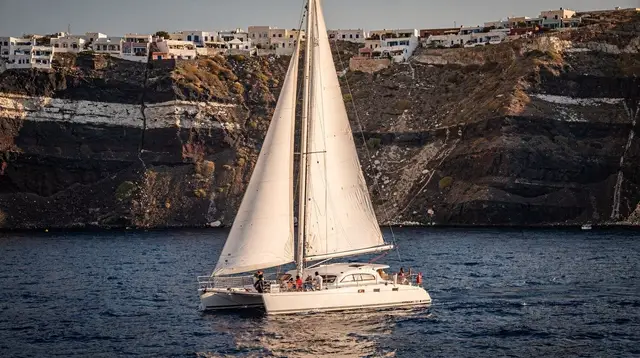
Every terrace in Fira, Imerovigli and Oia offers the same view pointed the same direction — down and across. A boat flips that: you look back up at the cliffs instead of down at the water, and it’s the only vantage point that shows the caldera’s actual scale, including the layers of solidified ash and lava in the cliff face that you can’t read from above.
Two boat styles dominate the market, and picking the wrong one for what you want is the most common regret:
| Boat type | Feel | Best for |
|---|---|---|
| Catamaran (larger, semi-private or shared) | Stable, social, usually includes a meal and open bar | Groups, first-timers, anyone prone to seasickness |
| Traditional sailing boat (smaller, like the Dreamcatcher) | Quieter, closer to the water, fewer passengers | Couples, photographers, people who want less crowd noise |
For a longer comparison of what each style actually delivers, see catamaran vs. sailing boat in Santorini and morning vs. sunset cruise. If you’d rather have the full run-down of every operator and route before choosing, the caldera cruise guide is the place to start.
If a catered, open-bar version suits your group better than a sailing boat, the Catamaran Cruise with Meal Open Bar covers the same islets with a different rhythm — more food and drink, fewer stops for photos mid-sail.
The sunset version
The caldera’s most photographed moment — the sun dropping behind the rim, with the cliffs of Oia and Imerovigli lit orange — is usually watched from a crowded clifftop. Watching it from the water instead means the cliffs themselves become the subject rather than the obstacle. The Dreamcatcher Sunset Sailing Cruise in the Caldera times its return specifically for this, and a shorter Santorini Sunset Tour exists for anyone who wants the same idea without a full afternoon commitment.
Sunset time swings a lot across the year — around 20:50 in late June, closer to 17:15 in late December — so check the actual time for your dates rather than assuming an “evening” slot works. For clifftop alternatives to the usual Oia crush, see Oia sunset without the crowds and best sunset spots beyond Oia; the general overview is at the Santorini sunset guide.
Reading the caldera from land
You don’t have to get on a boat to understand the geology, though it helps. The Fira-Oia caldera path runs along the rim for about 10.5 km, taking three to five hours on foot with no shade and real elevation change after Imerovigli — the paved stretch to Imerovigli is easy, what follows is a dirt path that demands water and a plan for the return leg, usually a bus or taxi rather than walking back. Along the way, the exposed rock in the cliff face — layered ash, pumice and solidified lava from different eruptions — is the clearest cross-section of the volcano’s history you’ll find anywhere on the island.
For a slower, more grounded read on the same subject, a wine tasting works surprisingly well: Santorini’s vines grow in volcanic ash with no irrigation, and a good host will explain the soil while you taste it in the glass. The Volcanic Wine Tasting the Athenian House Santorini pairs Assyrtiko with exactly that explanation, tying the caldera’s mineral floor to what ends up in the bottle.
If four wheels feel like too much and a boat feels like too little, a caldera-rim horseback ride is the third option worth knowing about, following clifftop paths rather than the water or the villages themselves — the Santorini Caldera Horseback Riding Tour with Guide covers that route with a guide.
Getting down to and around the caldera
The old port at the base of Fira’s cliff — separate from the ferry port at Athinios — is where most caldera cruises depart, and it only serves cruise-ship tenders and excursion boats, not scheduled ferries. Three ways down from Fira: the cable car (about 3 minutes, roughly 220 m of descent), the 588 stone steps, or by donkey.
Costs and comfort trade-offs are covered properly in the cable car and the 588 steps guide and the shorter comparison at cable car vs. steps vs. donkey — donkeys remain legal to ride, with a weight limit introduced in 2018, so this page won’t moralise about the choice, just note that walking or the cable car sidesteps the question entirely.
If you’re arriving on a cruise ship rather than staying on the island, most shore excursions to the caldera islets run on a tight clock — the caldera cruise guide and the broader one day in Santorini from a cruise ship guide both account for that constraint directly.
Frequently asked questions about the Santorini caldera
Is the Santorini caldera an active volcano?
Yes, in the geological sense — the system beneath Nea Kameni is monitored and considered active — but “active” doesn’t mean erupting. The last eruption was in 1950, and there is no visible lava anywhere in the caldera today.
Can you see lava in Santorini?
No. Any tour or listing implying you’ll see flowing or glowing lava is misleading — the volcano’s last eruption was in 1950, and what you actually see at Nea Kameni is a cooled, walkable crater of dark volcanic rock.
How was the Santorini caldera formed?
A massive eruption in the Late Bronze Age, generally placed around 1600 BCE though the exact date is still debated among researchers, emptied the underlying magma chamber and caused the centre of the island to collapse into the sea, leaving the crescent shape seen today.
Is it safe to visit the caldera after the 2025 earthquakes?
Yes. The 2025 swarm near Santorini and Amorgos lasted about forty days, produced tens of thousands of tremors, and has ended without any eruption; current research points to a deep magma intrusion rather than a build-up toward one.
What’s the difference between Nea Kameni and Palea Kameni?
Nea Kameni is the islet you walk on, up to its crater rim; Palea Kameni is the islet you swim next to, in warm, iron-rich water from underwater hot springs — you don’t land on Palea Kameni at all.
Do I need to pay extra to visit Nea Kameni’s crater?
Usually yes. A landing fee in the order of €5, paid in cash on the island, is common and often not included in the price of a caldera cruise ticket — check before you book.
Is the caldera the same thing as “Santorini”?
No. Santorini (Thira) is the whole crescent-shaped island; the caldera is the flooded volcanic basin at its centre, bordered by the island’s cliffside villages and containing the Kameni islets.
What’s the best way to see the caldera if I don’t want to swim or hike?
A caldera cruise is the easiest option that requires no exertion — most include the Nea Kameni landing and a stop near the Palea Kameni springs, and you can stay on board the whole time if you’d rather just watch from the deck.