Cable Car, Steps, or Donkey: Getting Up From Fira's Old Port
Should I take the cable car, walk the 588 steps, or ride a donkey up from Fira's old port?
The cable car is the fastest and most predictable option, taking about 3 minutes for a fare in the order of a few euros. The 588 steps are free but slow and steep, best attempted early or late in the day. Donkeys still operate legally, though a weight limit introduced in 2018 means not every rider is accepted.
Getting Up From the Old Port Isn’t Optional
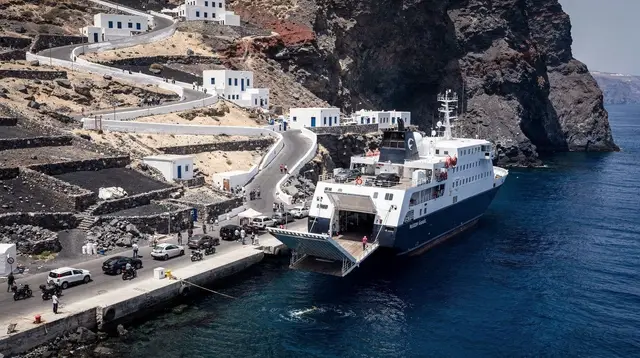
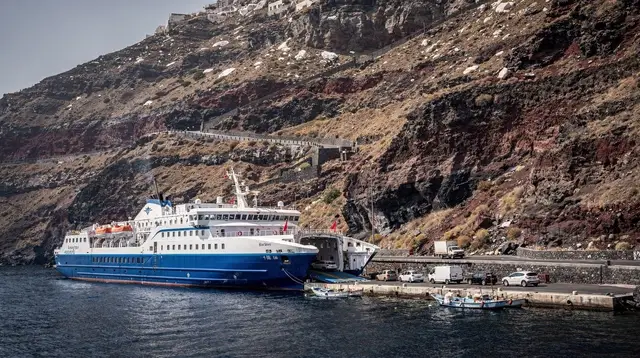
If your boat drops you at the old port of Fira — a tender from a cruise ship, a caldera cruise returning from Nea Kameni, or a small ferry from Thirassia — you are standing at sea level, and Fira itself sits roughly 220 metres above you on the clifftop. There is no road down to the water here, no gentle path, just a wall of switchbacks. Everyone who lands at Skala, as the old port is properly known, has exactly three ways to close that gap: the cable car, the 588 stone steps, or a donkey. This page compares the three head to head, for the specific situation of someone who has just come off a boat and needs to decide quickly.
This isn’t a guide to whether Santorini as a whole is accessible for mobility needs — that broader question, including alternatives to all three options here, is covered separately in our accessibility guide. And it isn’t about which village to base yourself in; if you’re weighing Oia against Fira for your stay, that comparison lives on its own page. This one is narrower and more practical: cable car, steps, or donkey, right now, at the old port.
The Three Ways Up, Side by Side
| Cable Car | 588 Steps | Donkey | |
|---|---|---|---|
| Time | About 3 minutes | 30–45 minutes | Roughly 20–25 minutes |
| Typical cost | Order of a few euros one way (varies by year) | Free | Similar order of magnitude to the cable car, sometimes more |
| Physical effort | None | Significant, especially in heat | Low, but not comfortable for everyone |
| Luggage | Yes, built for it | Difficult | Not practical |
| Queue risk | High on cruise days | Low | Moderate, fewer animals available at peak times |
| Best for | Cruise passengers on a schedule, anyone with bags | Travellers with time, good shoes, and no rush | Visitors who want the novelty and can manage the mount and dismount |
Treat every figure above as an order of magnitude rather than a fixed number. Fares and queue times both shift from one season, and one year, to the next.
The Cable Car: Fastest, Not Always Cheapest
The cable car runs the length of the cliff face in about three minutes, covering the 220-metre climb that would otherwise take the better part of an hour on foot. It’s the option built for exactly this situation: cruise passengers with limited time, anyone travelling with a wheeled suitcase, and visitors who simply don’t want to walk uphill in the sun.
The fare has moved around over the years and currently sits somewhere in the region of a handful of euros for a one-way trip — enough that it’s worth having small cash or a card ready at the kiosk, but not a figure we’ll pin down here, since it’s exactly the kind of number that goes stale between seasons. What doesn’t change is the trade-off: speed for a queue. On days when several cruise ships are anchored offshore, the line for the cable car can stretch well past the platform and take thirty minutes or more just to reach the cabin, even though the ride itself is over in a flash. If your tender back to the ship is on a fixed schedule, build that possible wait into your plan rather than assuming three minutes covers the whole transaction.
The cable car operates in both directions, so it’s just as useful coming down from Fira to catch a boat as it is going up. If you’re heading out on a caldera cruise or a sunset sail, this is normally the way you’ll reach the water in the first place.
a full-day cruise around the caldera is one of the more popular reasons visitors end up riding the cable car down to Skala in the morning and back up again in the late afternoon, so it’s worth timing your ride around the boat’s own departure and return windows rather than the other way round.
The 588 Steps: Free, Slow, and Shared With Donkeys
The stone staircase connecting the old port to Fira has exactly 588 steps, built long before any mechanical alternative existed, and it remains free to use at any hour. For travellers who enjoy the climb, or who simply refuse to pay for a three-minute ride, it’s a legitimate option — but go in with realistic expectations. Most people need somewhere between 30 and 45 minutes to reach the top, more in the midday heat, and the path is steep, uneven, and worn smooth in places by generations of foot and hoof traffic.
That last detail matters: the steps are shared with the donkeys, which means droppings, flies, and a strong smell in patches, particularly lower down near the port. Sturdy, closed shoes are far more useful here than sandals. If you’re doing this for the experience rather than out of necessity, early morning or the couple of hours before sunset are noticeably more pleasant than midday, when the stone radiates heat and the crowd of ships’ passengers is thickest.
The steps are a one-way decision in practice — walking down is easier on the legs than walking up, so if you have a choice about which direction to tackle on foot, save the walking for your descent from Fira rather than your climb up from a tender. This is a different climb entirely from the longer Fira-to-Oia caldera path, which runs along the clifftop rather than up it — don’t confuse the two when planning your day.
The Donkey Ride: What’s True and What Isn’t
Riding a donkey or mule up from the port is one of the oldest images associated with Santorini, and it’s still available today — there is no ban on the practice, despite what you may read online. What did change is a weight limit introduced in 2018, brought in specifically to protect the animals from being overloaded on a climb that is genuinely steep and repeated many times a day in high season.
Riders above that limit will be turned away at the mounting point rather than refused in advance, which can be an awkward surprise if you’ve arrived expecting a straightforward transaction. Discussion of further welfare rules for the animals has continued into more recent seasons, so policies at the port can be stricter than they were a few years ago.
Beyond the weight question, a donkey ride is simply not the most comfortable or fastest option for most visitors. The mount and dismount take a moment of coordination on a narrow, sloped path, the pace is roughly on par with a brisk uphill walk, and animals are not always available in the numbers needed when several ships arrive at once. We’re not going to tell you whether to ride one — that’s a personal call, and plenty of travellers do it every day without issue — but we’d rather you know the facts (a real, published weight limit; no outright ban; possible unavailability at busy times) than arrive assuming either that it’s forbidden or that it’s guaranteed.
Which One Should You Actually Pick If You’re Off a Cruise Ship
If your tender back to the ship runs on a fixed schedule, the cable car is the safer default. Its ride time is short and predictable even if the queue occasionally isn’t, and it’s the only one of the three that comfortably handles a day bag, a camera, or a rolled-up jacket picked up against the wind. Passengers on a tight shore excursion — a quick loop through Fira and back, or a half-day out to Oia — generally do better allowing extra time for a possible cable car queue than gambling on the steps being faster.
If you’re not on a clock, the steps are the option that costs nothing and lets you set your own pace, and they double as a mild workout with a view that keeps improving as you climb. Just don’t attempt them for the first time laden with luggage, in flip-flops, or at 1pm in August.
The donkey sits in between: not the fastest, not the cheapest, but the one visitors choose for the experience itself rather than for efficiency. If that’s your reason for being here, go in knowing about the weight limit and the possibility that animals may already be spoken for on a busy morning.
Timing It Around Your Excursion
Most people reading this are trying to solve a scheduling problem, not just a transport one: how to get up to town, do something worthwhile, and get back down before a boat leaves. A short list of what tends to fit that window well:
- A quick coffee and photo stop in Fira or nearby Firostefani, both an easy walk from the top cable car station.
- a guided tour of the island’s best-known viewpoints, useful if you want the highlights covered without working out logistics yourself.
- A shore excursion booked in advance, which typically includes transport from the port itself and removes the cable car queue from your own planning entirely.
If your ship docks and you’re heading straight into a pre-booked outing, check whether your excursion already includes the climb — many do, since operators know exactly how bad the queue can get on a multi-ship day. Visitors travelling independently from Crete or the mainland sometimes structure their whole day around the port here, whether that’s a full day trip over from Heraklion or a day trip out from Athens, and for both, knowing which of the three climbs suits your return time is worth settling before you land.
Beyond the Old Port: Other Ways to See the Caldera
Not every visit to Santorini’s clifftop starts at Skala. If you’re staying overnight rather than passing through on a ship, you’ll likely arrive in Fira or Oia by road from the airport or the ferry port at Athinios, in which case none of this applies to your arrival — the cable car, steps, and donkeys matter specifically for the old port connection. Where they become relevant again is any time you head down to the water: boarding a sunset cruise along the caldera, joining a boat out to the volcanic islets, or simply wanting to see Fira from sea level for the photograph everyone eventually takes.
Whichever way up you choose, remember that the choice cuts both ways: the option you skip on the way up is often the best one to take on the way down, once time pressure has eased and the light is better for photos over the caldera.
FAQ: Cable Car, Steps and Donkeys in Santorini
Is the cable car the only way up from the old port?
No. You can also walk the 588 steps on foot, or ride a donkey. The cable car is simply the fastest and least physically demanding of the three.
How much does the Santorini cable car cost?
Fares have moved from year to year and sit roughly in the region of a handful of euros one way. Treat any number you see online as an estimate rather than a fixed price, and expect to pay in cash or by card at the old port kiosk on the day.
How long does it take to walk the 588 steps?
Most visitors need somewhere between 30 and 45 minutes going up, longer in midday heat or if you stop for photos. The steps are steep, uneven in places, and shared with donkeys, so sturdy shoes matter more than speed.
Are donkeys banned in Santorini?
No. There is no ban on donkey rides. A weight limit was introduced in 2018 to protect the animals, and welfare rules have continued to be discussed for later seasons, but riding itself remains legal and widely available.
What happens if the cable car queue is too long?
On heavy cruise days, the queue for the cable car can run well past thirty minutes at peak hours. If your ship’s tender schedule is tight, the steps are often faster in practice than waiting in line, even if walking takes longer once you start.
Can I bring luggage up or down on the cable car?
Yes, and this is exactly what it is built for. Anyone arriving with a wheeled suitcase or heavy bag should use the cable car rather than the steps or a donkey, both of which are impractical with luggage.
Which option is best if I only have a few hours in Santorini?
For cruise passengers on a tight tender schedule, the cable car is the safest choice because its timing is predictable. Save the steps for a leisurely descent later, once you are not racing a departure time.
Popular Santorini experiences on GetYourGuide
Verified deep-linked GetYourGuide tours. Book through these links and we earn a small commission at no cost to you.
GetYourGuide does not provide a product photo for this activity — the image shows the meeting point, photographed by us.