Skala, the harbour under the cliff
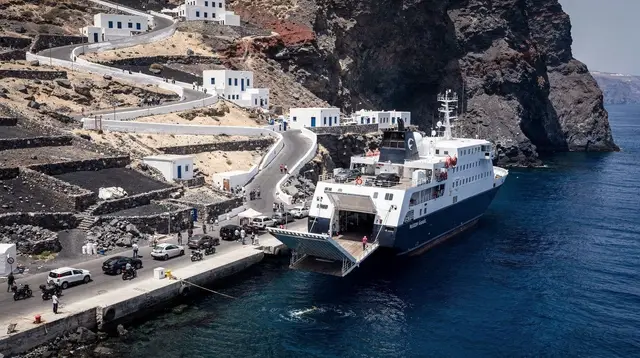
Fira Old Port is not a resort marina and it is not the island’s ferry gateway. It is a narrow strip of concrete and rock at the base of the caldera cliff, known to locals as Skala, where tender boats from anchored cruise ships and small excursion craft pull in and out all day in high season. Above it, some 220 m up a near-vertical wall of pumice and ash, sits Fira itself, the island’s capital. There is no road connecting the two directly; whatever comes ashore at Skala has to be carried, walked or ridden up the cliff.
This is a different place from Ammoudi Bay, the similarly small harbour below Oia at the island’s northern tip, and it has nothing to do with Ormos Athinios, the island’s one and only ferry port a few kilometres to the south. Confusing the three is the single most common mistake first-time visitors make when planning how they will arrive. If you are booking a ferry ticket, you want Athinios. If you are stepping off a cruise-ship tender or an excursion boat, you want the Old Port, and this page is about that port and the climb above it.
Why cruise ships stop offshore at all
Santorini’s caldera is a flooded volcanic crater roughly 12 km by 7 km, with the sea floor dropping away steeply just off the cliff. There is no deep-water quay for large cruise ships to dock alongside, so vessels anchor out in open water and ferry passengers to shore in tenders. Those tenders land at the Old Port, which means every cruise passenger’s day in Santorini begins with the same decision: how to get from sea level up to the villages along the Santorini caldera rim.
A cap of 8,000 cruise passengers per day now applies across the island, and a cruise levy of the order of €20 per passenger in peak summer (lower outside June-September) is collected by the cruise line rather than at the port itself. Neither of those changes anything about the physical climb from Skala, but they do explain why some days at the port feel far busier than others: the cap smooths out the worst of the crowding compared to a few years ago, though a single large ship in port can still fill the lower station’s queue for the better part of an hour.
Three ways up, one climb
However you plan to spend your time in Fira, Firostefani or Oia, your day starts here, at the bottom of the cliff. There are three ways to make the ascent, and each has a real trade-off.
| Method | Time | Effort | Notes |
|---|---|---|---|
| Cable car | About 3 minutes | Low | Fastest option; queues build fast when ships are in |
| 588 steps | 20-40 minutes | High | No shade, uneven stone, shared with donkeys |
| Donkey | 15-20 minutes | Low physical effort | Weight limit applies; not everyone’s preference |
The cable car
The cable car is the practical choice for most people, and especially for anyone with luggage, mobility concerns, small children, or simply limited time before their ship’s return deadline. The ride itself takes roughly three minutes to cover about 220 m of elevation, and cabins run at short, regular intervals rather than on a fixed timetable. Luggage is charged separately from passengers, and cash or card is generally accepted at the lower station, though exact pricing is reviewed locally from time to time.
Do not plan around a specific fare you have seen quoted online; check on the day, and add a buffer for the wait rather than the ride, since the queue at the base is almost always the longer part of the experience. Our cable car and 588 steps guide breaks down queue patterns by time of day in more detail.
The 588 steps
Walking up (or down) is free, and it is a real Santorini experience in its own right: a switchback stone stairway cut into the cliff face, worn smooth by more than a century of foot and hoof traffic. It has almost no shade, the stone can be slippery when wet or dusted with loose grit, and you will be sharing the path with donkeys and their handlers, which means watching your footing for more than just the steps themselves.
In cooler shoulder-season weather it is a manageable, even enjoyable, 20 to 30 minute walk with views back over the harbour and the tankers at anchor. In the full heat of a July or August afternoon, it is genuinely hard going, and not something to attempt without water and reasonable fitness. Photographers tend to like this option for the switchback shot looking down at the port and the moored boats below.
The donkeys
Riding a donkey up from Skala is the option most associated with Santorini in old postcards, and it still operates today. There is no ban on the practice, contrary to a claim that circulates online from time to time. What does exist is a weight limit for riders, introduced in 2018, and a further tightening of animal-welfare rules was under discussion for the 2026 season, so the specifics may continue to evolve. If riding an animal for a tourist photo does not sit well with you, the honest answer is simply to take the cable car or walk; neither requires justifying your choice to anyone, and both get you to exactly the same place.
Timing your arrival
The single most useful thing to know about Fira Old Port is that its crowding follows the cruise schedule, not the clock. On days when two or three ships are anchored in the caldera at once, the lower cable car station can back up for the better part of an hour around mid-morning, as hundreds of passengers land within a short window. Excursion-boat passengers on a caldera cruise or a morning sailing tend to move through in smaller, steadier waves, which is one reason boat-based days here are usually less frustrating than a big-ship tender queue.
If your schedule allows any flexibility, the calmest windows are the first cable car runs of the morning, before the main tender wave lands, and the return crossing in the late afternoon once day-trip groups have started heading back to their ships. The same logic that applies to Fira and Oia up on the rim, where the busiest hours run roughly from 10am to 5pm on high-traffic days, applies here in reverse: the port is at its worst exactly when the villages above are also at their worst.
What is actually down at the port
Skala itself is a working harbour, not a destination to linger at. There are a handful of tavernas and cafés built into the cliff face near the lower cable car station, useful for a coffee or a cold drink while waiting out a queue, plus ticket kiosks for boat trips and the odd shop selling sun hats and sunscreen to passengers who arrived unprepared. There is no beach here and no swimming platform; if a swim is part of your plan, that happens later, out on the water, not at the port itself. There is also no left-luggage office, which matters more than it sounds: anyone arriving with a rolling suitcase should budget for the cable car’s luggage fare rather than attempting the steps or a donkey while managing bags.
Boat trips that leave from Skala
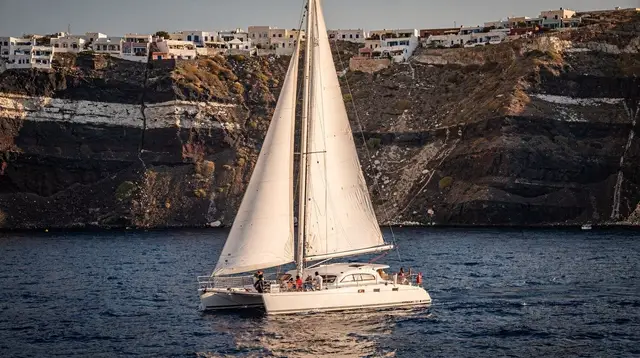
Because it sits directly beneath Fira, the Old Port is also the departure point for a number of the caldera’s boat trips, which makes it worth knowing even if you are not arriving by cruise ship. A morning cruise departing from the Old Port of Fira typically combines a swim stop, a look at the volcanic islets and views back up at the cliff from the water, one of the better ways to see the caldera without fighting for a spot on a clifftop terrace.
In the evening, a private sunset sailing from the Old Port gives the same water-level perspective on the Santorini sunset that so many people instead try to catch from a packed viewpoint in Oia.
For visitors arriving with only a single day on the island, whether by cruise or otherwise, a cruise-friendly tour covering Pyrgos, Oia and Fira is built around exactly this port-to-village logistics problem, timing the group’s ascent to avoid the worst of the queue. If you would rather start the day before the crowds arrive, a private sunrise tour from Fira taking in Oia village gets you up and out while the cable car and the steps are both still quiet.
Fira Old Port versus Athinios and Ammoudi
It is worth being precise about which port does what, because the three are easy to mix up when planning transport. Ormos Athinios is the island’s only ferry port, reached by road, serving Piraeus, Crete, Rhodes and the other Cyclades; our Athinios port guide covers it in full. Ammoudi Bay, beneath Oia at the island’s northern end, is a small fishing harbour with a handful of seafood tavernas and its own separate staircase, unrelated to Fira’s cable car and steps.
Fira Old Port, Skala, sits in between the two geographically and serves neither ferries nor Oia; it exists purely for cruise tenders and Fira-based excursion boats. Our broader Santorini cruise port guide and best shore excursions from Santorini round out the picture for anyone arriving by ship for a single day, alongside a one-day cruise itinerary built around the same port-to-cliff logistics.
Practical notes for the climb
A few points are worth carrying with you rather than working out on the spot. Cash is useful at the lower cable car station and for tipping a donkey handler, even though cards are increasingly accepted. Footwear matters more than most visitors expect: the steps are uneven stone, not a paved path, and flip-flops make for an uncomfortable and occasionally risky descent.
Anyone with limited mobility, young children in a stroller, or simply a full suitcase should treat the cable car as the only realistic option rather than a preference. Independent taxis and transfers can meet you at the top of the cable car in Fira, but none operate down at the port itself, since there is no vehicle road connecting the two.
For anyone who enjoys the human geography of a place as much as the view, our long read on the 588 steps and a companion piece on the donkeys of Fira both go into the port’s daily rhythm in more depth than a practical guide allows, including the debates around animal welfare that occasionally surface in the local press.
Frequently asked questions about Fira Old Port
Is Fira Old Port the same as the cruise port?
For tender operations, yes. Large cruise ships anchor offshore in the caldera and send passengers in on tenders that dock at the Old Port (Skala), directly below Fira. Ferries to Athens, Crete and the other Cyclades use a different port entirely, Athinios, a few kilometres south.
How much does the Fira cable car cost?
Prices are set locally and revised from year to year, generally somewhere in the region of a few euros each way, with a separate lower fare for luggage. Treat any figure you read, including here, as an order of magnitude rather than a fixed price, and expect to pay in cash or by card at the lower station.
How long does the cable car take?
About three minutes for roughly 220 m of elevation. The queue at busy times, especially when several ships are in port at once, usually takes far longer than the ride itself.
How hard are the 588 steps?
It is a steep, uneven stone stairway shared with donkeys and their droppings, with almost no shade. Fit walkers manage it in 20-30 minutes going up; going down is faster but harder on the knees. In midday heat it is genuinely tough.
Are donkeys still allowed to carry passengers up from the port?
Yes, there is no ban. A weight limit for riders was introduced in 2018, and further animal-welfare rules were under discussion for the 2026 season, so specifics can change. If you would rather not ride, walking or taking the cable car avoids the question entirely.
Is there a swimming or luggage option at the port?
The Old Port is a working harbour with tavernas and boat operators, not a beach, and it has no left-luggage service. Anyone with a suitcase should budget for the cable car’s luggage fare rather than attempt the steps or a donkey with bags.
Can I catch a ferry from Fira Old Port?
No. All ferries to Piraeus, the other Cyclades, Crete and Rhodes use Athinios, Santorini’s single ferry port, reached by road rather than by cable car. Fira Old Port only serves cruise tenders and excursion or cruise boats.
What boat trips actually leave from here?
Caldera cruises, sunset sailings, private sunrise charters and some day tours to Nea Kameni and Thirassia depart from the Old Port, since it sits right beneath Fira. Search results for Santorini boat trips will show several options that name Skala or the Old Port as their departure point.