The Donkeys of Fira
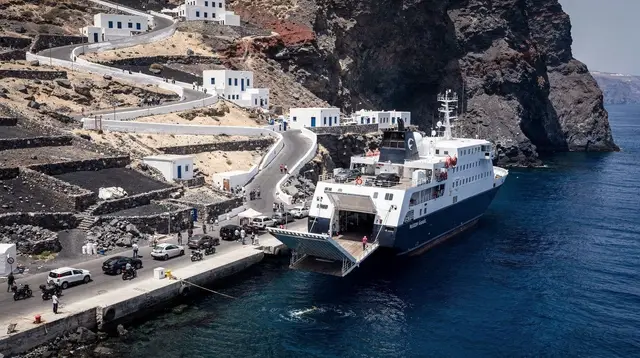
I’ve stood at the bottom of the old port in Fira more times than I can count, watching the same scene play out. A cruise tender pulls in, passengers spill onto the quay, and within a minute someone is pointing up at the switchback path clinging to the cliff, asking the question that every first-time visitor to Santorini eventually asks: do we walk, do we wait for the cable car, or do we ride one of the donkeys standing patiently in the shade with their handlers.
What I want to say here isn’t a verdict. It’s a correction, and then an opinion built on top of it.
The correction first, because it matters: there is no ban on donkeys in Santorini. I see this claimed constantly, in comment sections and in half-remembered headlines, and it simply isn’t true. What did happen is narrower and less dramatic. In 2018, after years of documented cases of animals being overloaded on the steep path up from Fira old port, a weight limit for riders was introduced. That’s a real, specific, verifiable rule — not a ban, a limit.
And going into the 2026 season, a further tightening of animal-welfare regulation for working animals was reportedly under discussion, though as far as I can establish it had not been finalised or enacted by the time I’m writing this. Two different facts, neither of which is “donkeys are banned,” and conflating them does nobody any favours — not the animals, not the handlers whose livelihood depends on this route, and not the traveller trying to make an informed choice.
I think that distinction is worth defending, and not just out of pedantry. When people repeat an inaccurate, sweeping claim — a ban that doesn’t exist — it lets everyone off the hook from engaging with the actual, narrower, harder question: under what conditions is it acceptable to ride a working animal up a path that a thousand tourists take on a busy morning. That’s a real debate. “Are they banned or not” isn’t.
What I actually think about the donkeys
Here’s where I’ll go further than most guides are willing to. I don’t think this site’s job is to tell you whether riding a donkey up from Skala is ethical. I’ve read compelling arguments on both sides, from people who’ve spent far more time on this island than I have, and I don’t think the honest answer is a clean one.
What I do think is that most of the outrage aimed at tourists who ride the donkeys, and most of the defensiveness from people who do, skips past the actual regulatory history in favour of a simpler story. The 2018 weight limit exists because there was a documented problem. The 2026 discussion exists because that problem, evidently, wasn’t considered fully solved. Neither fact tells you what to do on the day. Both are more useful than a slogan.
If you’re uneasy about it — and a lot of visitors are, which is exactly why this keeps coming up — you have a straightforward way out that doesn’t require having an opinion at all: don’t take a donkey. The cable car runs the same route in a few minutes, and the 588 steps are walkable by most people who aren’t pressed for time or carrying heavy luggage.
Full detail on both, including what the walk down actually feels like underfoot in the midday sun, is on our Santorini cable car and the 588 steps guide, and I’ve put a direct comparison of all three options together on cable car vs steps vs donkey if you want it laid out side by side.
But I want to be honest about what that choice is. Walking or riding the cable car doesn’t resolve the welfare question — it just removes you from it personally. That’s a perfectly reasonable thing to want. It is not the same as having settled the argument, and I get uncomfortable when I see it presented that way, as if opting out were itself the ethical stance rather than simply the path of least involvement. If you do take a donkey and the animal is visibly well cared for, alert, unhurried, that’s worth noticing too — not every working animal on this route is in distress, and treating them all as identically mistreated erases the handlers who take the rules seriously.
Why this keeps surfacing every season
Part of why the donkeys of Fira generate so much noise is that they’re one of the few visibly “old” things left on a route that’s otherwise been reshaped entirely around cruise arrivals and cable car queues. Fira itself has changed enormously as a working town — walk a block back from the caldera edge into the old town lanes and you’ll still find shops that have nothing to do with excursions, but the port road is pure tourism infrastructure now, animals included.
There’s something almost quaint about an argument over pack animals happening on an island whose bigger, quieter transformation — cruise levies, an 8,000-person daily cap, entire villages restructured around timing a sunset photo — barely makes it into the same conversation.
I’d rather you leave this island having thought about both. If you want the wider village context beyond Fira’s port road, our Santorini villages guide is a decent starting point, and if you’re weighing the caldera on foot more broadly, the Fira to Oia hike covers the walking alternative to almost everything on this stretch of coast, including Imerovigli and the climb past Skaros Rock. Further along the ridge, Pyrgos has its own quieter version of this same old-island-meets-new-tourism tension, worth a look in our Pyrgos village guide.
If your time on the island is short and the port climb is one decision among a dozen you’re making at once, our first-time in Santorini guide covers the rest of that list. And if what you actually want, once you’re up the cliff, is simply to see Fira properly rather than rush through it toward a bus, a walking tour of Fira with a wine tasting stop is a gentler way to spend the afternoon than debating a donkey at the bottom of the steps.
For those arriving or leaving by water rather than cliff path, a morning cruise departing from the old port or a private sunset departure from the old port sidesteps the climb question in the other direction entirely — you’re already at sea level, looking up at the whole argument instead of standing in the middle of it.
None of this is a call to arms. I just think the facts are more interesting, and more useful, than the shorthand — and that “no ban, a 2018 limit, a 2026 debate” gets you further than either outrage or denial ever will.
Frequently asked: the donkeys, the ban that isn’t, and the alternatives
Are the Santorini donkeys illegal or banned?
No. There is no ban on donkey rides between Fira’s old port and the clifftop. A weight limit for riders was introduced in 2018, and stricter animal-welfare rules were being discussed for the 2026 season, but no ban has been enacted.
How do I get from the old port up to Fira without a donkey?
You can take the cable car or walk the 588 steps. Both routes are covered in detail, including timing and what to expect underfoot, on our Fira old port guide.
Is it cruel to ride a donkey in Santorini?
Opinions differ sharply, and I don’t think a travel article should settle that for you. What’s true is that a 2018 weight limit exists precisely because the animals were being overloaded, and that welfare rules have kept tightening since.
What is the weight limit for donkey riders in Santorini?
A weight limit for riders was introduced in 2018 after years of concern about overloading. I’m not going to print a number here, because these limits get revised and a stale figure printed as current does more harm than no figure at all — ask at the point of boarding.
Why do some travellers avoid the donkeys entirely?
Some avoid them on welfare grounds, others simply prefer the view from the steps or the three-minute cable car ride. Both are legitimate reasons, and neither requires judging the people who choose differently.
Is the cable car or the steps better than a donkey ride?
They’re different experiences, not a moral upgrade. The cable car is fast and shaded from the climb itself; the steps are slower and let you look back at the caldera. Details on both are on our cable car and 588 steps guide.
tours.Opinion
Verified deep-linked GetYourGuide tours. Book through these links and we earn a small commission at no cost to you.
GetYourGuide does not provide a product photo for this activity — the image shows the meeting point, photographed by us.