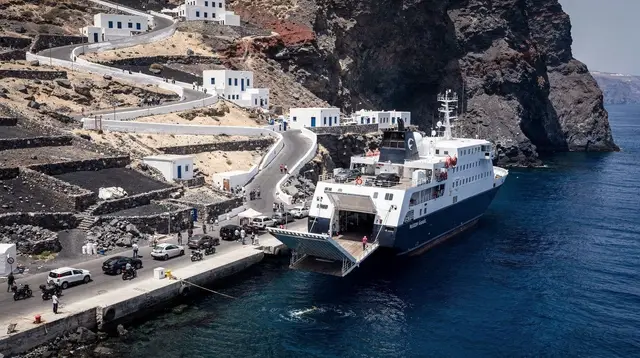
Most visitors who want a caldera view without a ticket, a table reservation, or a crowd end up walking the same short stretch of path below Imerovigli, out to a dark wedge of rock called Skaros. There is nothing to buy here and nothing to queue for. What there is: a clean drop into the caldera, the whitewashed rooftops of Imerovigli curling above you, and — if you time it right — a sunset that rivals Oia without a single tour bus involved.
A rock, not a ruin — what’s actually left of Skaros
Skaros looks, from a distance, like the natural fortress it once was made into. For several centuries a Venetian-built kastro stood on top of it, and for a stretch of that time Skaros served as Santorini’s fortified capital and the seat of the island’s Catholic bishopric — a genuinely important place, chosen precisely because the rock was so hard to attack. That history is real. What is not real, and worth saying plainly before you plan a visit, is that any of it still stands.
Centuries of earthquakes, culminating in the severe one that struck the wider region in 1956, brought the walls down piece by piece, and what tumbled was never rebuilt. Today Skaros is bare volcanic rock, scoured by wind and studded with the low scrub that survives on this side of the island. You are not walking to a castle. You are walking to the site of one, and to the view that made it worth defending.
That distinction matters because a fair number of visitors arrive expecting arches, a keep, something to climb through. There is none of that. What Skaros offers instead is uncluttered: a promontory jutting into the caldera with almost nothing built on it, which is exactly why the view from its base and from the path along its edge feels so open. No walls, no railings, no gift shop — just the rock, the water more than 300 metres below, and the arc of the caldera curving away toward Oia in one direction and Fira in the other.
Where Skaros sits, and why it isn’t Imerovigli
Skaros Rock is a headland of the caldera rim, reached from Imerovigli, the quiet cliff-top village that sits between Firostefani and Oia along the The Santorini Caldera coastline. If you are looking for a broader introduction to the village itself — where to stay, where to eat, its own smaller viewpoints — that belongs on the Imerovigli guide, not here. This page is only about the rock: the walk out to it, what you find when you arrive, and how to use it well.
It is also worth separating Skaros from the longer Fira to Oia caldera path, which passes near the top of the Skaros headland on its way north. That hike is a multi-hour undertaking between two towns. The walk to Skaros is a short detour off it, doable in trainers in under half an hour each way, and it ends at the rock rather than continuing on to Oia. Treat Skaros as a destination in its own right, not a waypoint you happen to pass.
Walking to Skaros Rock from Imerovigli
The path begins in Imerovigli itself, near the whitewashed chapel of Agios Nikolaos, and drops gently along the caldera rim before curving out onto the neck of the promontory. It is one of the easiest stretches of caldera walking on the island: no steps to speak of, a mostly even surface, and views that open up almost immediately rather than after a long climb. Most people cover it in 20 to 30 minutes at an unhurried pace, camera stops included.
The last few minutes narrow as the path follows the spine of the rock itself, with a real drop on either side. It is not a technical scramble and does not require special footwear beyond something with grip, but it is not a place for flip-flops, for young children left to wander, or for anyone uneasy with heights and unfenced edges. There is no barrier at the top — that absence of infrastructure is part of what keeps the crowd thin, but it also means the usual caldera-edge caution applies here more than almost anywhere else on the island.
| Stage | Distance / time | Terrain |
|---|---|---|
| Imerovigli to the base of Skaros | 10–15 minutes | Paved lane, then packed dirt path |
| Along the neck of the promontory | 5–10 minutes | Narrow rock path, real drops either side |
| Time at the viewpoint | As long as you like | Flat rock, no shade |
Bring water, especially outside the cooler months — there is no shade anywhere on the rock and no kiosk at the end of it. That is also true of every other caldera-edge walk on the island; see the broader hiking beyond the caldera path guide if Skaros is your appetiser for a longer walk another day.
Skaros at sunset, without the Oia crowds
Skaros exists on most itineraries because of one thing: it delivers a sunset view that competes with Oia’s famous kastro without the crush of people that has made Oia’s sunset hour a logistical exercise in itself. Where the Byzantine kastro in Oia fills up 90 minutes to two hours before sunset in high season, Skaros rarely does. There is more rock to spread out on, fewer people who know about it, and no single “best spot” that everyone converges on.
The trade-off is honest rather than perfect: Skaros looks across the caldera rather than framing the sun setting directly behind Oia’s own silhouette, which is the specific composition that made Oia famous. What you get instead is a wide, uncluttered view of the caldera itself — the water, the cliffs, the far rim — with the sun dropping somewhere over the sea beyond Thirassia.
For photographers this is often the better deal: a clean frame instead of a wall of raised phones. For a broader survey of where else to watch the sun go down, see sunset spots beyond Oia and Oia sunset without the crowds, both of which cover Skaros alongside Firostefani, Pyrgos, and the option of watching from the water instead of the land.
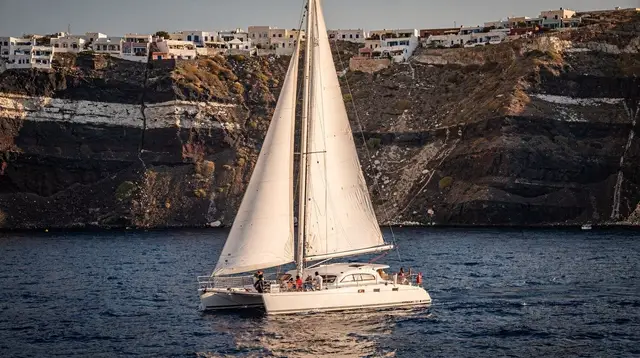
That last option is worth taking seriously. A catamaran sunset cruise along the caldera puts you on the water looking back up at Skaros and Imerovigli rather than standing on the rock looking out — a genuinely different, equally valid way to see this same stretch of coastline, and one that removes the crowd question entirely. A more private version of the same idea is a smaller private sunset boat trip, worth it if you’d rather not share the deck with strangers.
Seeing Skaros from below
Skaros looks different again from sea level. Boats running the classic caldera route pass directly beneath the promontory, and from the water you can actually make out the shape of the rock the fortress once occupied — something that is harder to appreciate from on top of it.
A morning caldera cruise takes this route earlier in the day, before the afternoon light flattens the cliffs, and pairs well with a walk out to Skaros later the same evening if you want both perspectives in one trip. A standard full-day caldera cruise covers the same stretch of coastline along with Nea Kameni and Thirassia, if you’d rather make a full day of the water side of the caldera.
None of this is necessary to enjoy Skaros — the walk and the free viewpoint stand on their own. But if you’re already choosing between a morning cruise and a sunset one, knowing that both pass beneath this exact rock is useful context; see the fuller morning versus sunset cruise comparison for the rest of that decision.
Alternative and complementary viewpoints
Skaros is one of several free-to-reach caldera viewpoints, and it is worth knowing how it compares so you can decide whether to add one, two, or all of them to your day.
| Viewpoint | Cost | Crowd level | What it offers |
|---|---|---|---|
| Skaros Rock | Free | Low to moderate | Wide open caldera view, walk required, no shade |
| Oia kastro | Free | Very high in season | The classic framed sunset, arrive 90+ minutes early |
| Firostefani terraces | Free (café terraces extra) | Low to moderate | Similar angle to Skaros, less walking |
| Pyrgos kastro | Free | Low | The only spot with a view of the whole island |
| Akrotiri lighthouse | Free | Low | South-facing, open sea rather than caldera |
If your plan is to base yourself in Imerovigli or Firostefani for a night or two, it’s realistic to fit in Skaros one evening and Oia another, rather than choosing permanently between them — the villages guide lays out how the caldera towns connect on foot and by bus.
What to bring, and what to skip
Because there is genuinely nothing to buy on the rock itself, the packing list is short: water, sun protection outside of the shoulder months, and shoes with some grip for the narrow final stretch. A tripod is worth carrying if photography is the point of the trip — the best photo spots guide covers Skaros alongside the island’s other reliable compositions, and unlike Oia’s kastro, there is usually enough room here to set one up without blocking anyone.
What you can skip: guided walking tours specifically for Skaros. It isn’t necessary infrastructure the way Akrotiri’s archaeological site is — this is a short, self-explanatory path that most people manage on their own using a map. If you want a guided version of caldera walking more broadly, the walking tours guide covers where that kind of structure actually adds value.
Practical notes: timing, safety, and what not to expect
A few points worth being direct about, because they get glossed over elsewhere:
- There is no fortress to visit. If ruins, walls, or an entry fee are what you’re picturing, Skaros will disappoint you. The historical interest is real; the physical remains are not.
- There is no shade and no facilities. Water and sun protection matter more here than on paved village streets.
- The path edge is unfenced. This is a walk for confident adults and closely supervised children, not a stroller-friendly route.
- Sunset is the busiest time, not the only good time. Morning and midday visits get you the same view with nobody else around, if a crowd-free photo matters more to you than the sunset light itself.
- It pairs naturally with Imerovigli, not with a full-day itinerary. Treat it as an hour or two folded into a caldera-town afternoon rather than a standalone half-day trip.
For a first visit that fits Skaros into a wider plan, the one day in Santorini itinerary shows where an evening detour like this typically lands relative to Fira, Oia, and the rest of a compact schedule.
Skaros Rock: questions visitors ask before they go
Can you still see the Venetian fortress at Skaros?
No. A Venetian-era fortress stood on the rock for centuries and served for a time as Santorini’s capital, but repeated earthquakes — including the severe one in 1956 — brought the structure down. What remains today is the bare rock itself, with no standing walls or ruins to explore.
How long does the walk to Skaros Rock take?
Most people cover it in 20 to 30 minutes each way from Imerovigli, at an easy pace with stops for photos. The path is mostly flat and unpaved dirt, narrowing to a rockier stretch along the final approach to the promontory.
Is visiting Skaros Rock free?
Yes. There is no entry fee, no ticket booth, and no infrastructure of any kind on the rock. The only cost involved is optional — a caldera cruise that passes beneath it, if you’d rather see it from the water as well.
Is Skaros a good alternative to Oia for sunset?
It’s a strong one. The view is a wide, open sweep of the caldera rather than Oia’s specific framed composition, but it comes with far fewer people and no need to claim a spot 90 minutes early. Many visitors go to both on different evenings rather than choosing one over the other.
Is the path to Skaros Rock safe for children?
The initial stretch from Imerovigli is straightforward, but the final approach along the neck of the promontory runs close to unfenced drops. It’s manageable for older, closely supervised children, but not a route to let young kids run ahead on.
Do I need a guide to walk to Skaros Rock?
No. The path is short, well-trodden, and easy to follow without assistance. A guide adds more value on longer routes like the full Fira-to-Oia caldera hike, where distance and navigation are bigger factors.
What should I bring for the walk?
Water, sun protection outside the cooler months, and shoes with grip for the final stretch. There is no shade and nowhere to buy anything once you leave Imerovigli, so plan as you would for any short, exposed coastal walk.
Can you swim near Skaros Rock?
Not from the rock itself — there’s no beach or safe entry point on this stretch of the caldera edge. Swimming here means being on a boat that stops nearby, such as a caldera cruise that pauses along the coastline beneath Imerovigli.