Oia Sunset Without the Crowds
How do you avoid the crowds at Oia's sunset?
Arrive at the Kastro at least two hours before sunset in July and August, since that is when the ruins start filling. If that sounds unappealing, watch from Imerovigli, Skaros Rock, or Firostefani instead, or book a boat that faces the caldera from the water rather than competing for a ledge on land.
The Real Timing Problem, Not the Scenery
If you’ve already read our general sunset guide, you know Oia is the island’s best-known place to watch the sun go down behind the caldera. This page assumes you’ve made that choice and skips the comparison. What it covers instead is the one thing that actually ruins the experience for a lot of visitors: density of people, not lack of a good view.
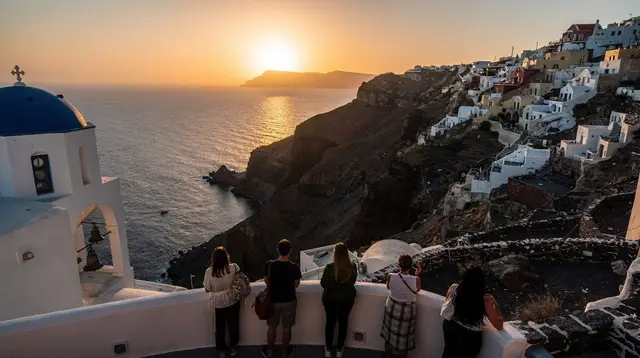
Oia has one landmark that concentrates almost everyone’s attention — the ruined Byzantine Kastro at the village’s western tip. In July and August, its ledges and steps start filling 90 minutes to two hours before sunset, and by the last 20 minutes it can be standing room only, with people packed onto the walls and each other’s sightlines. None of that is a rumor; it’s simply what happens when a single viewpoint in a small village becomes the internet’s most-photographed sunset spot in the Cyclades.
The good news is that the crowd is almost entirely self-inflicted by timing, and it is also entirely optional. You have three realistic strategies: get to the Kastro early enough that the crush hasn’t formed yet, go somewhere close by that draws a fraction of the people, or skip land altogether and watch the same cliffs from a boat. This guide works through all three.
Beating the Kastro on Its Own Terms
If you want the Kastro specifically — and it is a genuinely good spot, with the ruined walls framing the view and the whole village stepping down toward the water — the only reliable fix is arriving well before the crowd does.
In practice that means:
- June through August: be in position at least two hours ahead of sunset. Bring water and something to sit on; you’re trading comfort for the space to actually see something.
- Shoulder months (April–May, October): 45–60 minutes ahead is usually enough. Fewer people means you don’t need the full buffer.
- Winter (November–March): arriving 15–20 minutes ahead is normally fine, though at this time of year many Kastro-adjacent restaurants and bars are closed for the season, so the walk there and back is quieter but has fewer stops along the way.
The one thing not to do is aim for the exact window everyone else aims for — a leisurely stroll to the Kastro starting 20–30 minutes before sunset in August. That’s precisely when the ruins are at their fullest, and it’s the single most common disappointment reported about Oia’s sunset.
It’s also worth being honest that sunset time itself moves a lot across the year — from around 8:50pm in late June to around 5:15pm in late December — so “arrive two hours early” means a different clock time depending on the month you’re visiting. Check the sunset time for your actual dates rather than assuming a fixed hour, and see our month-by-month weather guide if you’re still choosing when to come.
Skipping the Kastro Entirely: Imerovigli and Skaros Rock
If standing in a crowd for two hours doesn’t sound like a holiday, the simplest fix is not to fight for the Kastro at all. Imerovigli, a 20–25 minute drive or taxi from Oia along the caldera rim, faces the same volcanic islets and catches the same light, with a fraction of the foot traffic.
The walk out toward Skaros Rock — the abandoned medieval fortress promontory just beyond the village — spreads whoever does show up along a path rather than packing them onto one terrace. You lose Oia’s cascading white cubist houses in the foreground, but you gain space, quiet, and the option to move around and choose your own angle instead of holding a spot for an hour.
Imerovigli sits higher on the caldera rim than Oia, which gives an arguably wider sweep of the volcano and Thirassia beyond it. It’s a legitimate substitute, not a consolation prize, and it’s the answer we give most often to visitors who ask how to see “the Oia sunset” without actually going to Oia.
Firostefani: The Middle Ground
Between Imerovigli and Fira sits Firostefani, a smaller, quieter village that gets overlooked by most itineraries entirely. Its caldera-facing cafés and a scattering of small terraces offer the same west-facing view with even less competition for a spot than Imerovigli, simply because fewer visitors know to stop there.
The tradeoff is that Firostefani has fewer viewpoints overall, so if you arrive to find your preferred terrace full, there isn’t a second or third option a short walk away the way there is in Oia. It rewards visitors who scout a spot earlier in the day — over lunch, say — and return for the sunset itself rather than showing up cold.
Pyrgos: The One Village That Sees the Whole Island
For a genuinely different angle, Pyrgos and its hilltop kastro sit inland, away from the caldera rim entirely, at one of the highest points on the island. It’s the only spot on Santorini from which you can see the whole island rather than just the caldera side, which makes for a different kind of sunset photograph — the light falling across vineyards and villages rather than over open water.
It draws a small, mostly local crowd rather than a tourist one, and because it isn’t caldera-facing in the same way as Oia or Imerovigli, most visitors never think to go there for sunset at all. That’s exactly its appeal if the goal is fewer people rather than the single most famous view.
Watching the Falaise From the Water
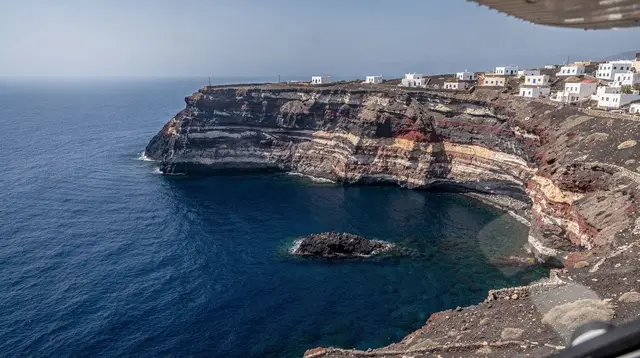
The most complete way to sidestep the crowd problem is to stop standing on the cliff and instead look at it. A boat on the caldera during sunset shows you the layered villages, the cliffs, and the volcanic islets lit from the side — the same cliffs everyone on land is standing on top of, seen from a genuinely different vantage point, with no one blocking your view because there’s no ledge to compete for.
A private sunset boat trip down to Oia and Ammoudi Bay takes you along the base of the cliffs as the light changes, with none of the jostling for space that defines the Kastro at peak season. For a slower, wine-focused version of the same idea, a caldera cruise that stops at the hot springs before finishing with sunset off Oia turns the same window into a half-day outing rather than a 20-minute scramble for a spot.
Boats aren’t guaranteed either, though — the meltemi wind, which blows hardest from July through August, cancels sailings on its stronger days, so a boat is a solution to crowding, not a solution to weather. If you’re set on being on the water, book ahead and check conditions the morning of, and see our comparison of caldera cruises if you’re deciding between a shared and a private option.
Making Oia Itself Work Better
If you’d still rather stay in the village, there are ways to thin the crowd without leaving it. The Kastro is what everyone photographs, but Oia’s older lanes just a street or two back from the main pedestrian route are almost as scenic and considerably quieter, since most visitors funnel straight toward the ruins and don’t wander.
A reserved table at a restaurant with its own caldera-facing terrace is the most reliable fix of all, because it converts “find a spot and hold it” into “walk in and sit down.” These fill up in high season, sometimes weeks out, so if this is your plan, book it rather than hoping for a walk-in — our guide to what sells out and when covers exactly this kind of reservation.
A guided option removes the guesswork entirely: a private sunset photo walk through Oia is timed and routed by someone who watches these crowds every evening, and a guided walking tour through Oia’s cultural sites ending at sunset builds in the buffer time most visitors underestimate. If photographs are the actual goal rather than the sunset itself, a 1.5-hour photography session in the village is scheduled around the light rather than the crowd, and can be timed for well before or after the peak crush.
Comparing Your Options
| Spot | Crowd level (high season) | Arrival buffer needed | What you actually see |
|---|---|---|---|
| Oia Kastro | Very high | 90 min–2 hrs | Classic view, village cascading below |
| Imerovigli / Skaros Rock | Low–moderate | 20–30 min | Same caldera, volcanic islets, more space |
| Firostefani | Low | 20–30 min | Caldera view, fewer terraces overall |
| Pyrgos | Low | 15–20 min | Whole island, vineyards, not caldera-facing |
| Boat on the caldera | Low (space-wise) | Book in advance | Cliffs and villages lit from the water |
| Reserved restaurant terrace, Oia | Low (once seated) | Book weeks ahead in summer | Kastro-area view without standing |
Getting There and Back Without Adding to the Chaos
However you choose to watch, plan your exit before the sun actually sets, not after. Oia’s lanes and the road out of the village are at their most congested in the ten to fifteen minutes right after sunset, when everyone leaves at once. If you’re day-tripping from elsewhere on the island — say, after walking part of the Fira-to-Oia caldera path earlier — build in extra time for the return, whether that’s a bus, a pre-booked taxi, or a boat back to your base in the caldera.
None of these strategies require giving up on Oia or on the sunset itself. They just shift the one variable that actually determines how crowded your evening feels: when and where you show up, not which village you picked. For the full range of viewpoints across the island, including several we haven’t detailed here, see our roundup of sunset spots beyond Oia or browse sunset experiences more broadly.
Frequently Asked Questions About Avoiding the Oia Sunset Crowds
How early do I really need to arrive at the Oia Kastro in high season?
In July and August, the best-known ledges are already occupied 90 minutes to two hours before sunset. Arriving 30 minutes ahead, which feels early to most visitors, often means standing several rows back.
Is there a quiet spot in Oia itself, or do I have to leave the village?
Oia’s most photographed corners are the ones that get crowded. The narrower lanes just off the main pedestrian street, and the terraces of restaurants that require a reservation, thin the crowd without requiring you to leave the village at all.
Is Imerovigli actually less crowded than Oia?
Yes, noticeably. Imerovigli faces the same caldera and the same sun, draws far fewer visitors, and the walk out to Skaros Rock spreads people along a path instead of concentrating them on a single viewpoint.
Does watching from a boat solve the crowd problem?
It solves a different problem: instead of standing in a crowd looking at the sun, you’re on the water looking at the cliffs and villages lit up by it, which is a different and arguably better view of the same event.
What time does the Oia sunset crowd actually build up?
It tracks the sunset itself, which shifts by hours across the year, so there is no fixed clock time. What is constant is the interval: crowds build roughly 90 minutes to two hours ahead of whatever the local sunset time happens to be that week.
Can I get a good view without booking anything in advance?
Yes, if you arrive early enough or choose a viewpoint outside the Kastro. A reserved table or a booked boat removes the uncertainty, but neither is required to see the sunset well.
Does the wind affect where I should watch from?
In summer, the meltemi can make exposed clifftop spots like the Kastro genuinely uncomfortable to stand in for an hour, and it can also cancel boat trips outright, so check conditions rather than assuming any option is available on a given evening.
Sunset Experiences on GetYourGuide
Verified deep-linked GetYourGuide tours. Book through these links and we earn a small commission at no cost to you.
GetYourGuide does not provide a product photo for this activity — the image shows the meeting point, photographed by us.