Why Fira works as a home base, not a hideaway
Fira is Santorini’s capital, and it behaves like one. This is where the buses start and end, where the taxis queue, where the cable car from the old port arrives, and where the airport road leads within about fifteen minutes of touching down. If your priority is spending less time in transit and more time doing things, Fira solves that problem better than any other village on the island — the full picture of why is laid out in this guide to Fira, Santorini’s cliff-top capital.
What it does not offer is calm. The same density that makes it convenient — shops stacked on shops, restaurants with caldera tables booked solid by 7 p.m., a pedestrian strip that never really empties — makes it the loudest, busiest place in Santorini. Choosing Fira is choosing logistics over serenity, and the town works best when you go in with that trade-off in mind rather than expecting a quiet clifftop retreat.
That distinction matters because Fira is often photographed and described in the same breath as Oia or Imerovigli, as though the caldera villages were interchangeable. They are not. Oia is built around a single, famous view and closes down early outside the sunset rush. Imerovigli is genuinely quiet, spread along a narrower stretch of cliff with fewer shops and a slower pace.
Fira is the opposite of both: a working town of several thousand residents that happens to sit on top of one of the most photographed volcanic calderas on earth. If you want a base to sleep, eat, restock and move on from efficiently, Fira is very hard to beat. If you want your hotel balcony to be the highlight of your evening, look at Imerovigli or Oia instead — this side-by-side of Oia versus Fira as a base walks through the trade-off in more detail.
What the town actually feels like
Arriving in Fira from any direction — the airport road, the bus station, or the top of the cable car — drops you into a knot of narrow lanes lined with jewelry shops, wine bars, gyro counters, tour agencies and boutique galleries selling local ceramics and volcanic-stone jewelry. The commercial core is dense enough that a short walk can take longer than expected simply because there is so much to look at, and so many other visitors doing the same thing. The caldera-edge path running through town is the main draw: a string of restaurant terraces and viewpoints looking out over Nea Kameni, Thirassia and, on a clear day, the whole sweep of the crescent-shaped island. A self-guided route through these lanes and down to the water is mapped out in this guide to walking Fira’s Old Town.
Away from that edge, Fira thins out quickly. A few streets back from the rim, the lanes turn into ordinary Cycladic architecture — whitewashed walls, blue shutters, small chapels tucked between buildings — with far fewer tourists and correspondingly lower prices. This is where locals actually shop and eat, and it’s worth the short detour if the caldera-front prices feel steep. The town’s southern edge blends into Firostefani, which is essentially a quieter extension of Fira proper and a common compromise for travelers who want walking access to the capital without sleeping in the middle of it.
The Museum of Prehistoric Thera
Fira’s most substantial indoor attraction is the Museum of Prehistoric Thera, which houses the wall paintings, pottery and everyday objects recovered from the buried Bronze Age town of Akrotiri, on the island’s south coast. It is the place to see the frescoes up close — ships, antelopes, boxing children — before or after visiting the excavation site itself.
The museum is compact, air-conditioned, and one of the few attractions in Santorini that works equally well as a midday break from the sun or as a wet-weather plan, alongside Akrotiri’s own covered site. For context on how the Bronze Age eruption that buried Akrotiri shaped the island you see today, the two sites are best understood together rather than separately.
Fira also holds the island’s Orthodox Metropolis Cathedral, rebuilt after the major 1956 earthquake, along with a scattering of smaller churches and a small Catholic quarter reflecting the island’s Venetian past. None of these require more than an hour combined, but they round out a stay in town beyond shopping and sunset-watching.
Eating, drinking and shopping in Fira
Fira has by far the widest range of dining on the island, from simple souvlaki counters to formal caldera-view restaurants that require reservations days ahead in July and August. The general rule holds across the whole town: a table directly on the caldera edge costs more and books out faster than one a street or two back, and the food quality doesn’t necessarily track the view. Wine lists lean heavily on local Assyrtiko and Vinsanto, and several shops in town sell bottles from the island’s wineries if you don’t have time to visit one directly.
| Where in Fira | What to expect | Typical price level |
|---|---|---|
| Caldera-edge terraces | Sunset views, reservations recommended, busiest tables | €€€ |
| Main pedestrian lanes | Wide choice, tourist-focused, open latest | €€ |
| Streets back from the rim | Where residents eat, fewer views, better value | € – €€ |
| Fira’s market streets | Jewelry, ceramics, local wine, souvenirs | Varies widely |
Shopping in Fira ranges from mass-produced souvenirs to genuinely well-made local jewelry and volcanic-stone pieces; prices are rarely fixed for anything beyond food, so it’s normal to compare a few shops before buying.
Getting around from Fira
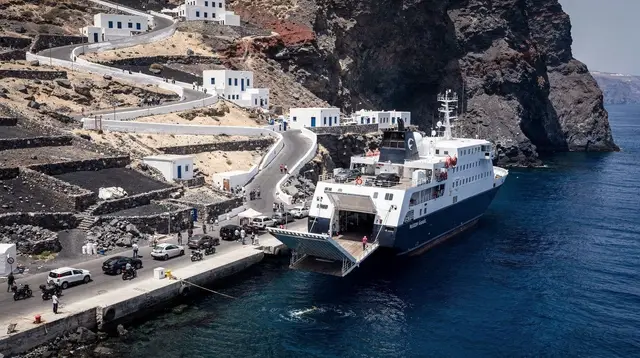
Fira’s biggest practical advantage is transport. The island’s central bus station is here, with KTEL buses running to Oia, Kamari, Perissa, Akrotiri and most other villages — inexpensive, frequent in high season, and largely stopped by early evening. Taxis are scarce across the whole island (only around thirty serve all of Santorini), so booking a transfer ahead of time, especially for an early ferry or flight, is standard practice rather than an inconvenience specific to Fira. Ferries themselves dock further south at Athinios, the island’s main gateway, which is why that early-morning transfer usually means a taxi or a KTEL bus timed to the boat schedule rather than a walk down from town.
For reaching the sea directly below town, the cable car connects Fira to the old port at Skala in about three minutes, with the switchback stone staircase and donkey rides as slower, cheaper — or more scenic — alternatives; that descent, and the old port itself, is covered in full on its own page rather than here. The same applies to the caldera-rim walking route north: the popular Fira-to-Oia hike begins right at the edge of town but is a destination in its own right, not part of what makes Fira itself worth a stay.
Day trips and tours that start here
Because so many transfers, buses and boats converge on Fira, it’s the natural starting point for organized excursions covering ground you wouldn’t easily reach alone. A half-day minibus tour taking in Pyrgos, Oia and Fira’s own highlights is a practical option if you’re arriving by cruise ship and have a fixed window ashore, since it’s built around getting back to port on time.
Travelers staying overnight who want to beat the crowds have another option: a private sunrise tour departing from Fira and continuing to Oia covers the same villages before the day-trip buses arrive.
For a broader sweep of the island in a single outing, a Santorini highlights minibus tour ending with the Oia sunset is a straightforward way to see the caldera villages, wineries and viewpoints without renting a car or coordinating buses yourself.
If wine is more the point of the day than sightseeing, a wine-focused tour through the island’s lesser-known corners usually departs from central pickup points in Fira as well. All of these are bookable directly from town, which is another reason Fira suits travelers assembling an itinerary on the fly rather than planning every detail in advance.
Sunset in Fira versus Oia
Every visitor to Santorini eventually asks where to watch the sunset, and the honest answer depends on how much crowding you’re willing to tolerate. Oia’s Kastro is the famous spot, and it fills up ninety minutes to two hours before sunset in high season — a fact worth knowing before committing an entire evening to the trip. Fira’s own caldera-edge path offers a wider, less concentrated view of the same sunset, without a single bottleneck point, which makes it a genuinely reasonable alternative rather than a consolation prize. It won’t have Oia’s particular composition of blue domes and whitewashed houses catching the light, but it also won’t have you standing shoulder to shoulder with a tour group.
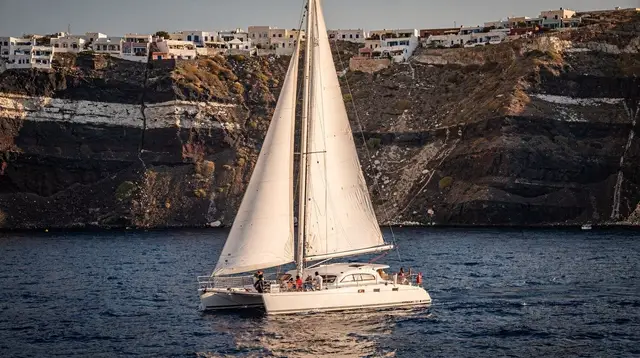
Travelers who want the postcard version without the crowd logistics sometimes solve the problem by watching from the water instead. A private sunset boat tour around the caldera puts the whole cliff-side view — Fira, Imerovigli, Oia — in front of you at once, which is a genuinely different experience from standing on any single viewpoint on land.
Practical notes for staying in Fira
A few things are worth knowing before booking a room in town. First, tap water across Santorini comes from desalination — it’s safe to drink but tastes brackish, and most visitors and residents alike default to bottled water. Second, cash still matters here for smaller purchases and for the entry fee at Nea Kameni’s volcano crater if you’re booking a caldera cruise independently; card acceptance is otherwise near-universal. Third, if you’re staying more than a couple of nights, consider splitting the trip: Fira for arrival, transport and one or two big dinners out, and a quieter village such as Imerovigli or Firostefani for the nights you’d rather not hear the town below you.
Finally, remember what Fira is not. It has no beach of its own — the closest options, Kamari and Perissa, sit twenty to thirty minutes away by bus on the island’s other coast. It is not where you go for silence; that’s what the villages further along the caldera rim are for. And it is not a place to expect a bargain, since prices on the caldera edge run higher than almost anywhere else on the island. Book it for what it actually is: the busiest, best-connected, most useful base in Santorini.
Frequently asked questions about staying in Fira
Is Fira a good base for a first trip to Santorini?
Yes, for practicality. Fira sits closest to the airport, the ferry port and the island’s only bus hub, and it has the largest concentration of restaurants and shops. It trades quiet for convenience — expect noise well into the evening.
Is Fira noisy at night?
Yes, particularly along the main pedestrian strip near the caldera edge, where bars and restaurants stay lively until late in high season. Rooms set back from the rim, in the Firostefani direction, are noticeably quieter.
Does Fira have its own beach?
No. Fira sits on top of the caldera cliff with no direct sea access. The nearest beaches, Kamari and Perissa, are a short bus or taxi ride away on the island’s east and south coasts.
What is there to see in Fira itself?
The Museum of Prehistoric Thera, which holds the frescoes and finds excavated at Akrotiri; the Orthodox Metropolis Cathedral; a dense old town of shops and galleries; and a caldera-edge walkway with viewpoints toward Nea Kameni and Thirassia.
How do I get from Fira to the port or the airport?
The airport is about 15 minutes away by taxi or public bus. The old port at the base of the cliff is reached by cable car in roughly three minutes, on foot down the switchback path, or by donkey.
Is Fira or Oia better for sunset?
Oia’s Kastro is the famous sunset spot and fills up 90 minutes to two hours ahead in high season. Fira offers a wider, less crowded sunset view along its own caldera-edge terraces, without the same crush of people.
Can I walk everywhere in Fira without a car?
Yes. The town is compact and pedestrian-friendly, and buses from the Fira station reach most of the island’s villages and beaches, which is why many visitors without a rental car choose to stay here.