The Museum of Prehistoric Thera
Where can I see the Akrotiri frescoes?
Not at the Akrotiri excavation site itself. The original wall paintings, along with pottery, tools and other finds, are displayed at the Museum of Prehistoric Thera in Fira. The site at Akrotiri shows the buried city; the museum shows what was found inside it.
A Museum Built From What Akrotiri Couldn’t Keep
Most people arrive at Akrotiri expecting to see the frescoes. The town buried by the eruption of around 1600 BC is famous, above almost everything else, for the wall paintings its houses once carried — and then they walk the covered site and see none of them. That is not a mistake in the itinerary. The frescoes were never left in place. They are on display a few kilometres north, in Fira, at the Museum of Prehistoric Thera.
The two sites answer different questions about the same discovery. Akrotiri, excavated since 1967, shows the shape of the city itself — the streets, the two- and three-storey houses, the drainage, the storage rooms still holding their jars. The museum in Fira shows what was inside those houses when they were dug out: the paintings that once covered the walls, the pottery that filled the shelves, the tools people used, and a handful of objects that survived the eruption in far better condition than anyone excavating them expected. Seeing only one half tells half the story.
This page covers the museum on its own terms — what it holds, why the objects ended up here rather than at the dig, and how to slot a visit into a day that also includes Fira’s old town, a rainy afternoon, or the excavation itself.
Why the Frescoes Left the Site
Wall paintings on lime plaster are not something you can leave exposed to a working excavation, let alone to decades of visitors. As archaeologists cleared the ash from Akrotiri’s buildings, the fresco fragments were painstakingly detached, backed, and conserved off site, then reassembled panel by panel — a process that in several cases took years per room. What survives is genuinely from the walls of the city you can walk through at Akrotiri, just no longer attached to them.
That distinction matters for how you plan the two visits. If you go to the excavation expecting painted walls, the covered site — impressive as it is for its scale and its ordinariness, the ordinary rooms of an ordinary Bronze Age town — can read as strangely blank. Knowing in advance that the paintings live in Fira changes what you’re looking for at each stop: structure and daily life at the dig, colour and craft at the museum. For the fuller account of the excavation itself, its history since 1967 and what to expect from the covered site, the dedicated guide to the Akrotiri excavations covers that ground; this page stays with what the museum holds.
What You’ll Actually See Inside
The collection is built almost entirely from Akrotiri material, organised loosely by type rather than by house of origin, though many labels do note where a piece was found.
Frescoes and fresco fragments. The wall paintings are the reason most visitors come. Subjects recovered from the site include figures, animals and marine life rendered in the flat, confident style typical of Late Bronze Age Aegean painting, along with decorative bands of plant and spiral motifs that ran along room borders. Some panels are large and largely complete; others are shown as fragments, reconstructed as far as the surviving plaster allows and left honestly incomplete where it doesn’t.
Pottery. Painted jugs, cups and storage vessels in local and imported styles sit alongside plainer domestic ware, giving a sense of both everyday use and trade — Akrotiri’s pottery shows contact well beyond the Cyclades.
Pithoi. The large storage jars used for oil, wine and grain are one of the more striking things to see at scale; several on display are the same type still visible half-buried in the storerooms at the excavation.
Tools and everyday objects. Stone and bone implements, weights, and other working tools round out the picture of a settlement that farmed, fished, wove and traded rather than one preserved purely as a curiosity.
Furniture casts. Wooden furniture in the buried houses decayed away over the centuries, leaving voids in the hardened ash in roughly the shape of the missing object — the same phenomenon that produced the famous body casts at Pompeii, applied here to beds, tables and other furnishings rather than people. Plaster poured into these voids during excavation captured shapes that would otherwise have vanished entirely.
The gold ibex. A small gold figurine of an ibex, one of the few gold objects the excavation has produced, is usually one of the more closely looked-at cases in the museum — a reminder that a wealthy Bronze Age town, not only a well-preserved one, lies under Akrotiri.
None of this is displayed as a substitute for the site; it’s the other half of it. A scale plan or model of the excavation is typically part of the exhibition too, which helps place objects back into the rooms they came from before or after standing in those rooms yourself.
The Museum in Fira, the City at Akrotiri
Since the two are often confused by name alone — both trace back to the same excavation, one is a building in the capital and the other is the buried town itself — it helps to lay out the difference plainly.
| Museum of Prehistoric Thera | Akrotiri excavations | |
|---|---|---|
| Location | Central Fira | South coast, near Red Beach |
| What you see | Frescoes, pottery, tools, the gold ibex | The excavated streets, buildings and storage rooms |
| Setting | Fully indoors | Covered site; getting there is outdoors |
| Typical time | 45 minutes to 1.5 hours | 1 to 1.5 hours |
| Best suited to | A wet or windy day, or a stop within a Fira walk | Understanding the scale and layout of the city |
| Pairs well with | A Fira old town walk | A wine stop nearby or Red Beach |
Neither replaces the other, and the order you visit them in is mostly a matter of logistics rather than storytelling — some prefer to see the objects first for context, others prefer to see the empty rooms first and let the museum answer the question of what used to be in them.
A Reliable Answer on a Windy or Wet Day
Santorini’s outdoor plans — boat trips into the caldera, the coastal walk from Fira to Oia, most of the beaches — depend on weather in a way an indoor museum simply doesn’t. When the meltemi is blowing hard enough to cancel cruises, or a rare rainy spell settles over the island, the Museum of Prehistoric Thera stays open and unaffected, exactly because everything in it is already indoors.
It’s a genuinely useful option to keep in reserve for winter or shoulder-season trips, when opening hours across the island shrink and a solid indoor plan is worth more than it sounds. Check seasonal weather patterns if you’re travelling outside the summer months and building slack into the itinerary for exactly this reason.
Fitting It Into a Half Day
Because it sits inside Fira rather than out at Akrotiri, the museum slots easily into a morning or afternoon built around the capital rather than requiring its own dedicated trip.
A straightforward half day: start with a walk through Fira’s old town, take in the museum while you’re already in the centre, and finish either at the cable car down to the old port or with a coffee looking over the caldera.
If you have a full day and a car, taxi or organised tour, add Akrotiri itself in the same trip — museum in the morning, excavation in the afternoon, or the reverse — which is a natural way to spend one day in Santorini if archaeology is the theme you want to build the day around. For visitors weighing up how to use limited time across the island’s villages more broadly, the villages guide and a look at combined tours covering more than one stop are worth reading alongside this page.
Getting There and Practical Notes
The museum is in central Fira, within walking distance of the bus station that serves buses across the island, which makes it one of the easier archaeological stops to reach without a car. As with most Greek state museums and sites, opening hours shift by season and there is typically one closed day a week — check the current schedule before you plan your visit rather than assuming year-round hours. Entry carries a modest fee; multi-site tickets covering several archaeological locations on the island sometimes apply, so it’s worth asking at the desk rather than assuming a single fixed price.
Photography rules for museum interiors vary and are usually posted at the entrance — flash is commonly restricted to protect the pigments on the frescoes, which is worth knowing if photographing the paintings is part of why you’re visiting.
Should You Book a Guided Visit
The museum’s labelling is generally good enough to follow on your own, but a guide who covers both the museum and the excavation in the same outing can connect a specific fresco or storage jar back to the exact room it came from — a link the exhibition cases alone don’t always spell out.
a guided visit focused specifically on the museum’s collection works well if you want the frescoes and finds explained in depth without necessarily continuing on to the dig site that day.
For those planning to see both in one outing, a guided tour of the excavated city pairs naturally with a museum stop either before or after, and a private tour of Akrotiri gives more flexibility to set your own pace between the two, useful if you also want time in Fira’s old town on the same day.
What This Page Leaves for Elsewhere
Two things come up often enough in the same breath as this museum that they’re worth flagging as separate reading rather than folding in here. The excavation itself — its history, the bioclimatic roof that makes it visitable in any weather, and what walking through it actually involves — has its own dedicated coverage at the Akrotiri excavations guide. And the popular idea that Akrotiri and the Santorini eruption are connected to the Atlantis legend is a separate question with its own page, the Atlantis myth, kept apart from the factual account of the finds here on purpose.
Museum of Prehistoric Thera: Common Questions
Are the Akrotiri frescoes on display at the archaeological site?
No. The frescoes were lifted from the walls during conservation and are exhibited at the Museum of Prehistoric Thera in Fira. Akrotiri itself shows the excavated streets, buildings and storage rooms, not the wall paintings.
Where exactly is the Museum of Prehistoric Thera?
It sits in the centre of Fira, an easy walk from the bus station and from the old town, so it fits naturally into a day spent in the capital rather than requiring a separate trip south.
Can I visit the museum and the Akrotiri site on the same day?
Yes, and it is the logical order: many visitors see the museum first, since the objects give context, then travel south to Akrotiri to stand in the rooms the finds came from. Allow transport time between Fira and Akrotiri.
What is actually on display inside?
Frescoes and fresco fragments, painted and plain pottery, large storage pithoi, stone and bone tools, plaster casts of wooden furniture destroyed in the eruption, and a small gold ibex figurine, one of the few gold objects the excavation has produced.
Is this a good option on a windy or rainy day?
Yes. The exhibition is entirely indoors, which makes it one of the more reliable plans when the meltemi is blowing hard or the caldera villages are wet, unlike outdoor viewpoints or boat trips.
Do I need a guide to get the most out of it?
Not strictly, since the museum is compact and labelled, but a guide who also covers Akrotiri can tie the objects back to the specific rooms and streets they came from, which the labels alone do not always make obvious.
How much time should I set aside?
Most visitors need 45 minutes to an hour and a half, depending on how closely they read the labels. It pairs comfortably with a walk through Fira’s old town on the same visit.
Archaeological Sites on GetYourGuide
Verified deep-linked GetYourGuide tours. Book through these links and we earn a small commission at no cost to you.
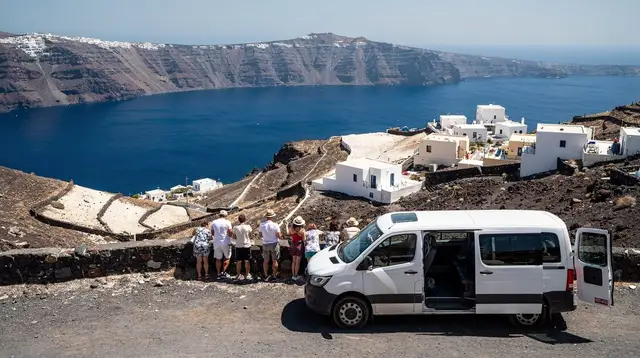
GetYourGuide does not provide a product photo for this activity — the image shows the meeting point, photographed by us.