Kokkini Ammos: a beach that gets photographed more than it gets walked to
Red Beach, known locally as Kokkini Ammos, is the single most photographed stretch of coastline in the southern Santorini area, and one of the least straightforward to actually reach. The draw is simple: a small cove backed by tall cliffs of dark red and black volcanic ash, with a strip of red-black sand and pebbles at the waterline. It is dramatic in a way few beaches anywhere manage, and it photographs beautifully at almost any hour.
What makes this page different from a straightforward beach guide is that Red Beach cannot be treated as a fixed, always-open destination. Since 2018, the cliffs above the access path have collapsed more than once, and each collapse has led authorities to close some or all of the route, sometimes for months. The most recent closure followed a landslide in December 2025, and as of this review in September 2026, access remains only partially open. This page exists to help you plan around that uncertainty rather than get caught out by it — and to make the case that seeing Red Beach from a boat is often the more reliable, and sometimes the better, option anyway.
What Red Beach actually looks like
The cliffs are the reason to come. They rise steeply from a narrow beach, streaked in deep red, rust and black, the result of oxidised iron in the volcanic ash laid down over thousands of years of eruptions. The beach itself is a mix of red sand, black volcanic pebbles and larger rock fragments that have fallen from above — a reminder, if one were needed, that the cliffs are still actively shedding material.
The cove is small and partly sheltered, with clear water that shows the red rock beneath near the shore. There is no real infrastructure: no permanent beach bar, no sunbed concession comparable to what you would find at perissa or Perivolos Beach, and only a limited amount of flat space to sit. It is a place people come to look at and photograph rather than to spend a full beach day at, and the site rewards a short, purposeful visit far more than a long one.
The access problem: three collapses since 2018
The path that leads from the car park near akrotiri down to Red Beach runs along the base and side of the same unstable cliffs that make the beach worth seeing. That is the core of the problem: the geology that creates the view is the same geology that periodically fails.
| Year | What happened | Effect on access |
|---|---|---|
| 2018 | Cliff collapse along the approach path | Path closed, later partially reopened with restrictions |
| 2023 | Further rockfall on the same stretch | Renewed closure of the most exposed section |
| December 2025 | Landslide affecting the access route | Access restricted again; only partly reopened by 2026 |
None of these events were linked to volcanic activity. Santorini’s volcano last erupted in 1950, and there is no lava, gas venting or magmatic unrest at Red Beach. This is straightforward coastal erosion acting on soft ash and cinder cliffs, the same material described in our overview of How the Santorini Caldera Was Formed — it is simply unstable rock, not a live hazard from the volcano itself.
It is also unrelated to the seismic swarm that shook the wider Santorini-Amorgos area in early 2025. That swarm ran from late January into March 2025, produced tens of thousands of small earthquakes, and prompted a temporary state of emergency on the island — but it did not include an eruption, and it has since ended. If you want the full picture on that separately from Red Beach, our guide to santorini-safety-and-the-2025-earthquakes covers it in detail. Red Beach’s closures are a local, structural issue with one specific cliff face, not a sign of island-wide risk.
Can you walk there in 2026? What to check before you go
As of this review, dated 2026-09-05, access to Red Beach is described locally as partially restricted rather than fully open or fully closed. In practice this has meant, at various points over the past two years, a shortened path with a barrier partway along, seasonal opening tied to inspection of the cliff face, or full closure after heavy rain loosens material. Conditions can change within a single season, and they are not reliably reflected on general travel sites.
Before you build a walk to Red Beach into your plans, do three things:
- Ask locally, on the day or the day before — your accommodation, a tour desk in fira or oia, or the Akrotiri village itself will know the current state of the path faster than anything published in advance.
- Treat any online claim that the path is “fully reopened” with some caution unless it is recent and specific to the current season; closures have reopened and then closed again more than once since 2018.
- Have a backup plan that does not depend on walking in, since the alternative — seeing the cliffs from the water — works regardless of the land closure and needs no checking at all.
For a page dedicated entirely to tracking the access situation and safety notes in more depth, see Red Beach: Access and Safety in 2026.
Seeing it from the water instead
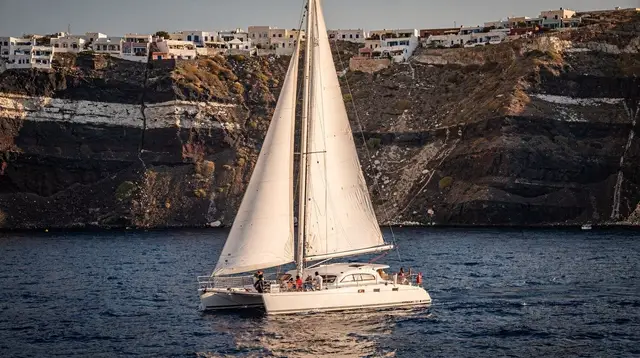
Because the cliffs face the sea, a boat gives you a clean, uninterrupted view of exactly the feature everyone comes for, without setting foot on ground that may or may not be officially open. A number of south-coast and caldera boat trips route past Red Beach on their way along the coastline, close enough for good photographs and a real sense of scale.
| Approach | What you get | Depends on path being open |
|---|---|---|
| Walking in from the car park | Standing on the sand, close-up views of the cliff base | Yes |
| Boat passing along the coast | Wide view of the full cliff face from the water | No |
| Photo stop from a headland nearby | Distant view, useful as a backup | No |
If a caldera or south-coast boat trip is already part of your plans, ask whether the route passes Red Beach — many do, since it sits close to Akrotiri and the Akrotiri Lighthouse. A private trip that combines the coastline with a stop for wine, such as this private day out pairing Red Beach and Akrotiri with a Santorini wine tasting, folds the view into a longer south-coast day rather than treating it as a separate errand.
For visitors already committed to seeing Akrotiri’s excavated Minoan town on the same day, a guided tour of the site Akrotiri, the city frozen by the volcano sits a short drive from the beach and works well either before or after.
If you would rather keep Red Beach as one stop on a broader boat day around the coastline, a full day cruise around Santorini’s coast or a caldera morning cruise both typically work the southern shoreline where the red cliffs are visible, without requiring any decision about whether the path is currently walkable. For more on how these boat options compare more broadly, see Santorini Caldera Cruise: Nea Kameni, Hot Springs and What to Expect.
What to bring if you do walk in
If local checks confirm the path is open on your visit, treat it like any other volcanic beach on this coastline, with a few extras given the terrain:
- Closed shoes or sturdy sandals. The sand and pebbles are dark and volcanic, and they get genuinely hot by midday — the same rule that applies at kamari and perissa applies here, with the added factor of loose rock underfoot on the path itself.
- Water and sun protection. There is no shade on the approach and very little at the beach.
- A camera with a wide lens or your phone’s wide mode. The cliffs are tall and close; a standard shot often can’t fit the full scale.
- A realistic sense of time. Treat this as a 30-60 minute stop, not a half-day beach visit — there is little to do once you have seen and photographed the cove.
- No expectation of facilities. Unlike Perivolos Beach or Vlychada Beach, there is no beach bar or sunbed setup here, and toilets are limited to the car park area.
If uneven, sometimes closed terrain is a concern, our broader notes in Santorini Beaches: Black Sand, Red Rock, and Pebbles Compared and White Beach and Black Beach, Akrotiri cover gentler alternatives nearby that don’t carry the same access risk.
Nearby: Akrotiri and the rest of the black-sand south
Red Beach sits within easy reach of the rest of the southern Santorini coastline, which makes it easy to build into a half-day loop rather than a single-purpose trip.
- Akrotiri village and the excavated Minoan town are a short drive away, and the covered archaeological site is one of the best rainy-day or high-wind options on the island regardless of what Red Beach’s path is doing that day.
- Vlychada, with its wind-sculpted ash cliffs, offers a similar volcanic-landscape feel with none of the access uncertainty — see Vlychada Beach: Santorini’s Sculpted, Lunar Coastline for details.
- Kamari and Perissa, on the opposite side of the Mesa Vouno ridge, are the island’s main black-pebble beaches, fully equipped and always accessible; our comparison at Perissa vs Kamari: Which Santorini Beach Should You Choose? covers which suits which kind of traveller.
- Akrotiri Lighthouse, at the southern tip, is a quiet spot for a sunset that doesn’t compete with Oia’s crowds.
If you have your own transport, this cluster works well as a single loop: Akrotiri village, a check on Red Beach’s status, then on to Vlychada or the lighthouse depending on the light and the time of day. Notes on renting a car or ATV for the day are in Renting a Car or Scooter in Santorini and Driving in Santorini: What to Know; if you’d rather not drive yourself, Renting a Boat in Santorini Without a Licence is worth reading before you commit to a route that depends on the coast road.
Best time to try
If your plan includes walking to Red Beach, mornings work better than afternoons for two reasons that have nothing to do with the access question: the light hits the red cliffs more directly earlier in the day, and the heat on the exposed path and sand builds fast once the sun is high. The shoulder months — April through June, and September into October — are also more comfortable for a walk with no shade than the peak of a July or August afternoon. None of this affects whether the path is open, but it affects whether the visit is pleasant if it is.
Winter brings its own version of the same trade-off: fewer people, cooler conditions, but also less consistent staffing around any barrier or checkpoint on the path, and rougher seas if you are relying on a boat instead. Our month-by-month breakdown at Santorini Weather, Month by Month has the fuller picture for planning around either approach.
Red Beach access, answered
Is Red Beach currently open?
It depends on the season and on recent conditions, and it has changed more than once since 2018. Check locally in Akrotiri village or with your accommodation on the day rather than relying on older information.
Why does Red Beach keep closing?
The cliffs above the access path are made of soft volcanic ash and cinder rather than solid rock, and they periodically shed material. Collapses were recorded in 2018, 2023 and December 2025.
Can I still see Red Beach if the path is closed?
Yes. A number of boat trips along the south coast pass close enough to the cliffs for a clear view and good photographs, without needing the path to be open at all.
Is Red Beach worth visiting if I have to skip the walk?
The colour and scale of the cliffs are the main appeal, and that comes through well from the water too. A boat pass-by is a legitimate way to see the place, not a consolation prize.
How do I get to Red Beach?
It is near Akrotiri, roughly 20-25 minutes from Fira by car, scooter or ATV. There is no dedicated bus service to the beach itself, so most independent visitors arrive with their own transport.
Do I need shoes for Red Beach?
Yes. The sand and pebbles are dark volcanic material that heats up quickly, and the approach can include loose rock underfoot.
Is Red Beach related to the 2025 earthquake swarm?
No. That swarm was a separate seismic event near Santorini and Amorgos that produced no eruption and has since ended. Red Beach’s closures come from ordinary cliff erosion, unconnected to it.