Driving in Santorini: What to Know
Is it easy to drive in Santorini?
The main roads are fine, but Fira, Oia and Imerovigli have lanes too narrow for cars, and the switchback road down to Athinios port jams solid every time a ferry arrives. Many visitors get by on buses and taxis instead of a rental.
What actually slows you down on the island
Santorini looks small on a map — the whole crescent is under 20 km end to end — and that scale convinces a lot of first-time visitors that getting around will be effortless. It mostly is, right up until three predictable moments: a ferry arriving at Ormos Athinios, a cruise-ship morning in Fira, and the hour before sunset on the road into Oia.
This page is about those moments and the ordinary conditions around them — the roads themselves, the traffic patterns, the narrow lanes of the caldera villages, and the KTEL bus network that ties it all together. It is not about how to rent a car or scooter, which is covered in car and scooter rental in Santorini, and it is not about ATV and quad specifics, covered in the ATV and quad guide.
The road network in outline
Santorini’s main road runs down the spine of the island, connecting Fira to Karterados, Messaria, Pyrgos and the airport, then branches out toward Kamari and Perissa on the east and south coasts, and separately toward Akrotiri and the Red Beach area.
A second branch heads north along the caldera rim through Firostefani and Imerovigli to Oia at the island’s tip. None of this is technically hard driving — the surfaces are sealed, the bends are graded for cars, and there is nothing like a mountain pass to contend with. The two things that catch people out are traffic concentration and destination geometry: almost every road eventually funnels toward Fira, and several of the places worth reaching (the caldera villages, the port) were built centuries before cars existed.
Since every road on the island funnels toward Fira, think about where your car will sleep rather than only where it will drive. Check whether the pick-up point is the airport or the port, whether your accommodation in the caldera villages has parking, and what the fuel and damage terms say before you pay. A small car suits these roads, and you can look at Localrent rental options for a Santorini pick-up.
The Athinios switchback and ferry-arrival traffic
Athinios is the island’s only ferry port, and it sits at the foot of the caldera cliff on the west side, reached by a single road that switches back on itself repeatedly as it climbs roughly 300 metres to the plateau above. This is the one piece of driving on Santorini that deserves real respect, not because the curves themselves are dangerous, but because of what happens on them at the wrong moment.
A large ferry unloads cars, coaches, taxis and foot passengers all within the same ten or fifteen minutes, and all of that traffic funnels onto the same narrow switchback road at once. The result is a predictable, recurring jam: buses queuing nose to tail, taxis trying to pass on blind bends, and rental cars caught in the middle with nowhere to go. It is not an occasional inconvenience — it happens at every arrival, every day, in every season, because the road has no alternative route and no capacity to absorb a surge.
The practical takeaway is about timing, not about avoiding the port. If you are driving to Athinios to catch a ferry, or driving away from it after arriving, build in extra time around the scheduled arrival and departure windows rather than assuming the drive will take as long as the map suggests. If you are simply planning a day elsewhere on the island and your route happens to cross near Athinios, check whether a ferry is due around that time before you commit to a schedule that assumes free-flowing roads. Anyone coming or going by sea should read the full picture in the Athinios port guide, which covers the port’s layout in more detail than fits here.
Driving into the caldera villages
The villages strung along the caldera rim — Fira, Firostefani, Imerovigli and Oia — were built as clusters of stepped, whitewashed houses on a cliff edge, long before anyone thought to plan for cars. Their historic cores are networks of stairs, covered passages and lanes barely wide enough for two people to pass, let alone a vehicle. You can drive to the edge of each village, but not through the middle of it, and the closer you get to the caldera view itself, the more certain you can be that the way in from there is on foot.
Parking reflects this directly. Fira has a handful of areas near the main road and the old port access point where cars gather, plus a couple of paid lots on the approach, but none of it is generous relative to the number of visitors on a busy day. Oia is tighter still: its car park at the village entrance fills early in high season, particularly on days when a cruise ship is in port and again in the hours before sunset, when everyone converging on the Kastro viewpoint needs somewhere to leave a car first.
Imerovigli and the area around Skaros Rock are quieter, which is one of the reasons they work well as a lower-stress alternative to the crowds further along the rim — a point covered from the sunset angle in sunset spots beyond Oia.
The practical rule that saves the most frustration: treat a caldera village as a place you park near and then walk into, not a place you drive through to find a specific address. Trying to inch a car down a lane built for donkeys, in a village where every other visitor is on foot with a camera, is a bad use of a holiday afternoon regardless of how confident a driver you are.
Buses: what KTEL actually covers, and where it stops
The island’s public bus network, run by KTEL, radiates entirely from a single station in Fira. Every route starts there, which means Fira functions as the hub whether you are staying there or not — a trip between two other points on the island, say from Kamari to Oia, typically means changing in Fira rather than travelling directly. Buses reach the main beach towns (Kamari, Perissa, Perivolos), the airport, Akrotiri, and Oia, and fares are inexpensive by the standards of Western European public transport. In July and August the buses toward the beaches and toward Oia fill up fast, particularly around midday and again in the run-up to sunset, so arriving early at the stop matters more than the timetable itself.
The limitation that catches people out is the schedule’s end, not its coverage. KTEL services thin out sharply after early evening and stop altogether well before midnight in most seasons, with the last departures from Oia often falling before or not long after sunset in midsummer, and considerably earlier in the shoulder months when daylight ends sooner.
A visitor who takes the bus to Oia for sunset without checking the return schedule can find themselves without a bus back at all, facing a taxi queue with everyone else who made the same assumption, or a long wait for one to become available. Full timetables and seasonal detail live in buses in Santorini; the point to take from this page is simply to treat the last bus as a firm deadline, not a rough guide.
Taxis: scarce by design, not by accident
Santorini runs on a strikingly small taxi fleet for an island with millions of annual visitors — on the order of a few dozen licensed taxis in total. That scarcity is structural, not a temporary shortage, and it means a taxi should be treated the way you would treat a pre-booked airport transfer anywhere else: arranged ahead of time, not hailed on a whim.
At ferry arrivals, cruise-ship mornings and the hour before sunset, every taxi on the island is likely already committed, and walking up to a taxi stand and expecting one to be free within a few minutes is often unrealistic in high season. Full detail on booking, typical routes and what to expect is in taxis and transfers in Santorini; the relevant point for this page is that a taxi does not bypass the island’s traffic bottlenecks, it just removes the need to park at the other end.
Choosing how to get around: a quick comparison
| Mode | Best for | Main limitation |
|---|---|---|
| Self-drive car | Wineries, inland villages, flexible beach days | Athinios traffic at ferry times; no parking inside caldera villages |
| KTEL bus | Budget trips to Oia, Kamari, Perissa, the airport | All routes hub through Fira; last buses run early |
| Taxi | Direct point-to-point, luggage, groups | Very few vehicles; must be booked ahead, especially at peak times |
| Organized tour or transfer | Ferry and airport connections, day trips, first-time visitors | Fixed schedule, less spontaneity |
| Walking within a village | Fira, Oia, Imerovigli cores | Impractical between villages or to beaches |
None of these is objectively best; they suit different bases and different priorities. A stay centred on the caldera rim, focused on villages, sunsets and wine, can work well on buses, taxis and walking alone, without ever touching a rental. A stay that also wants to reach Akrotiri, the wineries around Pyrgos and Megalochori, or the quieter south coast beaches at a time of your own choosing tends to benefit from having a car for at least part of the trip. The itinerary-level version of this decision, including a car-free version of a Santorini stay, is worked through in Santorini without a car.
Alternatives worth considering instead of self-driving
If the idea of navigating Athinios traffic or hunting for parking near Oia sounds like more stress than it is worth, a guided option removes the decision entirely. A private jeep tour to the island’s highlights covers the inland villages, viewpoints and photo stops with someone else handling the roads and the parking, which suits a first visit or a group that would rather look at the scenery than the traffic ahead.
For a shorter, more flexible way to reach viewpoints and beaches without committing to a rental car for the whole stay, an ATV quad experience built around transportation is a lighter-weight option, though the specifics of quad rules and safety belong in the dedicated ATV and quad guide rather than here.
For the sunset specifically, the single most effective way to sidestep both the Oia road traffic and the Kastro crowd is to be on the water instead of on the cliff. A sunset cruise approaches the caldera from below, watches the light change on the cliffs rather than fighting for a spot to view them from, and removes the return-drive problem entirely since the boat brings you back. And for visitors arriving by air rather than staying multiple nights, a day trip to Santorini from Athens is built around exactly the traffic patterns described above, with transfers and timing already worked out by someone who does this daily.
Practical notes that apply whichever way you choose
A few points are worth carrying regardless of mode. First, treat any plan that depends on precise timing — catching a ferry, making a specific sunset viewpoint, connecting to a flight — as needing a buffer of at least thirty minutes to an hour around Athinios or the caldera villages, because those are the two places on the island where a short trip on the map can quietly become a long one in practice.
Second, the cable car and the 588 steps between the old port and Fira are a separate transport question from anything covered here, relevant mainly to cruise-passenger routines rather than island-wide driving. Third, if your trip includes the airport, the roads there are among the least congested on the island outside of flight-arrival clusters, and the full picture is in the Santorini airport guide; the broader question of how to reach the island at all, by air or by sea, is addressed in getting to Santorini.
None of this makes Santorini a difficult place to move around — it is a small island with a functioning, if thin, network of buses and taxis, and roads that are perfectly ordinary outside two or three specific pinch points. The difference between a smooth few days and a frustrating one usually comes down to knowing where those pinch points are — Athinios at ferry times, the caldera villages at their cores, the last bus out of Oia — and planning around them rather than assuming the island’s size means everything will be quick.
Wine Tasting on GetYourGuide
Verified deep-linked GetYourGuide tours. Book through these links and we earn a small commission at no cost to you.
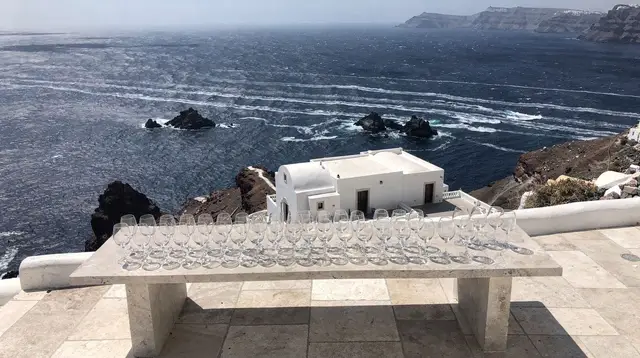
GetYourGuide does not provide a product photo for this activity — the image shows the meeting point, photographed by us.