Getting to Santorini: Flights, Ferries and Which to Choose
How do you get to Santorini?
Santorini is reached by plane into JTR airport, 6 km from Fira, with year-round flights from Athens and seasonal direct flights from Europe, or by ferry into the island's only port, Athinios, on routes from Piraeus, Crete and other Cyclades islands. Flying is faster and more predictable; the ferry suits travellers already island hopping.
Two ways in, and they are not interchangeable
There are exactly two ways to reach Santorini: by air into JTR airport, or by sea into the island’s single ferry port, Athinios. That is the whole list. Santorini has no train, no bridge, and — despite how often people assume otherwise — no ferry dock at Fira or Oia. If your itinerary has you “arriving by boat in Oia,” something in the plan needs fixing before you travel, because no scheduled ferry goes there.
This page is the overview: what each option actually involves, how they compare on time, cost and reliability, and which one suits which kind of trip. For the details of flying in, see Santorini Airport (JTR): Getting to Fira, Oia and Imerovigli. For the ferry itself, see Athinios Port: Santorini’s Only Ferry Gateway. Once you are on the island, getting around is a separate question, covered in Buses in Santorini: The Complete KTEL Guide, Santorini Taxis and Transfers and Santorini Cable Car and the 588 Steps: Getting Up From the Old Port.
The airport: JTR, six kilometres from Fira
Santorini’s airport, JTR, sits about 6 km from fira, the island’s main town. It runs year-round flights to and from Athens, which is the most reliable way in at any time of year, since Athens itself is served by direct international flights from across Europe and beyond. From roughly late spring to early autumn, a number of European airlines add direct seasonal flights straight into JTR, cutting out the Athens connection entirely for travellers coming from the UK, Germany, France, Italy and other nearby countries.
Outside that seasonal window, most non-Greek visitors fly into Athens first, then take a short domestic hop to Santorini. The Athens–Santorini leg runs multiple times a day in summer and considerably less often in winter, so it is worth checking the schedule before assuming a same-day connection is straightforward in January or February.
Once you land, JTR’s proximity to Fira is one of the airport’s real advantages: a taxi or pre-arranged transfer gets you into town quickly, without the winding descent that ferry arrivals face. Getting to oia or the beach towns on the south and east coasts takes longer, since the airport sits closer to the caldera side of the island than to Kamari or Perissa. For the specifics — terminal layout, transfer options, what to expect at arrivals — see Santorini Airport (JTR): Getting to Fira, Oia and Imerovigli.
The ferry: one port, Athinios, at the foot of the cliff
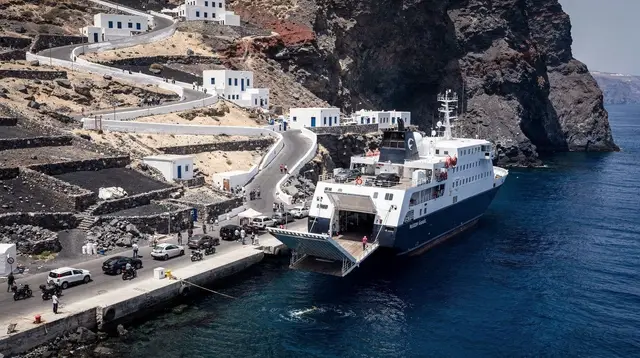
If you arrive by sea, you arrive at Athinios Port: Santorini’s Only Ferry Gateway, also written Athinios or Ormos Athiniou. This is the only ferry port on Santorini, full stop. It handles everything: connections to Piraeus (the port of Athens), routes across the Cyclades, and links to Crete and beyond. Fira’s old port, down at the base of the caldera cliff and reached by cable car or the 588 steps, is a different place entirely — it takes cruise ship tenders and small excursion boats, not scheduled ferries, and you cannot buy a ferry ticket to arrive there.
Athinios sits on the western side of the island, directly below the cliff, and the road up to Fira is a proper switchback — steep, with tight turns, and often congested right when a ferry has just unloaded several hundred passengers and their vehicles at once. There’s no train station feel to Athinios: no luggage storage, no real shelter beyond a few cafés, and a distinct sense of controlled chaos at each arrival. Budget extra time immediately after disembarking, both to clear the port and to get up the hill.
Ferry routes connect Santorini to islands across the Cyclades and further afield — ios, naxos, paros, milos, mykonos, folegandros, sikinos, amorgos — as well as Piraeus and Crete.
Journey times vary a fair amount depending on the operator and the vessel, so treat any duration you read as a rough order of magnitude rather than a fixed number; a fast ferry to Ios, for instance, is a notably shorter hop than the crossing to Crete. For the full route map and how to book, see Santorini Ferry Guide: How Athinios Port Works and Athinios Port: Santorini’s Only Ferry Gateway.
Comparing the two, side by side
| By air (JTR) | By sea (Athinios) | |
|---|---|---|
| Distance to Fira | ~6 km, quick transfer | Steep switchback road, longer transfer |
| Year-round service | Yes, via Athens | Yes, but far less frequent in winter |
| Direct from Europe | Seasonal only (spring–autumn) | Not applicable |
| Weather sensitivity | Occasional delays | Can be cancelled in strong meltemi winds |
| Best suited to | Fixed dates, short trips, connecting flights | Island-hopping itineraries, budget travel |
| Where you actually land | Airport terminal | Athinios port, not Fira or Oia |
Neither option is objectively “better” — they solve different problems. A flight gets you there quickly and predictably, which matters if your dates are fixed and you’re short on time. A ferry is often the more natural fit if Santorini is one stop in a longer Cyclades route, since you’re already moving by boat between islands anyway.
Which one should you choose
If you’re flying in from outside Greece with a set number of days, flying all the way to JTR — direct in season, or via Athens the rest of the year — is usually the simplest choice. It removes a variable from a trip that’s already tightly scheduled, and it means your first hours in Santorini go straight to sightseeing rather than to a port queue and a switchback road.
If you’re already in Greece or elsewhere in the Cyclades, the ferry becomes far more attractive. Someone finishing a stint in naxos or paros and continuing on to Santorini gains nothing from flying back to Athens first — the ferry goes island to island directly. This is also the case for travellers building a longer route; see Island Hopping from Santorini: Which Cyclades Island to Choose and Cyclades Island-Hopping Routes from Santorini for how Santorini fits into a wider itinerary, and Santorini to Ios Day Trip for a sense of how short some inter-island hops can be.
A common and sensible pattern is to mix the two directions: fly in, to arrive rested and on schedule, then leave by ferry to continue the trip elsewhere in the Cyclades, or the reverse. There’s no rule that both legs need to match.
Weather is worth factoring in either way. The meltemi, the strong seasonal wind that picks up from around July through August, can delay or cancel ferry crossings and occasionally disrupts smaller flights too, though flights are affected far less often. If your schedule has no slack — a connecting international flight the same day, for instance — build in a buffer, particularly around a ferry leg in peak wind season.
Seeing the caldera from the sea, whichever way you arrive
However you get to the island, most first-time visitors end up on the water anyway, because the view of the caldera cliff from below is one of the things Santorini is genuinely built around. A half-day out on a boat, gliding under Fira and Oia rather than photographing them from a crowded terrace, is a different experience from anything on land.
Options range from a relaxed catamaran cruise around the caldera with a meal, a swim stop and snorkelling to a sunset cruise that calls at the volcano and the hot springs before the light drops. Neither of these is your arrival ferry — they’re separate, shorter trips you book once you’re settled — but it’s worth knowing they exist before you assume the only way to see the caldera is from a village terrace.
What to expect once you land or dock
However you arrive, the first hour looks different depending on the method. Landing at JTR puts you within a short ride of Fira and the central villages; from there, Buses in Santorini: The Complete KTEL Guide and Santorini Taxis and Transfers cover onward movement. If you’d rather not deal with logistics at all on arrival day, a private tour with a driver can double as a transfer and a first look at the island in one go.
Arriving at Athinios is a different rhythm entirely. You disembark into a working port with taxis, transfer vans and buses all competing for space at once, then face the climb up the cliff road to Fira. If you’re heading down to Fira’s old port later in your stay — to catch an excursion boat, say — the cable car and the 588 steps are the two ways down and back up; neither has anything to do with the ferry port, which sits on the opposite side of the island.
However you plan the logistics, book transport in both directions before you travel if you can. Taxis on Santorini are genuinely scarce — around thirty for the whole island — so a pre-arranged transfer, whether from the airport or from Athinios, removes one of the more stressful unknowns of arrival day.
Practical notes for planning ahead
A few things worth deciding before you book flights or ferry tickets:
- Check the season for direct flights. Direct European routes to JTR run roughly from late spring to early autumn; outside that window, plan on connecting through Athens.
- Don’t assume a fixed crossing time for the ferry. Durations vary by operator and vessel, and are best treated as approximate.
- Build in a buffer around the meltemi season. July and August bring the strongest winds, which occasionally affect ferry schedules.
- Pre-book transport from whichever port you use. Taxis are limited in number, and neither JTR nor Athinios has an easy on-the-spot alternative if transfers are booked out.
- Never plan an arrival “in Oia” by ferry. All ferries dock at Athinios; Oia is a scenic drive or bus ride away, not a port.
If you want to see more of the island by land once you’ve arrived, an e-bike tour through the inland villages is a good way to get beyond the caldera towns, and travellers who want a route built entirely around their own priorities can look at a fully customisable private tour instead of a fixed itinerary.
For the deeper detail on each leg — airport terminals, ferry operators, ticket booking, and what the road to and from each port actually feels like — the dedicated guides are Santorini Airport (JTR): Getting to Fira, Oia and Imerovigli and Athinios Port: Santorini’s Only Ferry Gateway.
If your trip involves more than one island, Santorini Ferry Guide: How Athinios Port Works and Cyclades Island-Hopping Routes from Santorini map out how the routes connect. And if you’re still deciding when to come at all, The Best Time to Visit Santorini and Santorini Weather, Month by Month cover the seasonal trade-offs that affect both flights and ferries.
First-time visitors weighing up the whole trip, not just the arrival, may also find First Time in Santorini: What to Know Before You Go and How Many Days Do You Need in Santorini? useful before finalising dates. If you’re planning to rent a car or scooter once you land, Renting a Car or Scooter in Santorini and Driving in Santorini: What to Know are worth reading in advance, since pickup arrangements often tie directly into your arrival point.
Getting to Santorini: your questions answered
Is there more than one ferry port in Santorini?
No. Athinios (Ormos Athiniou) is the island’s only ferry port. Fira’s old port only receives cruise tenders and small excursion boats, and neither Oia nor any other caldera village has a working harbour for ferries.
Can you fly directly to Santorini from outside Greece?
Yes, in season. Several European airlines run direct flights to JTR airport from spring to autumn. Outside that window, most non-Greek travellers connect through Athens, which has year-round flights to Santorini.
How far is Santorini airport from Fira and Oia?
JTR airport sits about 6 km from Fira, a short taxi or transfer ride. Oia is further, on the northern tip of the island, so budget more time and confirm transfer options in advance.
Is it better to fly or take the ferry to Santorini?
Flying is faster, more predictable and less affected by wind. The ferry can be cheaper and lets you route through other islands, but crossings are longer and occasionally cancelled in strong meltemi conditions.
Do ferries to Santorini run all year?
Ferries run year-round, but frequency drops sharply outside June to September. In winter, some routes operate only a few days a week, so book with a buffer if you are travelling off-season.
How do you get from Athinios port up to Fira or Oia?
From Athinios you take a taxi, a pre-booked transfer or a KTEL bus up the switchback road to Fira, then continue by bus or taxi to Oia or other villages. There is no direct route from the port to Oia without passing through Fira.
Can you combine a flight in and a ferry out?
Yes, and many travellers do, especially when continuing to Mykonos, Naxos or another Cyclades island. Flying in avoids relying on the sea if it looks unpredictable, then leaving by ferry keeps the island-hopping route open.
Transfers and transport passes on GetYourGuide
Verified deep-linked GetYourGuide tours. Book through these links and we earn a small commission at no cost to you.
GetYourGuide does not provide a product photo for this activity — the image shows the meeting point, photographed by us.