Athinios Port: Santorini's Only Ferry Gateway
What is Athinios Port and how does it work?
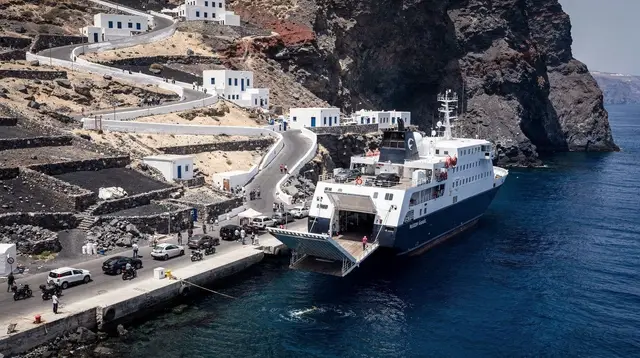
Athinios (Ormos Athiniou) is the only ferry port on Santorini, handling every boat to and from Piraeus, the Cyclades, Crete and Rhodes. It sits at the foot of the caldera cliff on the island's west side, reached by a steep switchback road, with no train station, no left-luggage office, and heavy traffic at every arrival.
The one door Santorini has by sea
Every ferry that touches Santorini, whether it comes from Piraeus, from a neighbouring Cycladic island, from Crete or from Rhodes, arrives at exactly one place: Athinios, officially Ormos Athiniou, on the island’s west coast beneath the caldera cliff. There is no second terminal, no overflow dock, and no alternative for scheduled boats. If you are travelling to or from Santorini by sea rather than by air, Athinios is where your trip begins or ends, and understanding its layout matters more here than at almost any other Greek port, because the site itself creates problems that have nothing to do with the ferry companies.
This guide covers Athinios specifically: what the port looks like, why the road above it backs up every time a boat docks, what facilities do and do not exist, and how to get away from the quay without losing an hour to a queue. For the wider picture of flights, ferries and the various ways of reaching the island, see getting to Santorini. For the airport itself, which is a separate and unrelated arrival point 6 km from Fira, see the Santorini airport guide.
Athinios is not the old port
The single most common confusion first-time visitors bring to Santorini is mixing up Athinios with the old port of Fira, known locally as Skala. They could not be more different in function. Athinios is the working ferry terminal: it is where the big Piraeus boats and the inter-island ferries dock, where cars and coaches roll on and off, and where anyone arriving by sea actually lands.
The old port at Fira, by contrast, sits directly beneath the town at the base of the caldera cliff and receives only cruise ship tenders and short excursion boats — the kind that go out for a caldera cruise or a trip to the volcanic islets. You reach the old port from Fira by cable car or the 588 steps, not by road, and no scheduled ferry ever calls there. If someone tells you they are “meeting you at the port” in Santorini, always confirm which one they mean — a taxi sent to the wrong port can cost you the better part of an hour.
What the port site actually looks like
Athinios sits in a narrow inlet on the caldera’s western flank, chosen not for convenience but because it is one of the few places on this stretch of coast where the cliff relents enough for a quay and a road to exist at all. The practical result is a working ferry terminal squeezed onto a shelf of land with the volcanic cliff rising immediately behind it. There is no flat hinterland for a proper terminal building, no rail link of any kind, and critically, no left-luggage office or storage facility anywhere on site. If you have a bag to store between a morning arrival and an evening ferry, that has to be arranged in Fira or through your accommodation before you get to the port, not at Athinios itself.
The terminal itself is functional rather than comfortable: ticket kiosks for the ferry companies, a handful of cafés and kiosks selling drinks and snacks, and open ground where vehicles queue to board. There is no single unified terminal building the way you might expect at a mainland port. Signage exists but is oriented toward drivers and coach operators rather than pedestrians working out where to stand.
The road is the real story
The single defining fact about Athinios is the road that leaves it. From the quay, the only way up to the rest of the island is a steep switchback road cut into the cliff face, climbing several hundred metres in a series of hairpin turns before it reaches the plateau and joins the route toward Fira. This road is narrow by the standards of the traffic it has to carry, and it is shared by everything: hire cars, ATVs and scooters, KTEL buses, coach transfers, taxis, and — in season — a fair number of pedestrians who assumed there would be a shorter route on foot. There generally is not; walking the switchback with luggage in the heat is not something the site rewards.
Because every arrival and departure funnels through this one road, traffic at Athinios is not an occasional inconvenience, it is a structural feature of the port. A single large ferry can disgorge several hundred passengers, dozens of hire vehicles, coaches booked for shore excursions and hotel transfers, and a stream of pedestrians all within a few minutes of docking. All of that has to filter onto one lane before it can climb the switchback.
Multiply that by the fact that several ferries can be scheduled close together in high season, and the road above the port routinely backs up for 20 to 40 minutes at a stretch. This is worth planning around rather than being surprised by: if you are booking a same-day connection to the airport after a ferry arrival, or trying to reach the old port in Fira for an afternoon caldera cruise, build in the delay rather than cutting the timing close.
Why “I’ll just grab a taxi” doesn’t work reliably
Santorini has a strikingly small taxi fleet for an island this popular — on the order of thirty licensed cars for the entire island, a fact covered in more detail in the guide to Santorini taxis and transfers. That fleet cannot be everywhere at once, and it tends to concentrate where demand is predictable: outside major hotels, at the airport, and at pre-arranged pickup points.
A ferry arrival at Athinios is exactly the kind of unpredictable, high-volume demand spike that a fleet this size struggles to absorb. When two or three ferries land within an hour of each other, which happens often between June and September, the small number of taxis at the port is simply outmatched by the number of people wanting one.
The practical consequence is that arriving at Athinios and expecting to walk up to a taxi rank the way you might at a busy mainland terminal is optimistic. It sometimes works, particularly outside peak months or on quieter routes, but it is not something to rely on if you have a schedule to keep — an evening flight, a hotel check-in with a deadline, or simply young children and luggage in September heat.
Booking a transfer in advance
This is the single most useful thing to arrange before you set foot on a ferry to Santorini: a pre-booked transfer that will be waiting at Athinios with your name on a sign, regardless of how many other boats have just docked. A private transfer sidesteps the taxi shortage entirely, sidesteps the uncertainty of whether a bus will have room, and gets you off the switchback road and moving before the worst of the post-arrival traffic builds. It matters even more for anyone connecting straight through to the airport, since flight timings do not bend around ferry delays.
a direct transfer between Athinios port and Santorini’s airport is worth booking specifically if you are arriving by sea and flying out the same day, or the reverse — landing by air and catching a ferry onward. It removes the guesswork of timing a taxi against ferry congestion.
For journeys elsewhere on the island — a hotel in Oia, a villa near Pyrgos, or simply into Fira — a private transfer to or from the port covers the same ground without the uncertainty of the taxi rank, and it is priced and booked before you ever see the switchback road.
Getting from Athinios into the island
Once clear of the port, there are three realistic ways to reach the rest of Santorini, and each suits a different kind of trip:
| Option | Best for | What to know |
|---|---|---|
| Pre-booked private transfer | Anyone with luggage, a schedule, or a group | Waits at the quay regardless of ferry congestion; the most predictable option |
| KTEL bus | Budget travel, light luggage, flexible timing | Runs to Fira only; generally timed around scheduled arrivals in high season, but can fill fast when several ferries dock together |
| Taxi hailed on arrival | Short notice, off-peak arrivals | Fleet of roughly thirty cars island-wide; unreliable when multiple ferries land close together |
| Hire car picked up at the port | Multi-day self-drive plans | Confirm pickup location with the rental company in advance; the switchback road is the first driving you’ll do on the island — see driving in Santorini |
If you already have a rental car or scooter arranged, some companies will meet you directly at Athinios; others require a short transfer to an office in Fira first. Either way, confirm the pickup point before you sail, since asking around at the port itself wastes exactly the time you are trying to save.
What actually connects through Athinios
Athinios is the departure and arrival point for the full range of Santorini’s ferry connections. Toward Piraeus, boats run year-round with a much heavier schedule from roughly May to September. Within the Cyclades, fast ferries reach neighbouring islands in times that vary meaningfully by boat and operator — Ios in around 35 minutes on the fastest services, Naxos in roughly an hour and a half, and Milos and Mykonos further out again — always worth checking on the day rather than assuming a fixed duration, since conventional and high-speed boats differ substantially.
Routes also run to Crete, roughly two hours to Heraklion, and onward to Rhodes on selected services. For a broader sense of how these routes link together across the island group, the island-hopping guide and the dedicated ferry guide cover route planning in more depth than fits here.
None of this traffic touches the old port in Fira. If your trip includes a day trip to another island, a multi-island itinerary, or simply the return leg of a package holiday, Athinios is where you will start and finish, and the same switchback-road and taxi-scarcity logic applies on departure exactly as it does on arrival — arguably more so, since missing a scheduled ferry is a harder problem to fix than a late taxi.
Timing your arrival or departure
A few habits make the difference between a smooth transit through Athinios and a frustrating one. Arrive at the port earlier than you think you need to for a departing ferry — the boarding process for vehicles and the walk-on queue for foot passengers both take longer than the schedule suggests once a large boat is loading. On arrival, resist the urge to linger at the quay hoping the crowd will thin; it generally builds rather than clears in the first 20 minutes after docking, so a transfer driver already holding your name is worth far more than a wait-and-see approach.
If your onward plan for the day includes reaching Fira for a first look at the caldera, or heading straight to Oia to secure a spot before evening, factor the switchback delay into that plan rather than the ferry’s advertised arrival time. Anyone new to the island who wants a broader sense of how a first day should be paced can cross-reference the one-day-in-Santorini itinerary and the general first-time visitor guide, both of which assume the kind of port delay described here.
Booking ahead matters more than it looks
Santorini’s popularity means that transfers, rental cars and even taxi bookings can be scarcer than expected in the shoulder and peak months, a pattern covered more generally in what sells out and when to book ahead. Athinios amplifies this because it concentrates demand into short, unpredictable bursts tied to ferry schedules rather than spreading it evenly across the day the way airport traffic does. Booking a transfer a few days ahead, rather than trying to arrange one from the quay, is a small piece of planning that removes one of the few genuinely stressful moments in an otherwise straightforward island transfer.
For visitors weighing overall costs for the trip, transfers from Athinios are a fixed, budgetable line item once arranged in advance — worth folding into the wider Santorini budget guide rather than treated as a surprise on arrival day.
Making the port work for you, not against you
None of this makes Athinios a difficult place to pass through — thousands of travellers do it every day in high season without incident. The port simply rewards a little preparation: knowing it is not the same as Fira’s old port, knowing the road above it will be slow immediately after any arrival, and knowing that a taxi cannot be counted on the way it might be at a larger terminal. Arrange transport before you sail, allow extra time on both ends of the switchback, and Athinios becomes what it should be — a quick, functional gateway to the rest of the island, rather than the first frustration of the trip.
Athinios port questions answered
Is Athinios the same as the old port in Fira?
No. Athinios is the ferry port for scheduled boats; the old port in Fira (Skala), reached by cable car or the 588 steps, only receives cruise ship tenders and excursion boats. They sit on different parts of the coastline and serve entirely different traffic.
How far is Athinios from Fira and Oia?
Athinios is roughly 10 minutes by road from Fira and around 30 to 40 minutes from Oia, depending on traffic. The road climbs the switchback immediately after the port, so travel times lengthen sharply whenever a ferry has just arrived.
Can I just find a taxi at Athinios when I arrive?
It is possible but unreliable. Santorini has only around thirty taxis for the entire island, and they concentrate where demand is predictable. Arriving without a booked transfer often means a long wait, especially when several ferries dock close together.
Is there anywhere to store luggage at the port?
No. Athinios has no left-luggage office, no lockers and no station building beyond the ferry company kiosks. Anyone with a same-day onward connection needs to arrange storage in Fira or through their accommodation, not at the port itself.
Why is there always traffic at Athinios?
The port has one access road, a single-lane switchback, and it serves every ferry arrival and departure on the island at once. When a large ferry unloads cars, coaches, rental scooters and pedestrians simultaneously, the road backs up until the vehicles clear, which can take 20 to 40 minutes.
Should I book a transfer before arriving by ferry?
Yes. Because taxis are scarce and buses cluster around scheduled departures rather than every arrival, a pre-booked transfer is the most reliable way to leave the port promptly, particularly with luggage, young children, or a tight onward connection.
Do buses meet every ferry at Athinios?
KTEL buses generally time services around ferry arrivals in high season, but they run to Fira only and can fill quickly when several boats dock together. Outside peak months, or late at night, service thins out considerably.
Transfers and transport passes on GetYourGuide
Verified deep-linked GetYourGuide tours. Book through these links and we earn a small commission at no cost to you.
GetYourGuide does not provide a product photo for this activity — the image shows the meeting point, photographed by us.