Santorini to Mykonos: Ferry Times, Prices and the Delos Side Trip
How do I get from Santorini to Mykonos, and can I see Delos on the way?
A high-speed ferry from Athinios to Mykonos takes roughly 2 to 2.5 hours, with slower conventional ferries taking longer. Delos cannot be reached from Santorini at all — it is a day-trip-only excursion from Mykonos, with no overnight stay and no sailings on most Mondays.
The one crossing everyone asks about
Of all the islands reachable from Santorini, the hop to Mykonos gets asked about the most, and for a reason that has nothing to do with either island’s beaches: it’s the gateway to Delos, and the two islands are so different from each other — one a caldera rim, the other a maze of white alleys and beach clubs — that pairing them feels like two trips in one.
This page covers that specific link: how the ferry works, what a realistic two-day plan looks like, and why Delos needs careful timing rather than a rushed add-on. For the fuller menu of islands reachable from Santorini, see the island-hopping overview; for a side-by-side comparison of the two islands themselves, see Santorini vs Mykonos.
How the ferry actually works
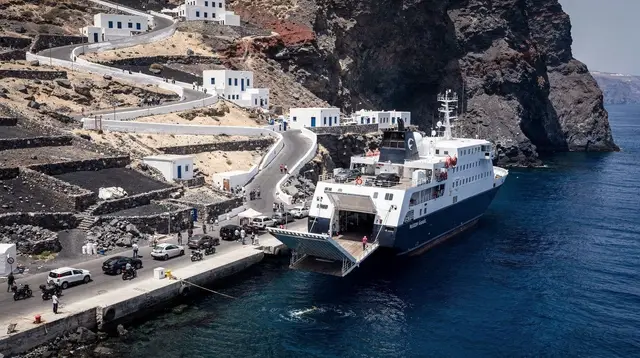
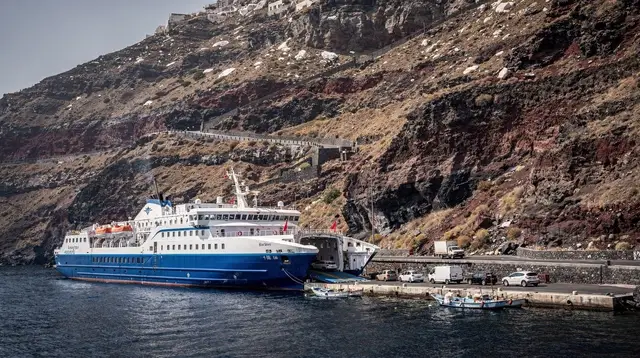
Every ferry to Mykonos leaves from Athinios, Santorini’s only ferry port, on the island’s west coast below the caldera villages. There is no ferry service from the old port in Fira or from any of the beach towns — Athinios is the sole option, and getting there in good time matters more than the crossing itself.
The port has a steep switchback access road, a crush of buses and taxis around every departure, and essentially no shelter, seating or luggage storage, so arriving with margin is worth more than it sounds. The full mechanics of getting to and through the port are covered in the Athinios port guide; the Santorini ferry guide covers routes beyond this one specific link.
Two kinds of boats run the route, and they behave differently enough to matter:
| Ferry type | Typical duration | Frequency | What to expect |
|---|---|---|---|
| High-speed catamaran | Roughly 2 to 2.5 hours | Several times daily in high season, fewer in winter | Faster, more exposed to swell, seats mostly assigned, luggage in a hold |
| Conventional ferry | Noticeably longer, more variable | Fewer daily departures | Slower but steadier in wind, open decks, more space to move around |
Treat both figures as order-of-magnitude rather than a timetable: duration depends on the operator, the specific vessel and how many other islands the boat calls at along the way. Some sailings run direct; others stop at Ios or Naxos first, which adds real time even though the map distance looks the same.
The other variable is the meltemi, the strong seasonal north wind that peaks from July into August. It doesn’t just make the crossing bumpier — it is the single most common reason fast ferries are delayed or cancelled outright between the islands. If this leg is your only way to reach a flight or another booking, build in a spare day rather than scheduling the connection back-to-back; the meltemi explained page goes into how the wind behaves month by month.
Booking the crossing without the port-day stress
Tickets can be bought directly from ferry operators, through a general booking site, or as part of a package that also handles the transfer on either end. The version worth knowing about pairs the ticket itself with a transfer on arrival: a ferry ticket bundled with a hotel transfer once you land in Mykonos removes one of the more annoying parts of arrival day — finding a taxi at a Mykonos port that is just as chaotic as Athinios, especially in the evening when several boats land within the same hour.
If you’re arranging your own transfer instead, the general patterns for taxis and transfers around the island — including how few taxis actually exist — are covered in Santorini taxis and transfers, and the same scarcity holds true on the Mykonos side.
Whichever way you book, carry the confirmation on your phone and on paper if you can — Athinios has patchy signal at peak times, and boarding staff move fast through a crowd that’s already tired from the road down the cliff.
Or let someone else handle the whole hop
If juggling ticket times, port transfers and luggage across two islands sounds like more logistics than the trip is worth, a guided crossing removes most of the decision-making: a guided island-hopping trip that handles the ferry, the transfers, and the timing between Santorini and Mykonos is built specifically around this one link rather than a longer multi-island loop, which keeps the day simpler if Mykonos is your only planned stop beyond Santorini.
It suits travelers who’d rather spend the crossing looking at the water than checking departure boards. Once you land, the usual first stops in Mykonos Town, the windmills and the beach clubs are covered under things to do in Mykonos rather than here — this page stays focused on getting there and on Delos.
Is two days actually enough?
It depends on what “enough” means. Two days is enough to cross, see Mykonos Town, and fit in Delos — it is not enough to also relax on a beach, do a boat trip, and see everything at a comfortable pace. A workable version looks like this:
| Day | Morning | Afternoon | Evening |
|---|---|---|---|
| Day 1 | Ferry from Athinios to Mykonos | Settle in, walk Mykonos Town | Dinner in town |
| Day 2 | Delos excursion (weather and schedule permitting) | Back on Mykonos, beach or more of the old town | Free, or ferry onward |
A packaged version of exactly this pairing exists as a two-day trip from Athens that loops through both islands:
a two-day combination trip that pairs Santorini and Mykonos from AthensIf your dates are fixed and short, this kind of pre-built pairing removes the guesswork of matching ferry times to hotel check-ins on both ends. If you have more time to spend, a full week split between the two islands is covered in the Santorini and Mykonos one-week itinerary, which leaves real room for a beach day and doesn’t compress Delos into a rushed morning.
Where Delos actually fits in
This is the part worth getting right, because the two mistakes are easy to make and hard to undo once you’re on a boat.
Delos is reached only from Mykonos. There is no direct excursion boat from Santorini, and no ferry that stops there on the way. Anyone who wants to see Delos has to first be in Mykonos, then book the separate, short boat crossing from the Mykonos port to the island.
Delos closes on Mondays for much of the year, and it has no accommodation of any kind — no hotel, no guesthouse, no room to rent. It is a protected archaeological site, not a village, and every single visitor leaves on a boat the same day they arrive. That makes two planning errors worth naming outright: don’t schedule your only free day on Mykonos for a Monday if Delos is the reason you came, and don’t build an itinerary that assumes you can stay there overnight to “beat the crowds” the next morning — there is nowhere to stay.
| Question | Reality |
|---|---|
| Can I reach Delos from Santorini directly? | No — only from Mykonos |
| Is Delos open every day? | No — closed Mondays for much of the year; check current hours before booking |
| Can I sleep on Delos? | No — no accommodation exists on the island |
| How long is a typical visit? | A half-day, including the short boat crossing each way |
Because opening days and boat schedules shift by season, treat the Monday closure as a rule to plan around rather than a fixed fact to quote at the ticket office — always confirm before you book. The full logistics of tickets, timing and what the site actually contains are covered in the Delos day trip guide; this page exists to make sure the Santorini-to-Mykonos leg and the Delos side trip don’t get tangled into one plan that doesn’t work.
If you want to keep going past Mykonos
Some travelers use Santorini to Mykonos as one leg of a longer Cyclades run rather than a there-and-back pairing. If that’s the plan, a week-long routing that threads Mykonos in among several islands is a more efficient way to book it than stitching separate ferries together yourself:
a week-long island-hopping route from Athens that works Mykonos into a longer Cyclades loopFor the full range of multi-stop routes through the Cyclades — including how Naxos, Paros and Milos fit around this same corridor — see Cyclades island-hopping routes, which covers the broader planning that sits outside the scope of this single-link page.
Practical notes before you book
A few details that don’t fit neatly above but change how the day actually goes:
- Luggage: high-speed catamarans store bags in a lower hold you can’t access mid-crossing, so keep anything you need in hand luggage.
- Seasickness: the open stretch of water between the islands can get choppy under the meltemi even when the forecast looks mild; if you’re prone to it, a seat toward the center and lower deck helps more than one at the stern.
- Arriving in Santorini first: if this crossing is the second leg of your trip, the Santorini airport guide covers getting from JTR to Athinios with enough margin for port chaos.
- Cash: Mykonos, like Santorini, is card-friendly almost everywhere, but keep a little cash for the Delos boat ticket counter and smaller tavernas.
- Don’t cut it close: whichever way you book the ferry, plan to be at the port at least 30 to 45 minutes before departure — Athinios in particular fills up fast in the final stretch before a sailing, with taxis and tour buses arriving in waves.
None of this makes the crossing complicated. It’s a well-worn route between two of the Cyclades’ busiest islands, and the ferries run often enough that the main risk isn’t missing the boat — it’s assuming Delos will simply slot into whatever day happens to be free, when it only ever works from Mykonos, and never on a Monday.
Frequently asked questions about the Santorini to Mykonos ferry and Delos
How long is the ferry from Santorini to Mykonos?
A high-speed catamaran usually takes around 2 to 2.5 hours from Athinios. Conventional (slower) ferries cover the same route in longer, more variable times. Treat any duration as an estimate, since it shifts by company, boat and sea conditions.
Can I visit Delos directly from Santorini?
No. There is no direct route to Delos from Santorini. Delos excursion boats leave only from Mykonos, so a Delos visit means first crossing to Mykonos and booking the short boat trip from there.
Is Delos open on Mondays?
For much of the year, no. Delos closes on Mondays, so a Monday arrival on Mykonos is not the day to plan the excursion. Check the current schedule before booking, since hours shift by season.
Can I stay overnight on Delos?
No. Delos has no hotels, rooms or campsites — it is an archaeological site, not a village. Every visit is a same-day excursion from Mykonos, out on one boat and back on a later one.
Is the Santorini-Mykonos ferry affected by wind?
Yes. The meltemi, which blows hardest from July to August, can delay or cancel high-speed crossings between the islands. Building a buffer day around a ferry-dependent connection is safer than booking a tight same-day link onward.
Should I book the ferry separately or take an organized crossing?
Both work. Booking the ferry yourself gives more flexibility on timing; a bundled crossing with a transfer removes the port logistics on both ends, which matters most at Athinios, where there is no left-luggage or shelter to speak of.
How far ahead should I book the Santorini to Mykonos ferry?
In July and August, popular sailings and cabins sell out days ahead, so booking as soon as dates are fixed is worth it. In the shoulder months, a few days’ notice is usually enough.
Is two days enough for Santorini, Mykonos and Delos?
It is tight but workable if the itinerary is built around it: one day for the crossing and a first look at Mykonos, one day for Delos in the morning and Mykonos Town in the afternoon. It leaves little room for delays, so it suits travelers with some flexibility.
Island Hopping on GetYourGuide
Verified deep-linked GetYourGuide tours. Book through these links and we earn a small commission at no cost to you.
GetYourGuide does not provide a product photo for this activity — the image shows the meeting point, photographed by us.