Thira or Santorini? Same Island, Two Names
If you’ve seen the island called both Thira and Santorini and assumed they were different places, you’re not alone — it’s the single most common mix-up for first-time visitors. Thira (Θήρα) is the official Greek name, used on ferry tickets, government documents, and the airport code JTR. Santorini is the Venetian-era name, given after Saint Irene, and it’s the name used by nearly every airline, travel site, and this one. The local municipality is the dimos of Thira, which administers the whole archipelago, not just the crescent-shaped main island. There is no separate island called Santorini sitting somewhere else — it’s one place with two names, and both are correct.
That distinction matters before you go further, because almost everything else on this site — villages, beaches, wine estates, boat trips — sits inside that one island and its immediate neighbours. This page is the orientation: what the island actually is, how its pieces fit together, and when and how to arrive. For the villages themselves, see the Fira, Imerovigli & Oia caldera rim region; for the geology behind the view, see how the caldera was formed.
An Archipelago, Not Just an Island
“Santorini” usually refers to the main crescent-shaped island, but it’s really the largest piece of a five-part archipelago, all remnants of the same collapsed volcano:
- Thira — the main island, home to every village and beach most visitors see.
- Thirassia — a small, sparsely populated island directly across the caldera from Oia, reachable by day-trip boat or a short ferry from Ammoudi.
- Nea Kameni — the black, still-active volcanic cone in the centre of the caldera, where cruise passengers land to walk up to the crater.
- Palea Kameni — a smaller islet next to it, known for the rust-coloured hot springs you swim to rather than land on.
- Aspronisi — an uninhabited rock at the southwestern edge of the caldera, visible from boats but not a stop on any itinerary.
Together they trace the rim and floor of what used to be a single, much larger volcanic island before it collapsed inward. Understanding that the black islets in the middle of the bay are part of the same place you’re staying — not a separate destination — makes the geography click much faster than a map alone.
The Shape of the Caldera
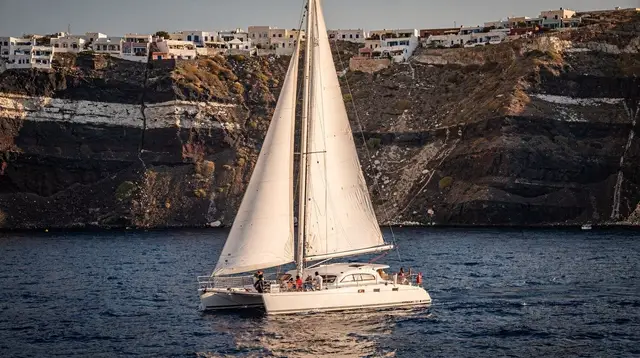
The flooded caldera at the centre of the archipelago measures roughly 12 kilometres by 7, and its inner wall — the cliff every postcard photo is taken from — rises 250 to 300 metres straight out of the sea on the island’s western side. It was carved out by the Late Bronze Age eruption, generally placed at around 1600 BCE, though the precise date is still debated between radiocarbon dating and archaeological chronology; nothing here is settled to the year, and this site won’t pretend otherwise.
This page won’t re-explain the caldera’s geology in depth or walk through its clifftop villages one by one — that belongs to two more focused pages: how the Santorini caldera was formed for the volcanic history, and the Fira, Imerovigli & Oia region page for the villages strung along its rim. What matters here is the basic shape: a ring of cliff on one side, open water and low land on the other, with the volcanic islets sitting in the middle of the bay they created.
Where People Actually Stay
Nearly every caldera-facing photo of Santorini was taken from one of four villages perched on the western cliff: Fira, the island’s capital and transport hub; Imerovigli, quieter and higher up; Firostefani, a short walk from Fira with the same views and fewer crowds; and Oia, at the island’s northern tip, famous for its sunset. None of these villages have a beach — the cliff drops straight into the caldera, and the closest thing to swimming from up there is the small bay at Ammoudi, well below Oia.
The island’s beaches sit on the opposite, gentler side: Kamari and Perissa, both black-sand and equipped with sunbeds and tavernas, flank the Mesa Vouno ridge on the south coast, and the striking Red Beach near Akrotiri draws crowds for its colour rather than its comfort. This page won’t detail any of them individually — each has its own page — but the pattern is worth knowing upfront: view and sunset on one side, sand and swimming on the other, and a fair number of visitors split their stay between the two rather than choosing only one.
Getting There and Getting Around
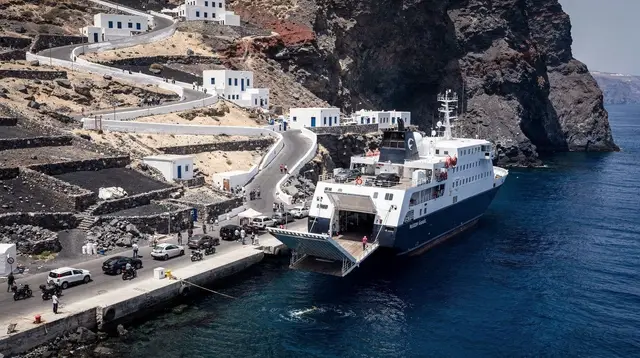
Most visitors arrive one of two ways. Santorini’s airport (JTR) sits about 6 kilometres from Fira and has year-round connections to Athens plus direct seasonal flights from several European cities — a flight from Athens takes around 40 minutes. The alternative is the ferry: Athinios, on the island’s western coast, is the only passenger port, serving Piraeus, the rest of the Cyclades, Crete, and Rhodes. It sits at the foot of the caldera cliff, reached by a steep switchback road, and every arrival brings a short burst of congestion as buses, taxis, and rental cars queue at once.
A separate, smaller harbour — the old port of Fira, also called Skala — only receives cruise-ship tenders and excursion boats, not scheduled ferries. From there, most people ride the cable car up to Fira in about three minutes; the alternative is the 588 steps on foot, or by donkey. On the donkeys: there’s no outright ban, but a weight limit was introduced in 2018 and stricter animal-welfare rules were under discussion for the 2026 season — walking or taking the cable car sidesteps the question entirely.
Once on the island, KTEL buses run from a central station in Fira out to most villages and beaches, and are cheap but crowded in season and sparse after early evening. Taxis are genuinely scarce — around thirty for the whole island — so a booked transfer is the norm, not a backup plan. Renting a car, scooter, or ATV is common and gives the most flexibility, though a matching licence category is required and checked, and quad accidents are the leading cause of tourist hospital visits on the island — worth taking seriously rather than treating as a formality.
If your time is limited and you’d rather see the island from the water than fight for a parking spot, a day cruise around the caldera covers the volcanic islets and a swim stop in one outing:
a full-day boat trip around the caldera, with a stop at the volcano and the hot springsWhen to Come
Santorini has three distinct seasons rather than a single “best time.” High season, June through September, brings the driest heat, the strongest meltemi wind — which can cancel boat trips outright — and the highest prices and crowds. The shoulder months, late April through May and October, are generally the best compromise: warm enough for most people, noticeably quieter, though the sea is still cool in May and at its best by October. Winter, November through March, sees many hotels, restaurants, and caldera-cruise operators close entirely; it isn’t a dead season so much as a different, much smaller island, and it shouldn’t be sold as equivalent to the rest of the year.
| Season | Months | What to expect |
|---|---|---|
| High season | June–September | Hottest, driest, busiest; strongest meltemi winds |
| Shoulder season | Late April–May, October | Warm, quieter, best overall value |
| Winter | November–March | Many businesses closed; cool, very quiet |
It’s also worth knowing the island’s recent seismic history without overreacting to it: in early 2025, an earthquake swarm between Santorini and Amorgos produced tens of thousands of tremors over about six weeks, prompted a local state of emergency, and led several thousand people to leave temporarily. No eruption occurred, and researchers have since linked the swarm to magma moving through a deep reservoir rather than surface volcanic activity. The swarm ended months ago. It’s a fact worth having in mind, not a reason to avoid booking — see Santorini safety and the 2025 earthquakes for the fuller picture.
What the Island Is Actually Known For
Ask most people what they picture when they hear “Santorini” and the answer is the Oia sunset — and it earns the reputation, even if the Kastro viewpoint fills up 90 minutes to two hours before the light actually turns in high season. Watching it from the water avoids the scramble for a spot entirely:
a sunset cruise around the caldera that faces the cliff instead of competing for a seat on itThe island’s other signature is wine. Vines here are trained low, in woven, basket-like coils called kouloura, to shield the grapes from wind and catch what little moisture the air provides — there’s no irrigation at all, and no rivers or springs on the island; even tap water comes from desalination. The result is Assyrtiko, a mineral, high-acid white that thrives despite the heat, alongside the sweet, sun-dried Vinsanto most people bring home. A tasting at one of the clifftop estates near the wineries pairs naturally with the same golden-hour light everyone comes for:
a late-afternoon wine tour timed to finish as the light turns gold over the calderaBeyond the view and the wine, Santorini’s volcanic identity runs deeper than most visitors realise. The Bronze Age eruption that carved out the caldera also buried a Minoan town at Akrotiri, excavated since 1967 and now covered by a roof that makes it visitable in any weather — notably, no human remains have been found there, suggesting its residents had time to leave.
It’s a different site entirely from the Ancient Thira ruins on the Mesa Vouno ridge, which date from a much later, classical-era settlement. And the volcano itself is still there to visit, not just imagine: cruises land at Nea Kameni’s active crater and swim guests over to Palea Kameni’s warm, iron-tinted springs — worth knowing that a small entry fee for the crater walk, usually paid in cash on-site, generally isn’t included in the boat ticket.
Practical Basics Before You Book
A few things are easy to overlook until you’re already there. Water is desalinated, not drawn from any river or spring — it’s safe to drink but tastes noticeably of salt, and most residents and visitors stick to bottled water. Cash matters more than you’d expect on a well-developed island: the Nea Kameni entry fee, some taxis, and small village tavernas often don’t take cards. A per-night accommodation tax applies at hotels and is settled on-site, in addition to your room rate.
If your trip includes a wider loop of the Cyclades, Santorini works well as a base for it — fast ferries from Athinios reach islands like Ios, Naxos, Paros, and Milos in a few hours, with durations that vary by route and operator rather than a fixed timetable. See island hopping from Santorini for how to sequence it. And if you’re arriving by cruise ship for a single day rather than staying overnight, that’s different enough logistically — tender queues, the levy on cruise passengers, limited hours — that it has its own dedicated guide worth reading before you plan the day.
For a longer stay, working out how many nights actually suit your pace and how to split time between a caldera view and a beach base is worth doing before you book a hotel — see how many days in Santorini and first-time in Santorini for that next step.
Santorini and Thira: Common Questions
Is Santorini the same place as Thira?
Yes. Thira is the official Greek name of the island; Santorini is the Venetian name, from Saint Irene, and is used interchangeably by everyone from airlines to locals. They are not two different places — the confusion is purely about naming, not geography.
What islands make up the Santorini archipelago?
Five: Thira, the main crescent-shaped island; Thirassia, its quiet neighbour across the caldera; Nea Kameni and Palea Kameni, the two black volcanic islets in the middle; and Aspronisi, an uninhabited rock to the southwest. All five are remnants of the same collapsed volcano.
How big is the Santorini caldera?
The flooded caldera measures roughly 12 by 7 kilometres, with the inner cliff on Thira’s western side rising 250 to 300 metres straight out of the sea. It formed after the Late Bronze Age eruption, generally dated to around 1600 BCE, though the exact date is still debated.
How many days do I need in Santorini?
Four to six nights lets you see the caldera villages, get to at least one beach, take a boat trip, and still have slack time — this island rewards slow mornings more than a packed checklist. Two or three nights works only if you’re combining it with another island.
Is Santorini safe to visit after the 2025 earthquakes?
Yes. The seismic swarm that began in January 2025 lasted about six weeks and produced tens of thousands of tremors, but there was no eruption, and the activity has since stopped. It’s worth knowing the background, not a reason to cancel a trip.
Should I stay in a caldera village or near a beach?
Caldera-side villages like Fira, Imerovigli, and Oia sit on the cliff with no direct beach access but the views everyone comes for; beach towns like Kamari and Perissa trade that view for flat streets, sand, and lower prices. Many visitors split a stay between the two.
Do I need a car in Santorini?
Not strictly — buses run from Fira to most villages and beaches, and taxis and transfers cover the rest — but the island is spread out and buses thin out in the evening, so a rental car or scooter makes a short stay noticeably easier.
What is Santorini actually known for?
The caldera view and Oia sunset first, then the Assyrtiko wines grown on ash-covered slopes, the volcanic islets you can sail out to, black and red sand beaches, and the Bronze Age site at Akrotiri, buried by the same eruption that shaped the island.