Santorini Safety and the 2025 Earthquakes
Is Santorini safe to visit after the 2025 earthquakes?
Yes. The seismic swarm that shook the area between Santorini and Amorgos in early 2025 was intense but produced no eruption and no lasting damage to tourist infrastructure. It ended within about six weeks, and researchers now attribute it to a deep magma intrusion rather than a warning of imminent volcanic activity. Boats, hotels, and volcano tours have operated normally since.
What Actually Happened in Early 2025
In late January 2025, an earthquake swarm began under the sea between Santorini and Amorgos. It started on 27 January and ran for roughly forty days. Over that period, seismographs recorded more than 28,000 individual tremors, the great majority too small to feel, but a number of them reached magnitudes strong enough to be felt clearly across the island, with the largest measured at around magnitude 5.2.
The pace and clustering of the swarm was unusual enough that Greek authorities declared a local state of emergency, closed schools on Santorini for several weeks, and advised caution around the harbour and older stone buildings in the caldera villages. Several thousand residents and workers left the island during the peak of the activity, and ferry companies added capacity to help people travel. It was, by any measure, an anxious few weeks for the people who live there.
What did not happen is just as important: no eruption occurred, no crater activity was observed on Nea Kameni, and no lava, ash, or gas emissions accompanied the swarm at any point. By March 2025, seismic activity had dropped back toward normal background levels, schools reopened, and the emergency measures were lifted.
If you are reading this because a headline from that period is what brought you here, the short version is that the event was real, it was significant for the people living through it, and it ended without an eruption.
Why Scientists Ruled Out an Eruption
Santorini sits on one of the most heavily monitored volcanic systems in the eastern Mediterranean, with a permanent network of seismometers, GPS stations that track tiny movements of the ground, and instruments that sample volcanic gases. That existing monitoring network is what allowed researchers to read the 2025 swarm quickly rather than guess at it after the fact.
The pattern that emerged pointed to a magma intrusion in the form of a dyke, magma pushing upward through a crack in the surrounding rock from a deep reservoir, rather than pressure building directly beneath the crater. Ground-deformation data showed the seabed between Santorini and Amorgos shifting slightly as this happened, consistent with a body of magma moving through rock at depth without approaching the surface. For a full walk-through of how the caldera itself formed and how the volcano’s plumbing is understood today, see how the caldera was formed.
This is a genuinely different mechanism from the kind of shallow pressure build-up that precedes an eruption, and it is why the scientific consensus moved fairly quickly from uncertainty to reassurance. It does not mean earthquakes and volcanism are unrelated on Santorini, they are part of the same underlying system, but a dyke intrusion at depth is not the same signal as a volcano preparing to erupt.
Is Santorini Volcanically Active Today
Yes, in the sense that Santorini is and always has been part of an active volcanic arc. The island’s active crater, on Nea Kameni, last erupted in 1950, following earlier episodes in 1939 to 1941, 1925 to 1928, and 1707. That history is worth knowing precisely because it puts 2025 in context: this is a volcano that erupts on a scale of decades, not one that had been dormant for centuries and suddenly stirred.
No, in the sense that matters for a 2026 trip: there is no ongoing eruption, no elevated alert level, and no restriction on visiting the crater or the hot springs at Palea Kameni. The swarm has ended, and monitoring since then has shown activity at typical background levels for the region. Occasional small, unfelt earthquakes are normal here and were normal long before 2025.
If you want the wider picture of how Santorini’s volcanic islets are actually visited today, from crater walks to the swimming stop at the hot springs, our guide comparing volcano tours covers what each option includes and what it costs.
What This Means If You’re Planning a Trip
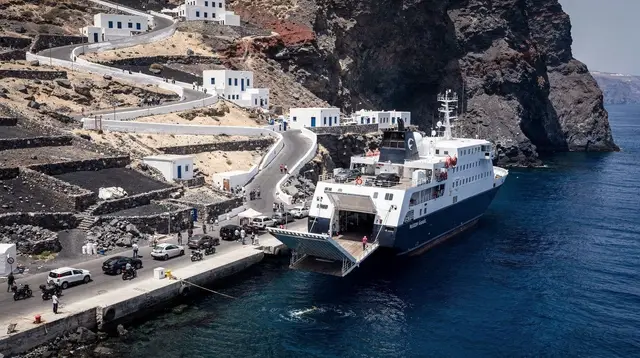
For a traveller booking a trip in 2026, the practical answer is that the 2025 swarm changes very little. Flights into Santorini’s airport run on the usual schedule, ferries dock at Athinios as they always have, and the caldera villages of Fira, Imerovigli, and Oia are open and operating normally.
That said, it is fair to hold two facts at once. The island experienced a genuine, disruptive seismic event in early 2025, and the region remains one where earthquakes happen, sometimes noticeably. Neither of those facts means the island is currently unsafe. Greece has decades of experience managing seismic risk across the Aegean, and Santorini’s monitoring network is specifically built to catch early signs of change well before they would affect a visitor.
If earthquakes weigh on your travel decisions generally, it can help to time a visit outside the height of summer, when the island is markedly quieter in every sense. Our guides to the best time to visit and Santorini’s weather month by month lay out how the island changes across the year, and visiting in winter is its own experience worth reading about on its own terms rather than as a fallback.
Cruises, Boats, and the Volcanic Islets Now
Boat-based activities are the part of a Santorini trip most directly tied to the volcano, since several of them sail into the caldera and land on the volcanic islets themselves. All of them continued through and after the 2025 swarm without operational changes.
A standard day cruise into the caldera typically stops at Nea Kameni for the crater walk, then at Palea Kameni for a swim near the hot springs, before continuing to Thirassia. None of these stops were affected by the swarm, and none require any special precaution beyond the ordinary advice given on board, sturdy shoes for the crater trail and old clothes for the iron-rich hot spring water, which stains fabric.
For travellers who want the caldera view without the crater walk, a sunset cruise along the caldera stays on the water and returns after dark, a good option if you would rather watch the cliffs from below than compete for a spot on land. Divers can go further, with a guided diving tour that explores the underwater slopes of the caldera itself, terrain shaped by the same volcanic history discussed throughout this page.
None of these operators paused or restructured their routes because of the 2025 swarm. The event was centred on a seabed fault zone north-east of the island, not on the crater or the caldera waters where these trips actually take place.
How Greek Authorities and Scientists Monitor the Island
Santorini’s volcanic complex is tracked around the clock by Greek geological institutes, using a combination of seismometers, GPS receivers that detect ground movement of just a few millimetres, and equipment that samples volcanic gases for changes in composition. This is a long-standing network, not something set up in response to 2025, and it is the same system that identified the dyke intrusion as the swarm’s cause within weeks rather than months.
Civil Protection authorities in Greece are responsible for issuing any public advisory tied to seismic or volcanic risk, and it was this body, not tour operators or hotels, that declared the local state of emergency in February 2025 and lifted it once activity subsided. If conditions ever changed materially, this is the channel through which travellers and residents alike would be informed.
For day-to-day travel planning, this level of detail is more than most visitors need. It matters mainly as the answer to the question “how would anyone know if this happened again,” and the honest answer is that Santorini is already one of the better-monitored volcanic islands anywhere, precisely because of its history.
What To Do If You Feel a Tremor During Your Stay
Most of the earthquakes Santorini registers in any given year, including the occasional ones since the 2025 swarm, are too weak to feel at all. If you do feel one, it typically lasts a few seconds and causes no damage. Standard precautions still apply: step back from cliff-edge terraces and railings above Fira and Oia, and avoid standing directly under old stone archways until the shaking stops. Caldera-rim hotels are inspected regularly and were not among the structures damaged in 2025.
Getting around afterwards is unaffected, buses and rental cars or scooters keep running their usual routes, so see our guides to buses in Santorini and renting a car or scooter if you’d rather set your own schedule than wait on a fixed departure. The steep, stepped paths through Fira and Oia were not altered by the swarm either, so our accessibility guide remains an accurate reference for travellers with limited mobility.
Putting the Risk in Perspective
It is worth being direct about what the 2025 swarm was and was not. It was a real seismic crisis that disrupted daily life on the island for about six weeks, displaced people temporarily, and was taken seriously by scientists and authorities alike. It was not an eruption, it did not damage the island’s tourist infrastructure, and it has not repeated since.
Santorini’s tourism economy, its cruises, wineries, and the crowds gathering for the Oia sunset, continued through 2025 largely unaffected once the swarm itself passed. If you want a fuller account of what the weeks of the swarm actually looked like on the ground, from the perspective of residents rather than headlines, our piece on what actually happened in Santorini in 2025 covers it in more detail, and is Santorini still worth it addresses the broader question of visiting an island that draws this much attention, seismic and otherwise.
None of this means dismissing the topic. It means treating it the way the evidence supports: a documented, monitored, resolved geological event, on an island whose volcano last erupted in 1950 and whose ferries, flights, wineries, and boats have run on schedule since the swarm ended. If you’re building out the rest of your trip, our broader planning and one-week itinerary resources pick up from here, and a spot on an island highlights tour is as reasonable a way to spend a day in 2026 as it was before January 2025.
Santorini Safety and the 2025 Earthquakes: Your Questions Answered
What caused the 2025 earthquake swarm near Santorini?
Studies published after the swarm point to a magma intrusion in a dyke, magma forcing its way upward through a crack in the rock, rising from a deep reservoir between Santorini and Amorgos. It was a subsurface movement of molten rock, not a build-up beneath the crater that threatened an eruption.
How many earthquakes were recorded and how strong were they?
More than 28,000 tremors were logged between late January and early March 2025, with the strongest reaching around magnitude 5.2. Most were far smaller and were only picked up by seismographs, but the sheer number, and a run of stronger shocks, was enough to unsettle residents and prompt local authorities to act.
Did Santorini’s volcano erupt in 2025?
No. There was no eruption, no lava, and no ashfall at any point during or after the swarm. Santorini’s last eruption remains the one in 1950, on Nea Kameni, and nothing in 2025 changed that.
Is Santorini still seismically active in 2026?
The swarm itself is over: activity dropped back to background levels within weeks and has stayed there. Santorini sits in an active volcanic arc and will always register occasional small earthquakes, as it did for decades before 2025, but there is no ongoing crisis.
Should I cancel a Santorini trip because of the earthquakes?
There is no factual basis for cancelling on safety grounds. The swarm ended, tourism infrastructure was not damaged, and the island’s hotels, ferries, and boat operators have run on a normal schedule since spring 2025.
Are boat trips to Nea Kameni and Palea Kameni still safe?
Yes. Landings on Nea Kameni’s crater trail and swimming stops at Palea Kameni’s hot springs continued through 2025 and into 2026 without incident. These are normal-season operations, unrelated to the 2025 swarm, which was centred on a seabed fault system rather than the crater itself.
How does Greece monitor the Santorini volcano now?
The Santorini volcanic complex is one of the most closely watched in the Aegean, tracked continuously by seismometers, GPS ground-deformation stations, and gas-monitoring equipment run by Greek and international geological institutes. That network is exactly what allowed scientists to characterise the 2025 swarm quickly and rule out an eruption.
Where can I check for updates before I travel?
Greece’s Institute of Geodynamics publishes seismic bulletins, and the Greek Civil Protection authority issues any advisories that would affect travellers. In practice, for the vast majority of visitors this is a background check rather than an active concern.
Trip-planning essentials on GetYourGuide
Verified deep-linked GetYourGuide tours. Book through these links and we earn a small commission at no cost to you.
GetYourGuide does not provide a product photo for this activity — the image shows the meeting point, photographed by us.