Santorini Volcano Tours Compared
Should I book a half-day or full-day Santorini volcano cruise?
A half-day trip covers the Nea Kameni crater hike and a swim stop near Palea Kameni's hot springs in about 3-4 hours; a full-day or sunset cruise adds a longer swim, sometimes Thirassia, and a BBQ or dinner on board. Whichever you pick, Nea Kameni's roughly €5 landing fee is paid in cash on the island and is usually not included in the price you see online.
Same volcano, five very different tours
Every boat that leaves for the middle of the caldera is heading to the same place: the black cone of Nea Kameni, with a swim stop near the rust-coloured hot springs off Palea Kameni tacked on either before or after. Past that, the listings stop looking alike. Some tours are done in three hours, others fill an entire afternoon. Some pack forty people onto a catamaran with a barbecue grill on deck, others put six people on a rib boat with a guide who adjusts the route on the spot. Some are built to end with the boat facing Oia at sunset; others get you back to port by early afternoon.
None of this shows up clearly in a search results page full of near-identical thumbnails and similar-sounding titles. This guide isn’t about the volcano itself — for how the caldera was actually formed, see how the Santorini caldera was formed — and it isn’t a swimming guide either, since the practicalities of the hot springs at Palea Kameni have their own page. Nor does it cover the wider spread of caldera cruise options, which the guide to Santorini caldera cruises handles on its own. What follows is the comparison that actually helps before you book: half-day against full-day, private against shared, sunset-included against daylight-only, and the one line item that catches almost everyone off guard.
The fee nobody prices into the headline number
Start here, because it changes how you read every offer on this page. Nea Kameni, the still-active islet at the centre of the caldera, charges a landing fee of roughly €5 per person. It is collected in cash, at a booth on the island itself, by the authority that manages the islet — not by the boat operator, and not as part of whatever you paid when you booked.
Most cruise listings, on every platform, do not fold this into the advertised price. It isn’t hidden out of bad faith; it’s simply a separate, government-set charge that changes independently of the tour operator’s own pricing, so operators tend to flag it in the fine print rather than the headline. The practical result is the same either way: you’ll be standing at a booth on a black volcanic path being asked for cash you didn’t budget for, unless you read the description in advance.
Before boarding anything, check the listing for a line like “entrance fee not included” or “landing fee payable locally.” If you don’t see it mentioned at all, assume it isn’t included rather than assume it is — that assumption has cost more travellers a slightly awkward moment on the crater path than any other detail of this trip. Bring small euro notes; card machines are not the norm on Nea Kameni, and a queue of tourists all needing change from a €50 note is not a fast queue.
Half-day or full-day: what the extra hours actually buy
The base structure of a half-day tour is consistent across operators: a boat ride out to Nea Kameni, the crater walk, a swim stop near the hot springs off Palea Kameni, and the return. Door to door, this runs about three to four hours. It’s enough time to say you’ve stood on an active volcano and swum in water tinted by its minerals, without giving up a whole day of your trip.
A full-day version keeps both of those stops but stretches everything around them: more time in the water, sometimes an added call at Thirassia for lunch in a quiet village across the caldera, and a proper meal on board rather than a bottle of water and a snack. Some full-day itineraries are timed to finish with the sunset cruise built in, turning the return leg into the main event rather than an afterthought.
What a full-day tour rarely does is add a second volcanic landing or a longer crater hike — the walk up Nea Kameni is roughly the same 25 to 30 minutes each way regardless of which tour you’re on, because that’s simply how long the marked path is. You’re paying for more time on the water and a more relaxed pace, not for more volcano.
| Format | Typical duration | What’s included beyond the crater and springs | Nea Kameni fee |
|---|---|---|---|
| Half-day | 3–4 hours | Return transfer, short swim stop | Usually extra, paid on-site |
| Full-day | 6–8 hours | Longer swim, meal on board, sometimes Thirassia | Usually extra, paid on-site |
| Sunset-inclusive | 4–6 hours, afternoon start | Timed to finish facing Oia’s cliffs at golden hour | Usually extra, paid on-site |
| Private boat | Set by you | Flexible stops, own pace, often smaller group | Usually extra, paid on-site |
That last column repeats itself on purpose. Whatever else changes between these formats, the entrance fee doesn’t disappear — check each listing individually rather than assuming the pattern holds for every operator.
Private motorboat, small rib, or shared catamaran
The boat type changes the trip almost as much as the duration does.
A shared catamaran or larger motor cruiser is the standard, most affordable option. You’ll be one of several dozen passengers, the schedule is fixed, and the stops are chosen by the operator rather than negotiated on the day. For a solo traveller or couple, this is usually the best value, and larger boats also sit more steadily in choppy water, which matters if you’re prone to seasickness.
A small rib boat trades comfort for intimacy and speed. Groups are smaller, the ride out is faster and bouncier, and some rib tours include an escorted hike up the crater with more one-on-one guiding than you’d get shuffling up the path with forty other people. It suits travellers who want a faster, more active version of the same itinerary.
A private motorboat charter is the most flexible and most expensive option. You set the schedule, decide how long to linger at each stop, and can turn back early if the wind picks up or the light isn’t cooperating for photos. Split between four or more people, the per-person cost can land surprisingly close to a shared tour, which is why groups of that size often skip the shared boat entirely. Whether that extra cost is worth paying for your group is exactly the question the guide to private tours in Santorini works through in more general terms.
a half-day volcano and hot springs cruise on a shared boat covers the standard format described above, while a small rib boat tour with an escorted crater hike is the faster, more guided alternative for a smaller group.
Should the sunset be part of the plan?
Not every volcano tour is built around sunset, and that’s worth checking before you book rather than assuming it’s a given. Purely daylight tours are timed to have you back at port by mid-afternoon — useful if you have dinner plans elsewhere or simply don’t want to spend your evening on a boat.
Sunset-inclusive cruises push the departure later in the day and plot the return leg to have the boat facing the caldera’s western rim, near Oia, as the light changes. This is one of the more honest ways to experience Santorini’s famous sunset without competing for space on the Kastro in Oia itself — you’re watching the cliffs from the water rather than fighting a crowd for a viewpoint on top of them. It does mean a longer day and, on most listings, a higher price, since a meal on board is usually bundled in. For a side-by-side look at that trade-off against watching the sunset from Oia on foot, see sunset cruise or Oia on foot.
a volcano cruise timed to end with the sunset off Oia follows this format, pairing the standard crater and springs stops with a later return built around the light. If a private, unhurried version of the same idea appeals more, a private motorboat charter combining the volcano hike with your own schedule lets you decide exactly when to head back toward the caldera wall.
Reading a listing before you book
A few checks catch most of the mismatches between what a tour promises and what actually happens on the day:
- Does the fee appear at all? If the Nea Kameni landing fee isn’t mentioned anywhere in the description, don’t assume it’s included — assume the opposite and bring cash.
- What counts as “full-day”? Compare the stated start and return times against the half-day option from the same operator. A two-hour difference sometimes buys little more than a longer lunch.
- Group size, stated clearly. “Small group” without a number can mean anywhere from eight to twenty-five people. Rib boat and private listings tend to state capacity explicitly; larger catamaran tours often don’t.
- Meal details. “Snack,” “BBQ,” and “dinner” are three different things. If food matters to your plans for the rest of the day, check which one is actually offered.
- Weather policy. The meltemi wind, strongest from July into August, regularly forces operators to shorten routes or cancel smaller boats outright. A clear rebooking or refund policy for wind cancellations is worth confirming before you pay, especially for a rib or private charter booked well in advance.
a standard volcano and hot springs boat tour is a useful benchmark for comparing prices, since it follows the same core structure as most half-day options on this page — crater walk, swim stop, return — without sunset or a private upgrade attached.
What this trip isn’t
It’s worth being clear about what a volcano tour does not include, since a few misconceptions travel further than they should. There’s no lava to see: Nea Kameni’s last eruption was in 1950, and the crater you’re walking on is warm underfoot in places, not glowing. The hot springs near Palea Kameni are tepid rather than hot, and the water’s iron content will discolour a pale swimsuit — worth knowing before you jump in wearing something you’d rather keep clean. And the 2025 seismic swarm between Santorini and Amorgos, while real and disruptive at the time, ended without an eruption; it isn’t a reason to treat a volcano cruise as riskier today than it was before.
For the geology behind why this stretch of water looks the way it does, how the Santorini caldera was formed covers that ground properly. For the practical detail of the hot springs swim itself — water temperature, currents, what to expect stepping off the boat — the dedicated guide to Palea Kameni’s hot springs goes further than this comparison needs to.
Choosing between the formats
If you only have a spare afternoon and want the core experience without commitment, a half-day shared tour on a larger boat is the simplest, cheapest way to tick the volcano off your list. If you’d rather turn the trip into the day’s main event, a full-day or sunset-inclusive cruise adds the time and the light without changing what you actually see on Nea Kameni itself. And if budget allows or your group is large enough to split the cost, a private boat removes the guesswork around schedules and crowding entirely — at the price of paying for that flexibility.
Whichever you choose, the volcano itself doesn’t change: the same crater, the same twenty-five-minute walk, the same rust-tinted water off Palea Kameni. What you’re really comparing is pace, privacy, and whether the sunset is part of the deal — and remembering that small handful of euros the booking page probably didn’t mention.
FAQ about comparing Santorini volcano tours
Is the Nea Kameni entrance fee included in the cruise price?
Usually not. Nea Kameni charges a landing fee of around €5 per person, paid in cash at a booth on the island itself, not to the boat crew. Most catamaran and boat tour listings price the cruise, the crew and often food and drinks, but leave this fee out because it goes straight to the port authority managing the islet. Read the tour description carefully, and bring small euro notes anyway.
What’s the difference between a half-day and a full-day volcano tour?
A half-day tour is built around the Nea Kameni crater walk and a swim near Palea Kameni’s hot springs, usually 3 to 4 hours door to door. A full-day tour keeps those two stops and adds more time in the water, sometimes a call at Thirassia, and a proper meal on board rather than a light snack. The extra hours cost more but rarely add a second landing beyond the volcano itself.
Should I choose a private boat or a shared catamaran?
A shared catamaran or larger boat is cheaper per person and works well if you don’t mind a fixed schedule and other passengers. A private motorboat or small rib costs more but lets you set the pace, skip a crowded stop, or turn back early if the meltemi picks up. Groups of four or more often find a private boat comparable in price to several shared tickets.
Does every volcano tour include the Oia sunset?
No. Some cruises are timed purely around daylight hours for the crater hike and the hot springs, and return to port well before sunset. Others are built specifically to end facing Oia’s cliffs at golden hour, which pushes the departure later and usually adds to the price. Check the departure and return times, not just the title, before assuming sunset is part of the plan.
How long is the walk up the volcano crater?
From the Nea Kameni landing point, the path up to the active crater rim takes roughly 25 to 30 minutes each way over loose volcanic cinder. It’s an unshaded, moderately steep walk, not a technical climb, but closed shoes and water matter more than most people expect from a boat trip.
What should I bring on a volcano and hot springs cruise?
Cash in small euro notes for the Nea Kameni entrance fee, closed shoes for the crater path, a swimsuit you don’t mind staining, a towel, sun protection, and a light layer for the boat ride back. The iron-rich water at the hot springs near Palea Kameni discolors pale fabrics, so leave your favourite white swimsuit at the hotel.
Can the meltemi wind cancel a volcano tour?
Yes. The meltemi blows hardest from July into August and can force operators to shorten a route, skip a swim stop, or cancel departures outright when the sea gets too rough for small boats. This is a safety call made on the day, not a booking error, and it applies more to smaller ribs and open boats than to larger catamarans.
Which volcano tour is best for someone who gets seasick?
A larger catamaran sits more steadily than a small rib or open motorboat, which makes it the more comfortable choice on a breezy day. A half-day tour also limits total time on the water compared with a full-day or sunset cruise, which matters more than the boat type for most people prone to seasickness.
Popular Santorini experiences on GetYourGuide
Verified deep-linked GetYourGuide tours. Book through these links and we earn a small commission at no cost to you.
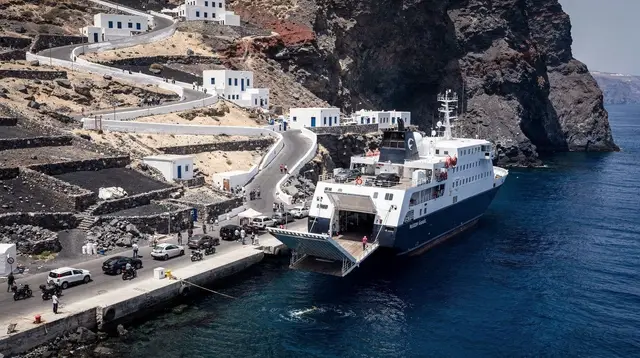
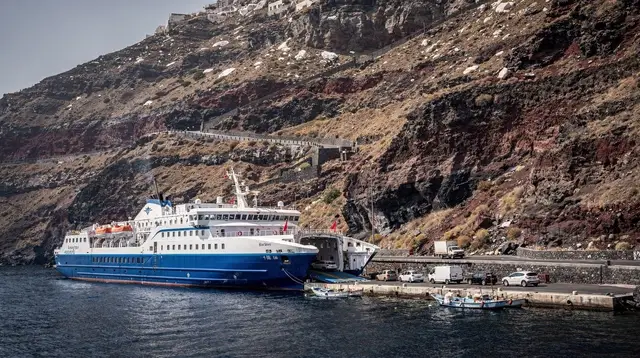
GetYourGuide does not provide a product photo for this activity — the image shows the meeting point, photographed by us.