The Crater You Can Actually Walk On
Most of what makes Santorini famous — the whitewashed villages, the cliffside sunsets, the wine terraces — sits on the rim of a collapsed volcano. Nea Kameni is the part that is still active: a low, dark islet rising from the middle of the caldera, built entirely of cooled lava and ash from eruptions that continued long after the Bronze Age catastrophe that shaped the wider bay. It is uninhabited, treeless, and, for a few hours at a time, full of visitors who came by boat to walk up to its crater.
There is no village here, no jetty town, no view of Oia’s blue domes. What there is: a short black-sand landing, a well-worn path through fields of volcanic cinder, and a rim from which you can look straight down into the most recent vent to have erupted on Greek soil. It is one of the few places in the world where a working stratovolcano sits inside a caldera that people live on the edge of, in plain sight of hotel balconies in Fira and Imerovigli.
Nea Kameni is not a place you plan a whole day around on its own. It is a stop — usually the anchor stop — on a caldera boat trip that also touches Palea Kameni for the hot springs and sometimes Thirassia for lunch. But it deserves its own explanation, because it is also the single most common source of confused, annoyed reviews about Santorini’s boat tours: people who did not know there was a cash entry fee, and people who assumed their cruise ticket covered everything on the water.
Getting There: Only By Boat
There is no ferry schedule to Nea Kameni, no public ticket counter, and no way to reach it independently. Every visit starts on a boat, typically departing from Athinios port or the old port of Fira, and the crossing itself takes something in the range of twenty to thirty minutes depending on where you start and how the boat is routed.
Three practical ways to get there:
- A shared caldera cruise or catamaran trip. These bundle Nea Kameni with Palea Kameni’s hot springs, a swim stop, and often lunch or drinks on board. This is the option most first-time visitors book.
- A private boat or yacht charter. More flexible on timing and crowds, at a higher price, and useful if you want to linger at the crater without a group schedule.
- A cruise-ship shore excursion. If you are arriving on a cruise call, Nea Kameni is one of the standard stops offered dockside, usually paired with a quick look at the caldera rather than a full day on the water.
Whichever way you arrive, the boat drops passengers at a small stone jetty on the islet’s northern side. There is no dock infrastructure beyond that — no cafés, no shop, no shade structure — so everything you need for the walk has to come with you.
The Walk to the Crater
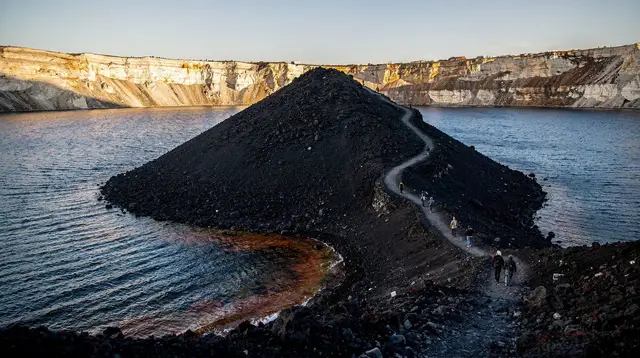
From the jetty, a single marked path climbs across the islet toward the main crater. It is not technical, but it is not paved either: the surface is loose volcanic cinder and ash, grey-black and slightly crunchy underfoot, with occasional larger rocks. The gradient is gentle at first and steepens modestly as you approach the rim.
Budget about thirty minutes each way at an unhurried pace, more if you stop often for photos or if the group in front of you is large. There is essentially no shade anywhere on the route, which matters enormously in summer heat — this is the detail that catches people out more than any other. Closed shoes are not a suggestion here; sandals and flip-flops turn an easy walk into a genuinely unpleasant one, and the loose gravel is unforgiving if you slip.
Near the top, the ground begins to show its volcanic character more directly: patches of discoloured, sulphur-stained rock, faint mineral smells, and in places a noticeable rise in ground warmth. None of this is dangerous on the marked path, but it is a reminder that Nea Kameni is not an extinct curiosity — it is the surface expression of a system that has erupted repeatedly within living memory, most recently in 1950, with earlier episodes in 1939-1941, 1925-1928, and 1707.
From the rim, the view opens out across the whole caldera: the crescent of Santorini’s cliffside villages behind you, Thirassia to the west, and the water filling in what was once, before the Bronze Age eruption around 1600 BCE, part of a much larger island. It is a genuinely strange perspective — looking at the postcard view of Santorini from inside the crater that helped create it.
The Entry Fee Nobody Mentions in Advance
Here is the detail that causes the most friction, and the reason this page exists as its own destination rather than a paragraph inside a cruise guide: landing on Nea Kameni requires a small entry fee, on the order of 5 euros per person, and it is collected in cash, on the islet, separately from whatever you paid for the boat trip.
Cruise and catamaran operators sell the transport, the swim stops, sometimes the food and drinks on board — but the entry fee to the protected volcanic site is a different charge, handled locally, and it is frequently not included in the advertised cruise price. Passengers who assumed a “full” caldera cruise ticket covered everything are the ones most likely to be caught without cash at the jetty.
The fix is simple: carry a small amount of cash in euros whenever you book a boat trip that includes a Nea Kameni landing, and if you are unsure, ask the operator directly before you board whether the entry fee is included. Do not assume either answer.
What Nea Kameni Is Not
It is worth being precise about what you will and will not see, because expectations set by dramatic photos of other volcanoes do not match this island.
There is no visible lava. The volcano last erupted in 1950; nothing has flowed here in over seventy years, and nothing is glowing, bubbling, or flowing today. What you are visiting is a dormant-looking but geologically active crater landscape — cinder fields, fumarole-stained rock, and a wide caldera view — not an eruption in progress.
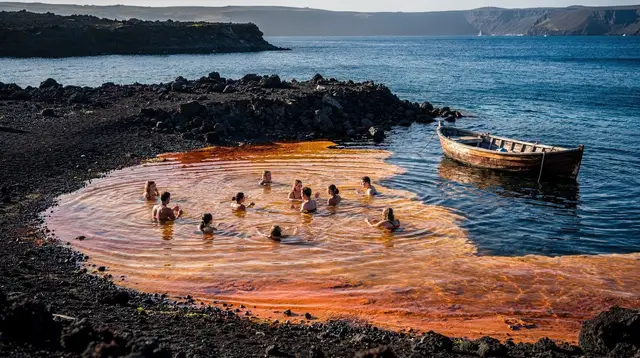
Nea Kameni is also not the place to swim. That happens at the neighbouring islet, Palea Kameni, where boats do not land at all; passengers swim directly from the boat to a patch of rust-orange, iron-rich water warmed by underwater vents. The two islets are almost always visited on the same trip, in that order, but they offer completely different experiences: one is a dry walk to a crater rim, the other is a swim to a discoloured, mineral-tinted sea.
The 2025 Earthquake Swarm, Briefly
Because Nea Kameni sits at the geological heart of the Santorini system, it is worth addressing the seismic activity that made international headlines in 2025. Starting on 27 January 2025, an earthquake swarm developed between Santorini and Amorgos, lasting roughly forty days and producing more than 28,000 recorded tremors, some as strong as magnitude 5.2. It led to a local state of emergency, school closures, and the temporary departure of several thousand residents.
There was no eruption. Research published since the swarm attributes the activity to a magma-filled dyke intrusion rising from a deep reservoir, not an imminent eruption at Nea Kameni or elsewhere in the caldera. The swarm ended months ago, and boat trips to the volcano operate normally. It is a fact worth knowing before you visit, not a reason to reconsider the trip.
Choosing a Boat Trip to Nea Kameni
Nea Kameni almost never appears as a standalone booking; it comes bundled into a wider caldera cruise. The main variables to weigh are timing, boat type, and what else is included.
| Trip style | Typical length | What’s usually included | Best for |
|---|---|---|---|
| Morning/day catamaran cruise | 5-7 hours | Nea Kameni walk, Palea Kameni swim, lunch, sometimes Thirassia | First-time visitors wanting the full picture |
| Shorter caldera cruise | 3 hours | Nea Kameni, Palea Kameni, drinks on board | Travellers with limited time |
| Sunset cruise | 3-5 hours | Caldera views, swim stop, sunset from the water | Couples, photographers avoiding Oia’s crowds |
| Private/semi-private charter | Flexible | Customisable stops and pace | Small groups wanting no fixed schedule |
For a straightforward day that covers the crater walk, the hot springs, and lunch on board, a day-time catamaran cruise with swim stops and a barbecue lunch is the most complete single option. Travellers with less time to spare tend to prefer a shorter three-hour caldera catamaran cruise with drinks included, which still fits in both islets without eating into a whole day.
If you would rather watch the caldera cliffs turn colour on the way back, a sunset catamaran cruise with swim stops and a barbecue dinner covers the same volcanic stops earlier in the trip, then times the return for the light show over Oia and Imerovigli — without competing for a spot on the cliff. For a simpler, no-frills option that still lands at Nea Kameni, a standard day cruise around the volcanic islands works well for anyone who wants the crater and hot springs without the extras.
Whichever trip you choose, remember that the Nea Kameni entry fee is separate from all of these prices — check with the operator, and carry cash.
Practical Notes for the Day
A few things worth knowing before you commit to a departure time or a particular boat:
- Wind matters more than heat. Santorini’s meltemi wind, strongest from July through August, regularly disrupts or cancels caldera crossings. Morning departures in the shoulder months are generally calmer.
- There is nothing to buy on Nea Kameni. No shop, no water vendor, no shade shelter. Bring your own water, sun protection, and a hat.
- The walk is not stroller- or wheelchair-accessible. The loose cinder path rules out wheeled access; anyone with mobility limitations should ask operators about alternative in-boat viewing.
- Photography is best in the late morning or afternoon light, when the crater’s textures and colours show up more clearly than in flat midday sun.
- Combine it with context, not just a boat ride. Reading a little about how the Santorini caldera was formed before you go makes the walk considerably more interesting than treating it as a photo stop.
Accessibility and Alternatives for Limited Mobility
The path from the jetty is loose volcanic cinder with no rail, no bench, and one steady climb of roughly a kilometre; wheelchairs, strollers, and canes with narrow tips cannot manage it, and operators will not guarantee assisted disembarkation for wheelchair users. Travellers with mobility limitations are usually better off staying aboard while the rest of the group walks to the rim — most catamarans still hold position long enough to take in the caldera view from the deck. For a fuller picture of which sites and viewpoints on the island work without stairs or gravel paths, the accessibility guide for Santorini covers the alternatives in more detail.
If You’d Rather Skip the Crater
Not every visitor wants a sweaty cinder walk in open sun, and Santorini has two half-day alternatives built around a different kind of history rather than geology. The Akrotiri excavations preserve a Minoan town buried under volcanic ash since the Bronze Age eruption, reached by covered walkways rather than loose gravel. Ancient Thira, a Doric hilltop city on Mesa Vouno, offers a similar trade of a paved or stepped path for sweeping views over Perissa and Kamari below, and pairs naturally with beach time afterward instead of a boat schedule.
Where Nea Kameni Fits in a Santorini Trip
For most visitors, Nea Kameni is a half-day commitment slotted into a longer stay, rather than the reason for the trip itself. It pairs naturally with a first full day exploring Fira or Oia, and works well as the “active” excursion sandwiched between village walks, wine tastings on the wineries route, and beach time at Perissa or Kamari.
If you are building out a full itinerary, see how a caldera cruise fits into a one-day plan for Santorini, or read a broader comparison of Santorini’s volcano tours and a dedicated look at what to bring on a caldera cruise before you book. For safety context around the 2025 seismic activity mentioned above, the fuller Santorini safety and the 2025 earthquakes guide covers what changed and what didn’t.
Nea Kameni will not be the prettiest photo from your trip — that is likely to come from a cliffside terrace at sunset. But it is the only place on the island where the geology stops being a backdrop and becomes the destination itself: a short, sweaty, genuinely worthwhile walk into the crater that built the view everyone else came to photograph.