Ancient Thira: The Doric City on Mesa Vouno
What is Ancient Thira and is it the same as Akrotiri?
Ancient Thira is a Dorian and later Hellenistic-Roman city on the Mesa Vouno ridge between Kamari and Perissa, occupied from roughly the 9th century BC. It has no connection to Akrotiri, the Bronze Age Minoan town on the other side of the island, which predates it by over a thousand years.
A Doric City with No Relation to Akrotiri
Most people who ask about “the ruins in Santorini” mean Akrotiri, the Bronze Age Minoan town buried by the volcanic eruption of around 1600 BC. Ancient Thira is a different site entirely, on a different part of the island, from a different civilisation, separated from Akrotiri by more than a thousand years. It sits on the crest of Mesa Vouno, the long limestone ridge that divides Kamari from Perissa on Santorini’s south-east coast, at an elevation of 396 metres.
The two sites get lumped together often enough — both are “ancient ruins in Santorini,” both appear on the same day-trip lists — that it’s worth saying plainly: Ancient Thira was founded by Dorian settlers, probably around the 9th century BC, and it was inhabited on and off for well over a thousand years afterwards, through the Hellenistic and into the Roman and early Byzantine periods. It was never buried by ash. It never had a Minoan population. It has nothing to do with the eruption, the caldera, or the Atlantis theories that surround Akrotiri.
What it does have is one of the most commanding positions on the island, a ridge-top settlement pattern typical of early Greek defensive cities, and a genuine sense of having been left to the wind. Where Akrotiri is climate-controlled, roofed, and visitable in any weather, Ancient Thira is an open hilltop site with essentially no shade — a very different kind of visit, and one that rewards a bit of planning.
Where It Sits, and Why the Location Matters
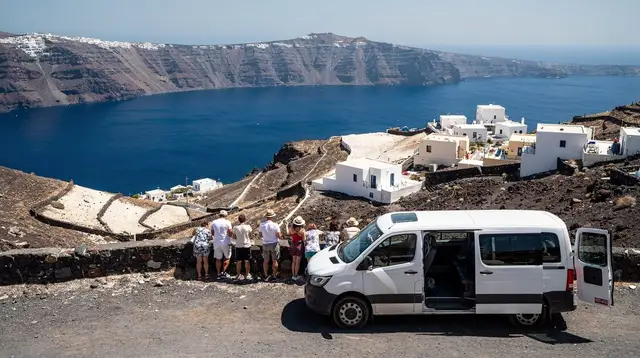
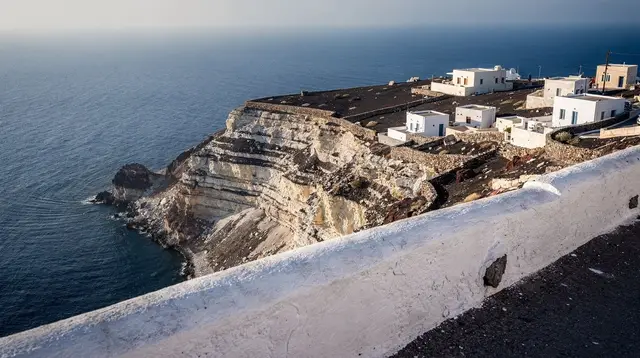
The Mesa Vouno ridge runs roughly north-south, closing off the plain around Ancient Thira from the flatter land near the caldera side of the island. On its east flank lies Kamari, a pebble-beach village under the cliff; on its west flank lies Perissa, the long black-sand beach that continues into Perivolos. The ridge itself was chosen by its Dorian founders for exactly the reason it’s inconvenient for modern visitors: it’s high, steep-sided, and hard to approach, which made it easy to defend and hard to besiege. The same qualities that made it a good acropolis make it a proper climb today.
This geography is the whole reason to think about Ancient Thira differently from Akrotiri. Akrotiri sits low, near the coast, close to the Red Beach and Vlychada side of the island, and slots naturally into a caldera-and-south-coast day plan. Ancient Thira belongs to the Kamari–Perissa side, and it makes most sense as a half-day paired with one of those two beach villages rather than tacked onto a caldera itinerary.
Getting There: Between Two Beaches, Up a Ridge
A paved road climbs the Mesa Vouno ridge from both directions — one branch rising out of Kamari, another out of the Perissa side — and the two roads meet near the top, where there’s a car park. If you’re driving or being driven, this is where the vehicle part of the trip ends. From the car park, the final approach to the ruins is on foot, along an unshaded path that climbs further before levelling out near the site entrance. There is a genuine, sustained gradient on this last stretch, and absolutely no tree cover anywhere along it. In the middle of a summer day, this is the single detail that catches people out most: they arrive expecting a short stroll and find a proper uphill walk in full sun.
Public buses don’t run to the top of the ridge, so the practical options are a rental car, a scooter, a taxi, or joining a guided tour that includes the site. If you’re relying on buses in Santorini for the rest of your trip, this is one of the destinations where you’ll want a different plan — either renting a car or scooter for the day or booking a taxi or transfer directly to the site.
Some visitors instead walk up from Kamari or Perissa on the footpaths that also climb the ridge, which is a legitimate way to do it if you’re already thinking in terms of hiking beyond the caldera path — but it adds real distance and altitude gain on top of the site visit itself, with the same total absence of shade. Whichever way you arrive, plan for a good half hour of walking in the open before you’re done, and treat this as one of the more physically demanding sites on the island rather than a quick stop.
No Roof, No Shade: What to Bring
The comparison with Akrotiri is worth spelling out because it changes how you should pack for the day. Akrotiri’s excavation is fully enclosed under a bioclimatic roof, which is precisely what makes it the island’s best option in bad weather or blazing heat — you can read more about that in the Akrotiri excavations guide. Ancient Thira offers none of that. It’s an open hilltop, exposed on every side, with no structures left standing tall enough to cast meaningful shade over the walkways.
In practical terms: a hat and proper sunscreen aren’t optional here, water matters more than at almost any other stop on a Santorini itinerary, and the middle of a summer afternoon is close to the worst possible time to attempt the climb. Early morning or the last couple of hours before closing are far more comfortable, and they also happen to be when the light over Kamari and Perissa is at its best for photos from the ridge.
What You’ll Find at the Top
The city that emerges once you’ve made the climb spreads across the ridge rather than sitting in one compact block. Excavated remains include a long main street, an agora, temple foundations dedicated to several deities, a theatre carved partly into the hillside, gymnasium terraces, and residential quarters, along with inscriptions carved directly into the rock — some of them centuries old even by the time later inhabitants were adding to the site. Because the settlement was occupied across Hellenistic and Roman periods and into early Byzantine times, what you’re walking through isn’t a single frozen moment the way Akrotiri is; it’s layers of a working city that changed hands and purposes over more than a thousand years.
The other reason people make the climb has less to do with any single ruin and more to do with the view. From the ridge, Kamari lies on one side and Perissa and Perivolos stretch out on the other, with the sea on both flanks and the shape of the island laid out below. It’s a different kind of panorama from the caldera views everyone photographs at Oia or Imerovigli — quieter, less crowded, and earned rather than handed to you at the end of a short walk from a car.
A modest entrance ticket is charged at the site, staffed by a small ticket booth rather than the visitor infrastructure you’ll find at Akrotiri; hours follow the general pattern of Greek archaeological sites, shorter in winter and longer in summer, so it’s worth checking the current schedule locally before making the climb, particularly outside peak season when several sites and services around the island scale back.
Pairing Ancient Thira with Kamari or Perissa
Because the site sits directly on the ridge between them, the obvious plan is to treat Ancient Thira as the midpoint of a day built around Kamari or Perissa rather than folding it into a caldera-focused itinerary. A common rhythm: an early climb to the ruins while the air is still cool, back down by late morning, then a swim and lunch at whichever beach you started from.
Kamari offers grey pebbles under the shadow of Mesa Vouno itself and a fairly built-up seafront; Perissa, on the other side, has longer black volcanic sand and a more strung-out, laid-back feel that continues into Perivolos. Neither beach requires shoes-off caution the way some sandy stretches do elsewhere, but the volcanic sand on both does get hot underfoot at midday, so bringing sandals for the beach as well as sturdy shoes for the ruins covers the whole day.
If you’re trying to decide which of the two makes the better base or day-trip anchor, the Perissa vs Kamari comparison lays out the practical differences in more detail. Either way, treating Ancient Thira as a morning add-on to a south-coast beach day works better logistically than trying to combine it with Fira, Oia, or a caldera cruise, which pull attention and travel time toward the opposite side of the island.
Ancient Thira, Akrotiri, and the Museum in Fira
It’s worth being explicit about how these three pieces of the island’s ancient past fit together, since they’re easy to blur into one generic “archaeology day.” Akrotiri is the Minoan town, sealed by volcanic ash around 1600 BC and excavated under cover; its portable finds — frescoes, pottery, tools — are displayed at the Museum of Prehistoric Thera in Fira, not at the excavation site itself. Ancient Thira is the separate, much later Dorian and Hellenistic-Roman city on the Mesa Vouno ridge, built in the open, with no connection to the eruption or the Minoan period at all.
Visiting both gives a far more complete sense of the island’s long human history than either alone, precisely because they don’t overlap — one is a moment frozen mid-life by disaster, the other a city that rose, changed hands, and was eventually abandoned gradually over centuries. For a broader sense of how the island’s settlements developed over time, the Santorini villages guide is a useful companion to both.
If archaeology is the main draw of your trip rather than a single stop, it’s worth building a loose day or two around it: Akrotiri and its museum on one day, Ancient Thira paired with Kamari or Perissa on another, with room left over for the Santorini and the Atlantis myth story as background reading rather than fact — it’s a popularised 20th-century hypothesis tied loosely to the Bronze Age eruption, not a claim this site or Akrotiri makes for itself.
Tours and Guided Options
There’s no dedicated ticketed tour built specifically around Ancient Thira the way there is for Akrotiri, so the practical routes in are either self-drive with a rental car or scooter, a taxi arranged for the round trip, or a private guide who can build it into a wider south-coast itinerary. A semi-private tour with a local guide is the most flexible option if you want Ancient Thira folded into a custom day alongside Kamari or Perissa, since the route and stops can be adjusted rather than fixed to a set itinerary.
For the Minoan side of the island’s archaeology, a guided archaeology tour of Akrotiri covers the excavated Bronze Age town in detail, and a guided visit to the Museum of Prehistoric Thera in Fira puts the frescoes and finds from that site into context — both useful if you’re building a fuller picture of the island’s ancient past around your visit to Ancient Thira rather than treating them as separate errands.
Practical Notes for the Visit
| Detail | Ancient Thira | Akrotiri (for comparison) |
|---|---|---|
| Civilisation | Dorian, later Hellenistic-Roman | Minoan (Bronze Age) |
| Approximate founding | Around the 9th century BC | Long occupied before ~1600 BC eruption |
| Shelter on site | None — open hilltop | Full bioclimatic roof |
| Access | Paved road to a car park, then a steep unshaded walk | Direct road access, level walkways under cover |
| Nearest villages | Kamari and Perissa | South-west coast, near Red Beach |
| Best paired with | A Kamari or Perissa beach day | A caldera or south-coast day |
A few points worth keeping in mind before you go: there is no shade anywhere on the approach or across most of the site itself, so timing the visit for morning or late afternoon in summer makes a real difference to comfort. The final stretch on foot has a genuine incline, so trainers or hiking sandals work far better than beach flip-flops.
And because the site sits between two beach villages rather than near the caldera, it fits most naturally into a plan built around Kamari or Perissa rather than a Fira-or-Oia day. If you’re mapping out a longer stay, the three days in Santorini itinerary is a reasonable place to see where a half-day like this can slot in without crowding out the caldera side of the trip.
Frequently Asked Questions About Ancient Thira
Is Ancient Thira the same site as Akrotiri?
No. Akrotiri is a Bronze Age Minoan town buried by the eruption of around 1600 BC and excavated under a roof on the island’s south-west coast. Ancient Thira is a Dorian and later Hellenistic-Roman city on the Mesa Vouno ridge, founded many centuries afterwards and never buried by the eruption at all.
How do you get to Ancient Thira?
A paved road climbs the Mesa Vouno ridge from either the Kamari side or the Perissa side. Most visitors drive or take a taxi to the car park near the top, then continue on foot up an exposed, unshaded path to reach the ruins themselves.
Can you visit Ancient Thira on foot from Kamari or Perissa?
Yes, footpaths climb from both villages, but they gain several hundred metres of altitude with no shade anywhere on the way. Most people who aren’t hiking specifically for the views drive to the upper car park and walk only the last stretch.
Is there shade at Ancient Thira?
Almost none. Unlike Akrotiri, which is fully covered by a bioclimatic roof, Ancient Thira is an open hilltop ruin with no structures to shelter under. Sun hats, water and sunscreen matter more here than at almost any other site on the island.
How long does a visit to Ancient Thira take?
Most visitors spend somewhere between 45 minutes and 90 minutes walking the ruins, plus the climb up and back. Add extra time if you plan to linger at the viewpoints over Kamari and Perissa, which are a large part of the reason to come.
Should I combine Ancient Thira with Kamari or Perissa?
Yes — that’s the natural pairing. Ancient Thira sits on the ridge directly between the two beach villages, so a half-day plan of ruins in the morning and a swim in Kamari or Perissa afterwards works better than trying to link it to the caldera side of the island.
Is Ancient Thira worth visiting if I’ve already seen Akrotiri?
Yes, precisely because it isn’t a repeat. Akrotiri shows a Bronze Age town frozen by ash; Ancient Thira shows a much later Greek city built in the open air on a defensible ridge, with a completely different layout, purpose and setting. Seeing both gives a far more complete picture of the island’s history than either alone.
Is Ancient Thira suitable for people with mobility issues?
Not easily. The final approach is an uneven, unshaded footpath with a real gradient, and the site itself is spread across rocky, sloped ground. It is one of the more physically demanding archaeological sites on the island.
Archaeological Sites on GetYourGuide
Verified deep-linked GetYourGuide tours. Book through these links and we earn a small commission at no cost to you.
GetYourGuide does not provide a product photo for this activity — the image shows the meeting point, photographed by us.