Santorini and the Atlantis Myth: What the Story Actually Claims
Is Santorini really Atlantis?
No one has proven it. Santorini is one of several sites proposed for Plato's Atlantis story, and the idea rests on the real Bronze Age eruption that buried Akrotiri around 1600 BCE. It remains a popular hypothesis, not an established fact.
A Vanished City and a Recycled Myth
Ask ten visitors why Santorini feels different from other Greek islands and several will mention Atlantis before they mention the sunset. It’s one of the most persistent stories attached to any Mediterranean destination: a great civilization, a catastrophic collapse, a legend that supposedly remembers it. The connection isn’t nonsense, but it isn’t established history either. It sits in the gap between a documented volcanic disaster and a 2,400-year-old philosophical text, and the honest version of the story lives in that gap rather than on either side of it.
This page is about the myth itself — where it came from, what actually lines up with the archaeology of Santorini, and where the comparison breaks down. It isn’t about visiting the excavations at Akrotiri or reading the finds in the Museum of Prehistoric Thera; those are separate, practical guides. This one is for the version of the question that comes up over dinner, on a boat, or on the walk back from the caldera path: is any of this actually true?
Where the Idea Comes From: Plato, Not Prehistory
Atlantis originates in two dialogues by the Greek philosopher Plato, Timaeus and Critias, written around 360 BCE. In them, an Egyptian priest tells the Athenian statesman Solon about a powerful island civilization that existed roughly nine thousand years before Solon’s own time, located beyond the Pillars of Heracles — the ancient name for the Strait of Gibraltar, which places Atlantis in the Atlantic, not the Aegean. According to Plato’s account, Atlantis grew arrogant and warlike, was defeated by ancient Athens, and was then destroyed in a single day and night of earthquakes and floods, sinking beneath the sea.
Nothing in that description points to a small volcanic archipelago in the southern Cyclades. The geography is wrong, the timeframe is wrong by thousands of years, and the political story — a war with ancient Athens — has no equivalent in the Bronze Age Aegean. Most classicists read the whole account as a philosophical allegory, a cautionary tale about the fall of a civilization corrupted by its own power, using the imagined island as a narrative device rather than a place Plato expected anyone to locate.
That hasn’t stopped people from trying. Atlantis theories have placed the lost island in the mid-Atlantic, in Antarctica, off Cyprus, in the Black Sea, and in a long list of other spots, gaining real popular momentum in the 19th century through writers like Ignatius Donnelly, long before Santorini entered the conversation at all.
The Eruption That Made the Case Possible
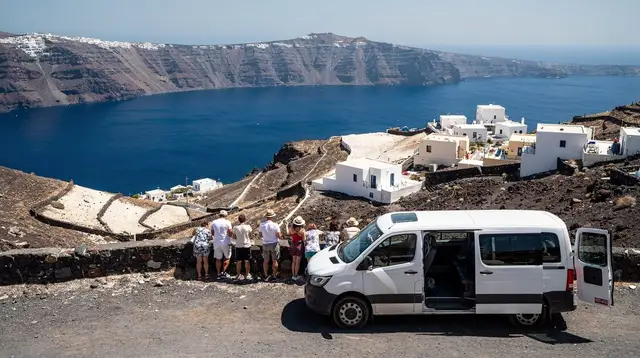
What Santorini actually offers isn’t a myth — it’s a documented catastrophe. Sometime in the Late Bronze Age, generally dated to around 1600 BCE, the volcano at the center of what is now the Santorini caldera erupted in one of the largest volcanic events of the ancient Mediterranean. The blast emptied a magma chamber beneath the island, and the ground above it collapsed into the void, creating the roughly 12-by-7-kilometer caldera that now defines the island’s shape and its famous cliffside views.
That date is worth treating carefully rather than repeating as fact. Radiocarbon evidence from olive wood and other organic material points to a date close to 1600 BCE. Archaeological cross-dating, based on comparing pottery styles and trade goods with securely dated Egyptian records, has traditionally suggested a slightly later date, closer to 1500 BCE. The gap between the two methods has never been fully resolved, and serious researchers on both sides continue to publish new evidence. Any source that gives you a single precise year for the eruption is smoothing over a real, ongoing scientific debate.
What isn’t in doubt is the human story underneath the ash. The Bronze Age town at Akrotiri, on the island’s south coast, was buried under volcanic pumice and ash in that eruption and preserved in remarkable detail as a result — multi-story buildings, drainage systems, and vivid wall paintings all survived under the debris.
Excavations there since 1967 have uncovered no human skeletons, which most archaeologists take as a sign that the town’s residents had enough warning, likely from preceding earthquakes, to evacuate before the eruption’s most violent phase. A city that empties out ahead of disaster is a very different story from a city that sinks in a single catastrophic night — and that mismatch is one of the clearest gaps between the archaeology and Plato’s account.
What Lines Up — and What Doesn’t
The case for a Santorini–Atlantis connection usually rests on a short list of genuine parallels, and it’s worth being specific about what they are:
| Parallel claimed | What the evidence actually shows |
|---|---|
| A sudden, catastrophic destruction | Real: the eruption was massive and abrupt in geological terms |
| A sophisticated, wealthy civilization lost | Real: Akrotiri shows multi-story buildings, imported goods, advanced plumbing |
| The island “sank” | Partly real: the caldera collapsed and filled with sea, though the main island did not disappear |
| A circular city layout with concentric rings | Not found: no such layout has been identified at Akrotiri or elsewhere on the island |
| War with ancient Athens | No equivalent: no evidence connects the eruption to any conflict with Bronze Age Athens |
| Timing of nine thousand years before Solon | Doesn’t match: the real eruption predates Solon by roughly a thousand years, not nine thousand |
The pattern is consistent: the physical, geological facts about Santorini are genuinely dramatic, and some details of Plato’s text can be made to resemble them if you’re willing to stretch the timeline, the geography, and the political details. That’s a very different thing from the story being a direct memory of the eruption.
There’s also a broader historical thread worth naming honestly. Some researchers connect the Santorini eruption to the later decline of Minoan civilization on Crete, roughly 110 kilometers south, through the combined effects of tsunami damage, ashfall on agriculture, and disrupted trade routes. That connection, too, is debated and almost certainly indirect rather than a single knockout blow — Minoan civilization persisted for generations afterward — but it’s a more defensible historical link than the Atlantis comparison, because it doesn’t require reinterpreting a philosophical text written a thousand years after the fact.
From Popular Science to Popular Culture
The Santorini–Atlantis theory as most travelers encounter it today is largely a 20th-century phenomenon. Interest accelerated after the Akrotiri excavations began providing physical evidence of an advanced Bronze Age society destroyed by natural disaster — for the first time, “Atlantis enthusiasts” had an archaeological site to point to rather than pure speculation. Popular books, television documentaries, and tourism marketing did the rest, turning a niche academic argument about Minoan chronology into a headline that’s now printed on postcards and travel blogs across the island.
It’s a useful case study in how a hypothesis becomes a fact in popular memory simply through repetition. Nobody excavated a plaque reading “Atlantis” at Akrotiri. What happened is that a real, dramatic, well-preserved archaeological site existed at the same time that Atlantis theories were already a fixture of popular culture, and the two got paired together because the pairing made a good story — which it genuinely does, as long as it’s told with its caveats intact.
Why Archaeologists Are Skeptical
Ask a working archaeologist or classicist about Santorini and Atlantis and you’ll typically get a patient, slightly weary answer rather than outright dismissal. The skepticism isn’t about the eruption — that part is real and well studied — it’s about the leap from “a real disaster happened here” to “this is the specific place Plato meant.”
A few reasons the leap doesn’t hold up under scrutiny:
- Plato’s stated location, beyond the Pillars of Heracles, places Atlantis in the Atlantic Ocean, not the Aegean Sea.
- His timeline puts Atlantis roughly nine thousand years before Solon, while the Santorini eruption occurred only around a thousand years before Solon’s lifetime.
- No text, inscription, or oral tradition from the ancient Aegean world ties Akrotiri, Thera, or the eruption to a story resembling Atlantis before Plato wrote his dialogues centuries later.
- The specific political and military details in Plato’s account — a war against ancient Athens — have no supporting evidence anywhere in the Bronze Age archaeological record.
None of that means the eruption is unimportant or that the comparison is worthless as a way to get people interested in real Bronze Age history. It means the connection works best as an origin story for the myth’s popularity, not as a solved historical mystery. If you want the version of this trip that treats the volcanic history on its own terms, the guide to how the Santorini caldera was formed covers the geology without the Atlantis framing at all.
Reading the Myth Without Losing the Real Story
None of this makes Santorini’s actual history less interesting — arguably it’s more interesting once the Atlantis framing is set aside, because what’s left is a real, unusually well-documented Bronze Age society that built multi-story buildings, traded across the Aegean, and vanished under ash so completely that its walls, paintings, and street plan survived nearly intact for over three thousand years. That’s the part worth carrying with you, whether or not you ever set foot at the excavation site itself.
a guided walk through the excavated city at Akrotiri puts the eruption’s physical evidence in front of you directly, with the myth as background rather than the headline. It’s a useful complement to a day otherwise built around the caldera’s more scenic side, and pairs naturally with time spent at the Ancient Thira site further along the coast, a separate ruin from a much later period that has nothing to do with the Bronze Age eruption or the Atlantis story.
If your interest in the myth is really an interest in the volcano itself, the more direct route is a trip out to the caldera’s active center. a caldera and coastline tour that takes in the volcanic landscape from the water shows the scale of the eruption’s aftermath — the cliffs, the black rock, the drowned crater — in a way that reading about the myth alone can’t. For context on the volcano’s current state rather than its Bronze Age history, the guide on Nea Kameni and the comparison of Santorini’s volcano tours cover the practical side of visiting it.
It’s also worth being clear-eyed about the difference between ancient volcanic history and current seismic activity. The eruption discussed on this page happened around 1600 BCE and left no ongoing threat. It has no connection to the 2025 seismic swarm near Santorini and Amorgos, a well-documented but separate episode that ended without an eruption; conflating the two — treating an ancient legend as evidence about present-day risk — is a mistake this page deliberately avoids. If you’re researching current conditions on the island rather than its deep history, that safety guide is the right place to go, not this one.
For travelers who want to spend a full day combining the archaeological side with the island’s other signature experiences, a private day combining the Akrotiri area, Red Beach, and a wine tasting ties the myth’s real-world anchor to two of the south coast’s other highlights without turning the day into a lecture. And if the appeal is really about ending the day somewhere dramatic after a morning spent thinking about a vanished civilization, a tour linking Akrotiri, Emporio, and an Oia sunset closes the loop between the ancient south coast and the island’s best-known evening view.
The myth itself is worth knowing precisely because it’s a myth, not despite it. Plato wrote a story about hubris and collapse; Santorini gave the world a real, extraordinary Bronze Age disaster three centuries before Plato was born. That the two got linked together, and stayed linked in the popular imagination, says more about how a good story travels than about what actually happened here — and both halves of that are worth understanding before you look out over the caldera and decide what you think you’re looking at.
If you’d rather sit with the story a little longer before or after your trip, the essay on what the Atlantis question actually asks and the piece on how a caldera is made both take a slower, narrative look at the same material covered here.
Common Questions About Santorini’s Atlantis Connection
Did Plato write about Santorini by name?
No. Plato’s dialogues Timaeus and Critias, written around 360 BCE, describe an island called Atlantis that sank beyond the Pillars of Heracles, meaning the Atlantic. Santorini sits in the Aegean, and Plato never mentions it.
Who first connected Santorini to Atlantis?
The idea gained traction in the 20th century, well after 19th-century writers like Ignatius Donnelly had already made Atlantis a popular subject. Excavations at Akrotiri from 1967 onward gave the theory a real archaeological anchor for the first time.
When did the eruption that buried Akrotiri happen?
Around 1600 BCE, in the Late Bronze Age. The exact year is debated: radiocarbon dating points to roughly 1600 BCE, while some archaeological cross-dating with Egypt suggests closer to 1500 BCE. Neither side has settled the question.
Were people killed when Akrotiri was buried?
No human remains have been found at the site, which suggests residents had enough warning from tremors to evacuate before the eruption’s main phase. That detail doesn’t fit Plato’s Atlantis, which sinks in a single catastrophic night.
Does the eruption’s size support the Atlantis story?
It was genuinely one of the largest volcanic events of the ancient world, and it likely caused real destruction across the region, including damage linked to the decline of Minoan Crete. Scale alone doesn’t prove a literary connection to Plato’s text.
Is Atlantis considered a real place by historians?
Most classicists read Atlantis as a philosophical device Plato invented to illustrate a moral point about hubris and downfall, not a report of a real location. That view coexists with genuine interest in what may have inspired the imagery.
Where can I see the archaeology behind this story?
The excavated city is at Akrotiri, and its finds are displayed at the Museum of Prehistoric Thera in Fira. Both are separate practical visits from this page, which focuses on the myth itself.
Is Santorini’s Atlantis story connected to Delos or other Cycladic islands?
No. Delos, reachable only as a day trip from Mykonos, is a separate archaeological site from a different period of Greek history with its own religious and political story, unrelated to the Bronze Age eruption or the Atlantis theory discussed here.
Archaeological Sites on GetYourGuide
Verified deep-linked GetYourGuide tours. Book through these links and we earn a small commission at no cost to you.
GetYourGuide does not provide a product photo for this activity — the image shows the meeting point, photographed by us.