Was Santorini Really Atlantis?
I get asked about Atlantis more than almost anything else on this island, usually in the same breath as someone pointing at the caldera and saying, “so this is it, right? This is where it sank?”
I understand the pull. You’re standing on the rim of a flooded volcanic crater, the sea filling a wound that used to be land, and somewhere behind you is a Bronze Age town that got buried in a single afternoon. It looks like the ending of a myth. But the honest answer, the one I give every time, is that nobody knows, and by the nature of the question, nobody ever will. What I can do is tell you where the idea came from, what actually connects Santorini to it, and where that connection runs out.
What Plato actually wrote
Atlantis starts with one author and two texts. Plato described it around 360 BC in the dialogues Timaeus and Critias, presenting it as a story passed down from Egyptian priests to the Athenian lawmaker Solon more than a century earlier. His Atlantis was a naval power lying “beyond the Pillars of Hercules,” meaning past the Strait of Gibraltar, out in the Atlantic. It was ringed by concentric walls of alternating land and water, immensely wealthy, and morally corrupt enough that the gods punished it. It sank, Plato wrote, “in a single day and night of misfortune.”
Read plainly, none of that is Santorini. There’s no Aegean setting, no Bronze Age Minoan world, no mention of an eruption. Most classicists still read Plato’s Atlantis as a philosophical device, a way of imagining a civilization’s rise and fall, rather than a coded reference to a real place. That’s worth sitting with before the theory even starts.
Where Santorini enters the story
The Santorini connection is a 20th-century idea, not an ancient one. The Greek archaeologist Spyridon Marinatos proposed it in 1939: a real catastrophe, a volcanic eruption in the Aegean, could have supplied the seed of a story that later got relocated and exaggerated into Plato’s Atlantic epic. Marinatos then spent much of his career trying to prove it by digging, and in 1967 his team uncovered what would become one of the most important Bronze Age sites in the Mediterranean.
That site is Akrotiri, on the island’s south coast, and it’s the real foundation under everything else in this theory. I won’t repeat the visiting details here — the practical side of Akrotiri, hours and tickets, belongs on its own page — but the shape of the discovery matters to the myth. Akrotiri was a genuinely advanced town: multi-story buildings, indoor plumbing, elaborate frescoes, evidence of trade across the Aegean.
It was buried by ash from the eruption that reshaped this island, and unlike Pompeii, no bodies have been found there. The people seem to have had warning and time to leave. It’s a striking, almost eerie parallel to a civilization vanishing rather than dying, which is part of why the Atlantis comparison has stuck so hard.
Where the theory gets shaky
Here’s where I try to slow people down. Even granting that the eruption was real and catastrophic, and that Akrotiri shows a sophisticated society, that’s a long way from proving this is Plato’s Atlantis. A few problems keep the theory in the category of “interesting hypothesis” rather than “established fact”:
- Plato placed Atlantis in the Atlantic, not the Aegean, and dated its destruction roughly 9,000 years before his own time — far earlier than the Bronze Age eruption, by thousands of years.
- Nothing found at Akrotiri names the settlement, references a flood myth, or ties it to anything resembling Plato’s account. The identification is inferred, not inscribed.
- The eruption’s own date is still debated among scientists, generally placed around 1600 BC on radiocarbon evidence versus a somewhat later date preferred by some archaeologists — a disagreement I go into properly in The City That Had Time to Leave, since it deserves its own space rather than a footnote here.
- Other candidates for Plato’s Atlantis exist too, from the Iberian coast to the Black Sea, which suggests the “solution” says as much about how satisfying a fit needs to be as it does about any single site.
None of that means the theory is silly. It means it’s a theory, built on a real and genuinely dramatic piece of archaeology, stretched to answer a question it was never designed to answer.
Why the theory still matters here
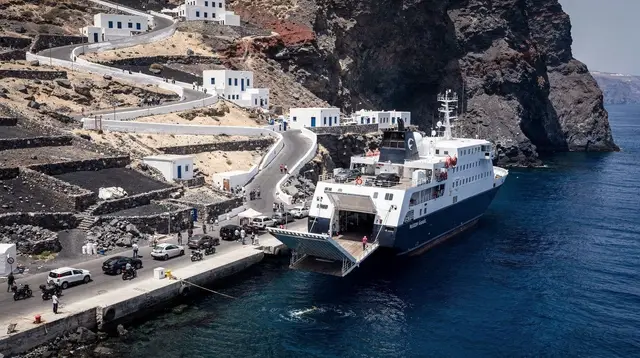
I don’t think the Atlantis question should be dismissed, and I don’t think it should be sold as settled either. What I like about it is that it gives people a reason to actually look at the caldera as a geological event rather than just a scenic backdrop for a sunset photo. Once you know how the caldera was formed, the crescent shape of the main island, the black islets of Nea Kameni sitting in the center where the volcano is still technically active, and the quiet, half-empty island of Thirassia across the water all start to make sense as pieces of the same collapsed structure.
If you want to see the evidence rather than just hear the argument, there are really two stops. The first is Akrotiri itself, where you can walk the excavated streets under cover and look at what a Bronze Age town actually looked like right before it was buried. The second is the Museum of Prehistoric Thera in Fira, which holds the frescoes pulled from the site — ships, saffron gatherers, antelopes mid-stride, painted with a confidence that makes the “advanced lost civilization” framing feel less like marketing and more like a reasonable reaction.
It’s also worth separating this Bronze Age town from Ancient Thira on the ridge above Kamari and Perissa, a much later Dorian city with no connection to Akrotiri or the eruption at all — I still hear the two mixed up constantly, and it’s worth reading the Ancient Thira guide if you’re planning to visit both.
I’ve also written about the eruption from the angle of the people who lived through it, in The City That Had Time to Leave, and about the mechanics of how a volcano turns into a flooded caldera in How a Caldera Is Made. If you’re wondering whether any of this ancient volcanism connects to the seismic swarm the island went through in 2025, it doesn’t in any direct way, but I’ve covered what that event actually was, and wasn’t, in Santorini Safety and the 2025 Earthquakes and in What Actually Happened in Santorini in 2025.
How I’d spend a day chasing the question
If the myth is what drew you here, don’t just read about it, go stand where the evidence actually lives. A boat trip around the caldera gives you the geology at a scale no photo captures, and a couple of the sailings around here lean into the theme directly — the Lost Atlantis beaches and wine tasting sail pairs the volcanic coastline with a stop for Assyrtiko, which at least puts the “lost civilization” framing next to something the island still produces rather than something it lost.
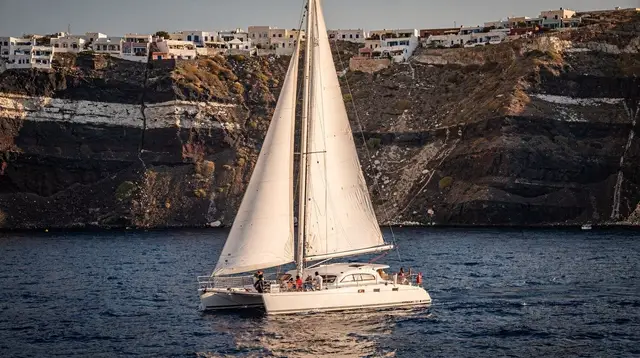
For a more general look at the caldera from the water, a standard day cruise around the volcanic islets or its quieter, smaller-group luxury version covers the same geography at a different pace. And if you’d rather close the day with the view instead of the theory, a sunset cruise along the caldera puts you on the water looking back at the cliffs that this whole myth grew out of.
So, was Santorini Atlantis? I’d put it this way: something enormous and real happened here, something that ended a civilization in a matter of hours and left behind evidence good enough to make a philosopher’s fable feel plausible. Whether Plato was ever thinking of this exact island is a question the ash can’t answer, no matter how many times I get asked it on a boat at sunset.
tours.Explainer
Verified deep-linked GetYourGuide tours. Book through these links and we earn a small commission at no cost to you.
GetYourGuide does not provide a product photo for this activity — the image shows the meeting point, photographed by us.