What Actually Happened in Santorini in 2025
I get some version of the same question in almost every message now: “Is Santorini safe? I heard about the earthquakes.” So let me lay out, as plainly as I can, what actually happened in early 2025, what it wasn’t, and where things stand today.
A six-week swarm, not an eruption
On 27 January 2025, seismic instruments around Santorini began picking up an unusual pattern: not one big shock, but a dense, ongoing swarm of small and moderate earthquakes clustered in the sea between Santorini and Amorgos. Over the following six weeks or so, the number of recorded events passed 28,000, with the strongest reaching roughly magnitude 5.2. Most of those quakes were too small to feel; a much smaller number were strong enough to rattle windows and nerves on Santorini, Amorgos, and the islands between them.
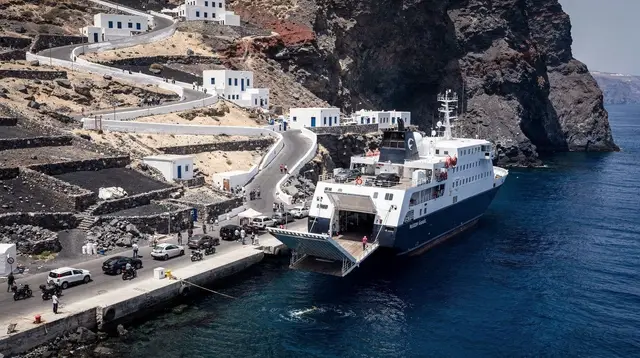
The response on the ground was real and visible. Local authorities declared a state of emergency, schools closed as a precaution, and several thousand residents left the island for the mainland while the swarm was at its most active. If you were following Greek news that winter, the images of empty ferries leaving Athinios and shuttered schoolyards were not exaggerated. What I want to be clear about is what those images meant, and what they didn’t.
What the swarm was not
It was not an eruption. No lava reached the surface, no ash fell on Fira’s whitewashed lanes, and no new vent opened anywhere in the caldera. That distinction matters more than it might sound like it should, because “Santorini volcano” and “Santorini earthquake” get flattened into the same story in a lot of the coverage that followed. They are not the same thing.
Research published in the months after the swarm has converged on an explanation: a dyke intrusion. In plain terms, that means magma pushed upward from a deep reservoir through a narrow crack in the crust, without ever breaching the sea floor. Dyke intrusions happen in volcanically active regions without leading to eruptions; they’re closer to the ground shifting under pressure than to a volcano “waking up.” The swarm was consistent with that kind of underground movement, not with an imminent eruption.
For the deeper mechanics of how this caldera came to exist in the first place, how the Santorini caldera was formed walks through the geology properly, including the Bronze Age eruption that this 2025 episode is sometimes wrongly lumped in with.
Where things stand now
The swarm is over. It ran its course by spring 2025 and has not resumed. I’m writing this in September 2026, and there is no active seismic crisis on the island. Ferries run on their usual schedules out of Athinios, flights land at the airport as normal, and the caldera villages are as full — or as quiet, depending on the month — as you’d expect for the season. If you want the full, current picture on how the island is handling both the aftermath and everyday risk management, I go into more depth in Santorini safety and the 2025 earthquakes.
What hasn’t changed is Nea Kameni. The dormant cone in the centre of the caldera, where cruise passengers land to walk up a cinder path to the crater rim, was never part of the hazard the swarm raised. It’s still there, still walkable, and still one of the more interesting hours you can spend on the water. I’ve written a full breakdown of what a visit there actually involves in the Nea Kameni volcano guide, and if you want the swim-in-warm-water half of the experience, Palea Kameni’s hot springs are covered separately.
A quick numbers table
| What | Figure |
|---|---|
| Swarm start | 27 January 2025 |
| Approximate duration | About 40 days |
| Earthquakes recorded | 28,000+ |
| Strongest event | Around magnitude 5.2 |
| Eruption | None |
| Leading explanation | Dyke intrusion (magma movement without surface breach) |
| Status today (September 2026) | Swarm ended, no ongoing activity |
Why this keeps getting misread
Part of the confusion, I think, comes from Santorini’s own marketing. This is an island that sells itself on being a volcano — the caldera views, the black sand, the wineries growing in ash-derived soil. So when “earthquake swarm” and “Santorini” show up in the same headline, it’s an easy jump to “the volcano is erupting.” It wasn’t, and as of now there’s no scientific basis for treating the 2025 swarm as a warning sign of one. Iceland-style dyke intrusions can go on for years without an eruption; this one already ended.
None of this means Santorini has zero seismic or volcanic risk — it sits in one of the more active corners of the Aegean, and that’s exactly why the monitoring network picked up 28,000 tiny signals instead of missing them. But treating a documented, finished earthquake swarm as an ongoing threat isn’t caution, it’s just out-of-date information. If you’re weighing when to book, that’s a question of crowds and weather more than seismology — best time to visit Santorini and Santorini in the shoulder season are the pages that actually answer it.
What I’d tell a friend booking now
I’d tell them what I’ve told you here: the swarm happened, it was significant enough to empty schools and send people to the mainland for a few weeks, and it ended without an eruption. I’d also point out that the island’s biggest current strain on daily life is less about geology and more about numbers of visitors — a subject I’ve covered separately in eight thousand a day and the cost of a caldera view, if you want the crowding side of the story instead of the seismic one.
For the trip itself, plan around the water. A day cruise around the caldera and volcanic islets gets you close to Nea Kameni without any of the 2025 headlines following you onto the boat, and if you’d rather see the caldera walls light up at golden hour, a sunset cruise on the water avoids the crowd-and-cliff standoff at Oia’s castle entirely. For something quieter and more private, a private sunset tour by boat is worth the extra cost if you’re travelling for an occasion.
If geology genuinely interests you beyond this one episode, it’s worth reading how the caldera itself was carved by a vastly larger event roughly 3,600 years earlier — a useful reminder of scale, and a good antidote to treating 2025 as more dramatic than it was. And if myth interests you more than seismology, Santorini and the Atlantis myth is the place for that, clearly labelled as legend rather than geology.
For onward travel once you’ve had your fill of caldera views, getting to Santorini and a look at Santorini’s volcano tours compared cover the practical next steps, while Thirassia and the walk up to Profitis Ilias are two of my favourite ways to see the same landscape from angles most visitors skip entirely.
tours.Explainer
Verified deep-linked GetYourGuide tours. Book through these links and we earn a small commission at no cost to you.
GetYourGuide does not provide a product photo for this activity — the image shows the meeting point, photographed by us.