Eight Thousand a Day: What Santorini's Cruise Cap Really Limits
I read about the 8,000-a-day cap for months before I actually watched it operate, and the day I finally paid attention to it, I was standing in the wrong place at the wrong time — the square above Fira’s old port, at half past eleven, wedged between a wedding photographer’s assistant and four separate tour groups converging on the same three metres of shade. Nothing about that moment felt capped.
What the Cap Actually Does
The rule is simple to state and easy to misread: Santorini and Mykonos limit cruise ship arrivals to 8,000 passengers a day. That number is coordinated between the port authority and the cruise lines themselves, and it applies specifically to people who step off a cruise ship onto the island. It says nothing about the ferry passengers coming through Ormos Athinios, nothing about the flights landing at JTR, and nothing about the people who are already here for a week, sleeping in a cave-house in Oia or a studio in Karterados. All of those visitors move around the same narrow footprint of villages and viewpoints, and none of them count against the 8,000.
So the cap is a ceiling on one channel of arrivals, not a ceiling on the island’s population on any given afternoon. On a day when the ferry timetable is heavy and three mid-size ships are each running under quota, you can have a full complement of cruise passengers, a full ferry terminal, and every hotel in the caldera booked solid, all at once. The math that makes 8,000 feel reassuring only works if you forget everyone else is also on the island.
The Part the Cap Doesn’t Touch
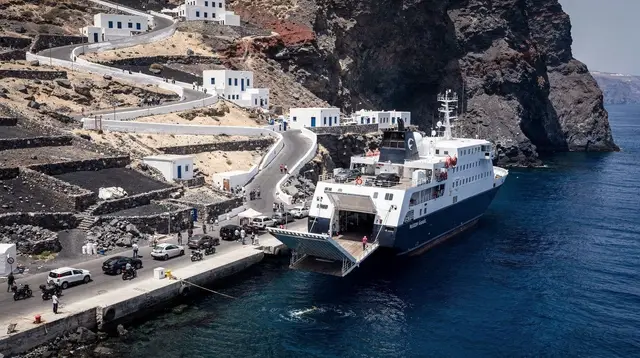
Here is what I actually watched from that square: tenders from three ships running almost back to back into the old port, a queue for the cable car that took the better part of forty minutes, and a stream of people walking the switchback path because the queue looked worse than the climb. None of that is illegal, none of that breaks the cap, and none of it makes the hour feel like less than what it is. Our cruise port guide and the Athinios port guide both cover the mechanics of how people actually move off the ships and ferries and up the cliff — worth reading before you assume the cap has smoothed anything out.
The honest pattern, repeated across the season, is this:
| Time of day | What’s happening | Cap’s effect |
|---|---|---|
| Before 9am | Villages quiet, first ships still arriving | None yet |
| 10am–5pm | Peak tender traffic, cable car queues, Fira and Oia at capacity | Caps the ceiling, not the crowd you feel |
| After 6pm | Ships departing, day-trippers gone | Cap irrelevant — crowd has left on its own |
If you want a single number to hold onto, it’s that window, not the 8,000. The cap sets an upper bound on how bad a day could theoretically get; it doesn’t lower the floor of how full Fira or Oia already are without it.
Where the Levy Fits, and Where It Doesn’t
It’s easy to fold the passenger cap and the cruise levy into the same idea, because they were both introduced as answers to the same complaint. They’re not the same mechanism. The levy is a fee — 20 euros per passenger in June through September, 12 euros in the shoulder months, 4 euros in winter — charged by the cruise line and settled on the ship’s account, not collected at a gate.
It raises the cost of bringing a passenger to the island; it does nothing to limit how many can come. The cap is the only one of the two that actually sets a number. Conflating them is the most common mistake I hear from people planning a stop here, and it leads to the wrong conclusion — that a fee has somehow thinned the crowd, when what’s thinning it, on the calmest days, is just an off-season sailing schedule.
Reading This the Right Way If You’re Comparing a Stay to a Stop
If you’re deciding between a single cruise call and a proper stay, the cap isn’t the variable that should decide it. What matters is whether you can control your own hours on the island, and a cruise passenger generally can’t — you’re tied to a tender schedule and a return time, regardless of what the daily total looks like on paper.
Someone staying two or three nights can walk down to a viewpoint at 7am or wait until after the ships have pulled out, and either choice avoids the worst of the day without needing the cap to do any work at all. Our best time to visit guide and the cable car and 588 steps piece both cover the practical side of dodging that window if you do have flexibility.
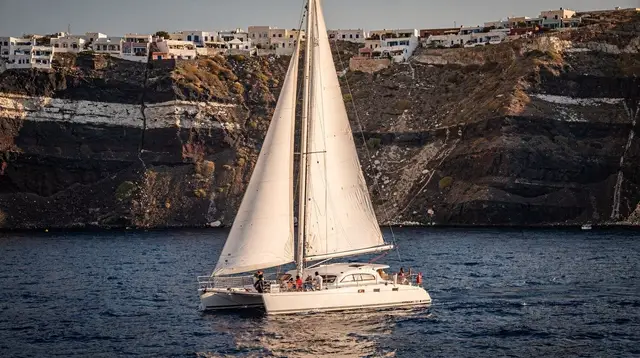
For the cruise-only visit itself, the smarter move is usually to get off the ship’s own route entirely. A caldera cruise puts you on the water looking back at the cliffs instead of standing in the queue for them — the Santorini: Day Cruise covers Nea Kameni and the hot springs in a single loop that mostly avoids the villages at their worst hour, and travellers connecting through Crete have a version built around that transfer with the Heraklion: Santorini 1 Day Cruise.
If your ship’s call happens to line up with the evening light, a Santorini: Sunset Cruise trades the fight for a spot on the Oia clifftop for a seat on the water instead — which is, not coincidentally, the same advice we give in our sunset experiences coverage regardless of how you arrived.
For the shore-excursion logistics themselves — tender times, how long you actually have on land, what’s realistic in a single call — that’s covered separately in shore excursions and in our one-day-from-a-cruise-ship guide and the cruise-day itinerary, rather than here.
What I’d want someone to take from this, more than any single figure, is that 8,000 is a policy number, not a description of what a Tuesday in July feels like. Read it as a ceiling on a specific kind of arrival, keep your own itinerary flexible where you can — our one-day guide is built around exactly that flexibility — and plan around the 10am-to-5pm window on the ground, because that’s the number that actually predicts your afternoon.
Common Questions About the Cruise Passenger Cap
What exactly does the 8,000 figure count?
It counts cruise passengers disembarking at Santorini in a single day, coordinated between the port authority and the cruise lines. It does not count ferry passengers arriving at Athinios, flights landing at JTR, or anyone already staying on the island.
Does the cap mean fewer ships, or smaller ships?
Neither, directly. Cruise lines self-schedule arrivals to stay under the daily total, so a day can still see two or three ships as long as their combined passenger counts land under 8,000.
Is Santorini actually less crowded since the cap started?
There is no reliable public count comparing crowd levels before and after the cap, so it is honest to say the cap addresses the worst single-day spikes rather than proving the island feels emptier overall.
What hours are worst regardless of the cap?
Roughly 10am to 5pm in Fira and Oia on any day with a cruise call, capped or not — that window is set by tender schedules and ship departure times, not by how many ships are in the caldera.
Should I skip a shore excursion because the island already feels full?
Not necessarily — timing and route matter more than the existence of a cap. Our shore-excursion guides cover how to sequence a stop around the crowded hours rather than avoid them entirely.
Is the cruise passenger levy the same thing as the cap?
No. The levy is a per-passenger fee — 20 euros in high season, lower in shoulder months — charged by the cruise line and passed to the port. The cap is a separate numeric ceiling on how many passengers can land in a day.
tours.Analysis
Verified deep-linked GetYourGuide tours. Book through these links and we earn a small commission at no cost to you.
GetYourGuide does not provide a product photo for this activity — the image shows the meeting point, photographed by us.