Santorini Cruise Port Guide: From the Ship to Fira
Where do cruise ships dock in Santorini and how do I get up to Fira?
Cruise ships anchor offshore and tender passengers to the Old Port of Fira (Skala), at the foot of the caldera cliff. From there you reach Fira by cable car (about 3 minutes), on foot up the 588 steps, or by donkey — Athinios, the ferry port, is a separate place on the other side of the island.
Two Ports, Not One: Getting Your Bearings Before You Disembark
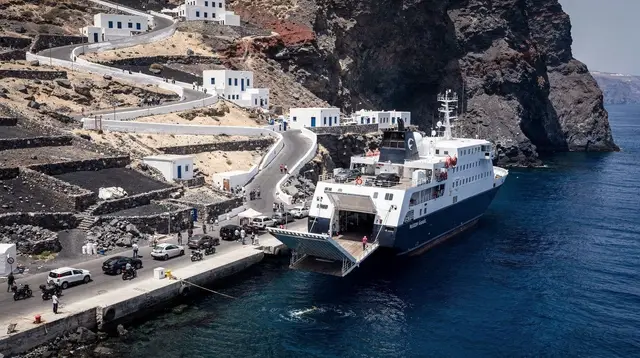
If you’re arriving on a cruise ship, the first thing to sort out has nothing to do with sightseeing — it’s simply how you get from the water up to the town. Santorini has two entry points that look interchangeable on a map and are nothing alike in practice. Cruise ships anchor in the caldera and tender passengers to the Old Port of Fira, a small harbor known locally as Skala, directly beneath Fira itself.
Athinios, the island’s only ferry port, sits several kilometres away on the western face of the cliff and handles scheduled boats to Piraeus, Crete and the rest of the Cyclades. It has nothing to do with cruise tenders, and you will not need to go there. Mixing the two up is the single most common confusion among first-time cruise visitors, and it matters because the roads, the queues and even the taxi ranks are entirely separate. For a full picture of the ferry side of the island, see the Athinios port guide — but for a cruise call, the Old Port is where your day actually begins.
The Old Port sits at the base of a nearly 300-metre volcanic cliff, and the town of Fira perches at the top of it. There is no road connecting the two directly for foot traffic; you either go up mechanically, on foot, or on an animal. Understanding this geography before you’re standing at the tender dock, slightly disoriented and surrounded by several hundred other passengers, saves a surprising amount of stress.
How the Tender Process Works
Large cruise ships cannot dock inside the caldera, so they anchor offshore and ferry passengers in on tender boats — smaller vessels, sometimes the ship’s own lifeboats, that shuttle back and forth to the Old Port. On a busy day, several ships can be at anchor simultaneously, which means the port area and the base of the cliff fill with passengers from multiple vessels at once, all trying to get up to Fira in the same one-to-two-hour morning window.
Tender operations typically begin soon after the ship anchors and run in cycles throughout the morning. There’s no fixed timetable published for outside planning — it depends entirely on your ship’s schedule, sea conditions and how many vessels are calling that day — so the practical takeaway is to disembark as early as your ship allows if you want to beat the crowd rather than join it. Every additional hour that passes tends to add both people and heat to the climb.
Once ashore, you’ll find yourself at a compact harbor with limited flat space, a scatter of small shops and cafés, and the three ways up staring back at you: the cable car station, the staircase, and the donkey path, all clustered together at the base of the cliff.
Three Ways Up the Cliff
The Cable Car
The cable car is the fastest and least physically demanding option, covering the 220-metre climb in about three minutes. It’s the default choice for most cruise passengers, particularly families, anyone with mobility concerns, or travellers who’d rather save their energy for the day ahead rather than spend it on a staircase. The one-way fare runs somewhere in the range of 6 to 10 euros depending on the year and where you check, so treat any number you see as an estimate rather than a guaranteed price, and be ready with cash or a card as availability can vary.
The catch is that on peak cruise days, the cable car queue at the bottom can become long enough to erase most of its time advantage. It runs continuously, moving passengers up in small cabins, but demand from several ships’ worth of tenders arriving close together can still mean a real wait. If you can time your descent from the ship for the earlier tenders, the queue is typically far more manageable.
The 588 Steps
For those who’d rather walk, or who simply want the experience of climbing the same route locals and mule handlers have used for generations, there’s a stepped path of 588 steps zigzagging up the cliff face. It is a genuine hike rather than a casual stroll: the steps are uneven in places, exposed to full sun with no shade for most of the way, and shared with donkeys and their handlers, which means watching your footing for more than scenery. Good closed shoes are essential, and it’s not a realistic option in the height of summer heat for anyone unused to stair climbs, or for young children.
The reward is a close-up view of the cliff and the town rising above you that you simply don’t get from inside a cable car cabin, plus the fact that it’s free. For hikers who enjoy this kind of route, it’s worth knowing this is a different, much shorter climb than the Fira-to-Oia caldera path, which runs along the top of the cliff rather than up its face.
By Donkey
Riding a donkey up the same path as the steps is still offered at the port, and it remains legal — there is no ban, despite rumors to the contrary. A weight limit was introduced in 2018 to protect the animals, and further animal-welfare regulation was under discussion heading into the 2026 season, so conditions and availability can shift from year to year. If avoiding the whole question feels simpler, walking or taking the cable car sidesteps it entirely, which is the position most guides — including this one — quietly take without moralizing about visitors who choose otherwise.
Comparing the Three Options
| Option | Time | Approx. cost | Best for |
|---|---|---|---|
| Cable car | About 3 minutes | Roughly 6–10 € one way | Most passengers, families, limited time |
| 588 steps | 20–40 minutes on foot | Free | Fit walkers, good shoes, cooler hours |
| Donkey | 20–30 minutes | Fee paid at the port | Travellers wanting the traditional route |
Prices and exact durations shift over time and by season, so use this table as a planning guide rather than a fixed schedule.
Once You’re in Fira
Arriving in Fira puts you at the heart of the island’s transport network and its densest concentration of shops, cafés and viewpoints over the caldera. From here, most cruise passengers either join a pre-booked shore excursion, explore the town independently, or head out toward Oia or the beaches by taxi, bus or organised tour. This guide focuses narrowly on the climb itself rather than what to do with the rest of your day — for that, the best shore excursions from Santorini and a full one-day itinerary built around a cruise call cover the ground in detail.
If you’d rather have the climb and the day handled for you, a morning departure straight from the port removes the guesswork:
Departure from Old Port of Fira Morning Cruise in SantoriniFor passengers who want a structured overview of the island without organising transport themselves, a shore excursion built specifically for cruise timings is often the least stressful route:
Santorini: Shore Excursion for Cruise PassengersGroups or families who’d rather not share a tour with strangers on a tight schedule sometimes prefer a private option instead:
Santorini: 5 Hour Private Tour for Cruise Ship GuestsAnd for cruise passengers who want to combine the climb with a proper hike rather than just a ride up, a guided walk along the caldera rim is a way to turn the ascent itself into part of the day:
Santorini: Fira to Oia Caldera Hike with GuideTiming Your Day Around the Ship
Because tender queues, cable car lines and Fira’s own crowds all build through the late morning, the single most useful piece of advice for cruise passengers is the same one that applies to the island generally: earlier is easier. If your ship allows an early tender group, take it. The Old Port, the cable car station and the streets of Fira are all noticeably calmer before mid-morning than they are from about 10am onward, when several ships’ worth of passengers overlap with independent travellers exploring the same narrow lanes.
Keep your ship’s all-aboard time firmly in mind throughout the day — it’s easy to lose track of it once you’re absorbed in the caldera views, and getting back down via cable car or steps takes real time of its own, especially with a queue. Building in a buffer of at least an hour before your ship’s deadline for the return trip down is a sensible habit rather than an overcautious one.
A Note on Safety and Getting Oriented
Santorini experienced a significant seismic swarm in early 2025, with tens of thousands of tremors recorded over about six weeks between the island and Amorgos. There was no eruption, the swarm has since ended, and current research points to a deep magma intrusion rather than any imminent volcanic activity. It’s mentioned here only because cruise passengers sometimes ask about it — day-to-day travel, including the port, the cable car and the walk up to Fira, has continued normally. For a fuller picture of what happened and what it means for visitors, see Santorini safety and the 2025 earthquakes.
Beyond that, standard caution applies: hold the handrail on the steps, watch for donkeys and their handlers sharing the same path, and don’t attempt the 588-step climb in the hottest hours of a summer afternoon without water.
Getting Around After You’ve Reached the Top
Once you’re up in Fira, the island’s buses run from a terminal in town toward Oia, Kamari and other villages, though they can be crowded during cruise season. Taxis are available but limited in number islandwide, so if your plans depend on one, arranging it ahead of time is far more reliable than hailing one on the spot. For a broader sense of the town itself before or after your climb, the Fira old town walk covers its lanes and viewpoints, and the Fira town guide rounds out what the town center offers beyond the port area.
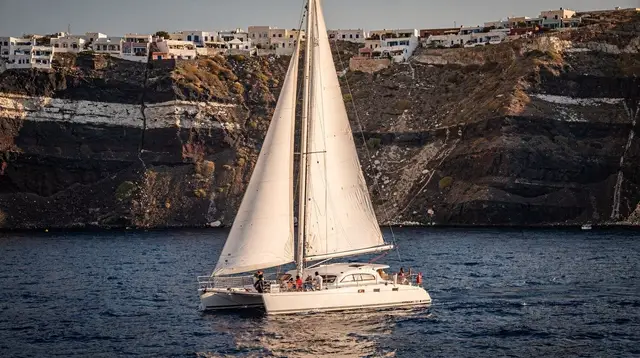
If your interests lean toward the water rather than the cliff, some cruise passengers skip the climb into town altogether in favor of a catamaran straight from the port area.
The One Thing Worth Remembering
Cruise passengers who confuse the Old Port with Athinios sometimes waste real time on the wrong side of the island looking for the wrong facilities — Athinios has no cable car, no cruise infrastructure, and is built entirely around ferry traffic. If you remember only one thing from this guide, let it be this: your ship brings you to the Old Port of Fira, at the base of the caldera cliff, and the cable car, the steps and the donkey path are your only three ways up from there.
Frequently Asked Questions About the Santorini Cruise Port
Where do cruise ships actually dock in Santorini?
They don’t dock in the conventional sense. Ships anchor offshore in the caldera and passengers are tendered ashore to the Old Port of Fira, also called Skala, at the base of the cliff below Fira.
What’s the difference between the Old Port of Fira and Athinios?
The Old Port only receives cruise tenders and small excursion boats. Athinios, on the island’s west coast, is the working ferry port for scheduled boats to Piraeus and the rest of the Cyclades. Cruise passengers never need to visit Athinios.
How much does the Santorini cable car cost?
Figure roughly 6 to 10 euros one way, though the exact fare shifts by year and source, so treat any number as an estimate.
Can I walk up the 588 steps instead of taking the cable car?
Yes. It’s a genuine staircase used daily by locals and mule handlers, climbing 220 metres in full sun over uneven footing, so it suits fit walkers in sturdy shoes rather than everyone in a group.
Is riding a donkey up to Fira still allowed?
Yes, it isn’t banned. A weight limit was introduced in 2018, and further animal-welfare rules were under discussion for the 2026 season, but the option remains alongside the steps and the cable car.
How long does the cable car take?
About three minutes for the 220-metre climb, which is why it clears the tender queues faster than walking or the donkey path.
What’s the best way to avoid the queues at the Old Port?
Taking an early tender group helps most, since crowding builds through mid-morning as multiple ships unload passengers around the same time. There’s no way to book a faster slot at the port itself.
Do I need to book a shore excursion in advance?
It’s worth deciding before you dock. Popular boat tours and guided walks can fill up on the busiest cruise days, and the port itself has no ticket desk for arranging one on arrival.
Caldera Cruises on GetYourGuide
Verified deep-linked GetYourGuide tours. Book through these links and we earn a small commission at no cost to you.
GetYourGuide does not provide a product photo for this activity — the image shows the meeting point, photographed by us.