The village built for one view
Oia sits at the northern tip of Santorini’s caldera, where the crescent of cliff curls away from Fira and the land runs out into open water. It is the smallest of the caldera villages and, by most counts, the most photographed square kilometre in Greece. Whitewashed cube houses stack down the cliff face, blue-domed churches punctuate the skyline at intervals that feel almost deliberate, and every terrace, however small, seems to have been angled toward the same horizon.
That horizon is the reason people come. Oia’s sunset has become the island’s signature image, repeated on every postcard rack and Instagram grid, and the village has organised itself around it: restaurants time their last seatings to it, hotels price their caldera-view rooms around it, and the medieval Kastro — the ruined Byzantine castle at the village’s western edge — has become an informal grandstand where people start claiming space 90 minutes to two hours before the sky actually turns, once the season is in full swing.
None of that makes Oia a one-trick village. Underneath the sunset ritual is a genuinely old place: a former captains’ town built on the wealth of 19th-century shipowners, largely rebuilt after the 1956 earthquake, with cave houses (yposkafa) carved into the volcanic rock that once belonged to sailors’ families and now mostly operate as boutique hotels. Walk it outside the two or three peak hours and it’s one of the quietest, most architecturally coherent villages in the Cyclades.
What Oia actually looks like up close
The main pedestrian lane runs the length of the village, lined with jewellery shops, galleries, and cafés that spill onto narrow balconies bolted to the cliff. Below it, a warren of stepped alleys drops toward the caldera edge, where the cave houses are — many with barrel-vaulted ceilings, whitewashed inside and out, their terraces stacked one above the other like a natural amphitheatre facing the water.
At the village’s western tip, past the last row of cafés, the land opens into the ruins of the Kastro, a Venetian-Byzantine fortress of which little remains beyond low stone walls and a viewing platform. It isn’t the ruin that matters; it’s the unobstructed sweep of caldera it frames, with Thirassia across the water and, on a clear evening, the sun dropping directly into the sea beyond it. That unobstructed line is exactly why it fills first and empties last.
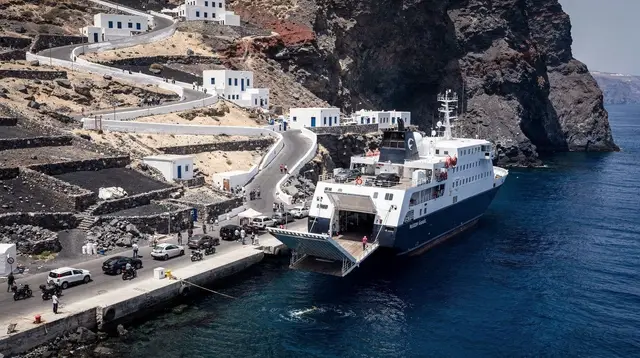
Below the village, a stepped path descends roughly 300 steps to Ammoudi Bay — Oia’s small fishing port, with a cluster of seafood tavernas on the water and a few boats still working. It’s a separate world from the lane above: quieter, closer to sea level, and one of the better places in the caldera to watch the same sunset from below rather than from the crowd. We cover Ammoudi Bay’s tavernas and swimming spots on its own page; if you only remember one thing about it, remember that the walk back up is steeper than it looks and there’s no lift.
The sunset problem, honestly
Oia’s sunset is not a secret, and pretending otherwise would waste your evening. In July and August, the approach lanes to the Kastro fill from mid-afternoon, and by the final half hour the platform itself is standing room only, with camera arms raised over rows of heads. It is still, genuinely, a striking sunset — the caldera does something to the light that flat coastline doesn’t — but the experience of watching it shoulder-to-shoulder is not what the photographs suggest.
A few things help. Arrive at the Kastro at least two hours before sunset in July and August, earlier if you want an unobstructed spot at the wall itself. Outside high season — April, May, late September, October — the same view is available with a fraction of the crowd and no need to arrive absurdly early. And crucially: the sunset time itself moves by more than three and a half hours across the year, from around 8:50pm in late June down to roughly 5:15pm in late December. Nobody selling a “sunset tour” can promise you a clock time worth planning around — check the actual time for your dates rather than assuming.
If the Kastro scrum doesn’t appeal, you don’t have to fight for it. The terraces of Imerovigli, a short drive south along the caldera rim, and the promontory of Skaros Rock just below it, face the same water at a similar angle with a fraction of the foot traffic. Firostefani, between Imerovigli and Fira, is another quiet alternative with caldera-facing bars that rarely fill the way Oia’s do.
And inland, the hilltop kastro of Pyrgos is the one spot on the island from which you can see the whole of Santorini at once — a different kind of sunset view, worth it for the perspective alone. We compare all of these properly in our guide to sunset spots beyond Oia.
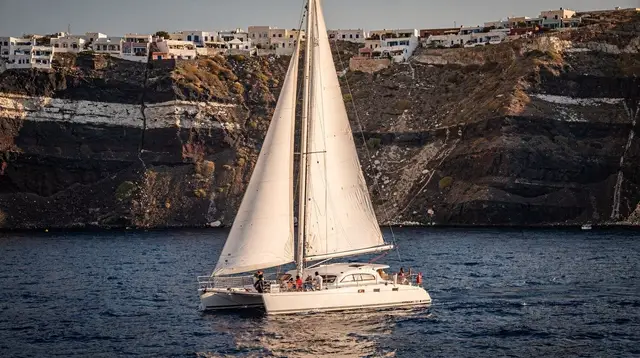
The other honest alternative is to leave the cliff entirely. Watching the sunset from a boat below the caldera reframes the whole scene — instead of fighting for space to look outward at the sea, you’re looking back at the illuminated cliff face and the villages perched on it, which is arguably the better photograph. Our caldera cruise guide and sunset cruise comparison go through the practical differences between catamaran, sailboat and semi-private options.
a private sunset tour that combines Oia’s viewpoints with the walk down to Ammoudi Bay, timed to have you in position before the crowd peaks, is the simplest way to solve the logistics if you’d rather not plan the timing yourself.
Beyond the sunset: what to do with the rest of the day
Come mid-morning, before the day-trip buses arrive, and Oia is a different village — quiet lanes, open cafés, light that photographs beautifully without the July haze. This is when the cave-house architecture actually reads: the vaulted doorways, the blue-domed church of Panagia Platsani near the main square, the bell towers cut against a sky that hasn’t yet gone hazy with heat.
Photography is Oia’s other major draw, separate from the sunset itself. The white walls and blue domes photograph well at almost any hour, and the village has a small industry built around it — professional shoots, “flying dress” sessions, and proposal photography are booked here more than anywhere else on the island. If that’s part of your plan, our dedicated guides on the Santorini photoshoot guide, the flying dress photoshoot and proposal and wedding photos in Oia go into logistics, permits and timing.
a guided photo walk through Oia’s backstreets that ends at sunset with a short video reel included is a straightforward way to get the shots without scouting locations yourself.
For a slower, more cultural read on the village, a walking tour that moves through the older residential lanes — away from the main shopping street — covers the maritime history, the earthquake rebuilding, and the cave-house architecture properly. a small-group cultural walking tour through Oia that finishes at a sunset viewpoint is built around exactly that arc.
If you’d rather sit somewhere and drink something local, one of the more distinctive options in Oia is a wine tasting inside a restored captain’s house — a way to get indoors, out of the wind, in one of the old sea-captain residences rather than a modern tasting room. a backstreets walking tour of Oia that ends with a wine tasting inside a restored captain’s house pairs the architecture with the island’s other obsession — Assyrtiko and the rest of the Santorini wine story.
Getting to Oia and getting around once you’re there
Oia sits at the far northern end of the caldera road, roughly 11km from Fira and about the same from Ormos Athinios, the island’s only ferry port. Public KTEL buses run from Fira’s central station to Oia regularly through the day, though they thin out in the evening and get crowded around sunset — plan your return before the last bus, not after.
Taxis exist but are genuinely scarce across the island (around thirty for all of Santorini), so booking a transfer ahead of time is the norm rather than a backup plan; our taxis and transfers guide explains why. Renting a car or ATV gives the most flexibility for timing your arrival around the light rather than the bus schedule — see our car and scooter rental guide and driving in Santorini for what’s required.
Parking inside Oia itself is limited and mostly outside the pedestrian core, so budget an extra ten minutes of walking either way. Once you’re in the village, everything is on foot — there’s no vehicle access to the lanes themselves, and the steps down to Ammoudi Bay are the only route to the water below.
If you’re arriving by cruise ship rather than staying on the island, Oia is a popular add-on to a shore excursion, though it means sharing the village with everyone else’s tender schedule too — our one day in Santorini from a cruise ship guide covers how to sequence it against Fira and the caldera.
Where Oia fits with a caldera cruise
Because Oia sits directly above Ammoudi Bay, it’s a natural pairing with a boat trip on the water below it — several caldera cruises time their return, or a stop, around sunset near Oia specifically, which lets you watch the cliff light up from the sea instead of standing on top of it. a caldera cruise that stops at the volcanic hot springs before finishing near Oia at sunset combines the two best-known Santorini experiences — the volcano and the sunset — into one afternoon, and avoids the Kastro crowd entirely. Our Nea Kameni volcano guide and Palea Kameni hot springs guide cover what to expect from that stop before the boat turns back toward Oia’s cliffs.
Where to stay if Oia is the point
Staying in Oia itself means being in position for sunrise and late evening without moving, and the village empties out considerably once the day-trip crowd leaves after sunset. It’s also the most expensive lodging on the island, concentrated in cave-house hotels with caldera-facing plunge pools booked many months ahead. If you’d rather stay somewhere calmer and closer to Fira’s restaurants and nightlife, Imerovigli or Firostefani put you within a short drive or a caldera-path walk of Oia while costing noticeably less — our Oia vs Fira comparison walks through the trade-offs by traveller type.
For those arriving on foot rather than by car, the Fira–Oia caldera path ends (or begins) right at Oia’s edge — a roughly 10.5km walk along the cliff that takes three to five hours with no shade, best started early morning or timed to arrive for sunset. It is a serious walk, not a stroll, and the return leg is almost always better done by bus or taxi than on foot a second time. Full route notes are in our Fira to Oia caldera hike guide.
Oia sunset FAQ: timing, crowds and where to stand
What time does the sunset happen in Oia?
It varies enormously across the year — from around 8:50pm in late June to roughly 5:15pm in late December. There’s no fixed hour worth planning around; check the sunset time for your actual travel dates rather than assuming an evening slot.
How early should I arrive at the Kastro for sunset?
In July and August, arrive at least 90 minutes to two hours before sunset if you want a spot at the wall itself. In the shoulder months (April, May, October), 30–45 minutes is usually enough.
Is there a better alternative to the Oia Kastro?
Several. Imerovigli and Skaros Rock face a similar angle of caldera with far fewer people, Firostefani is quieter still, and Pyrgos gives a wider island-wide view rather than a caldera close-up. Watching from a boat on the water is the alternative most people underrate.
Can I see the sunset from Ammoudi Bay instead of the village above?
Yes — Ammoudi sits at sea level directly below Oia and offers a different, lower angle on the same sunset, along with waterside tavernas. It’s less crowded than the Kastro but has its own bottleneck: the roughly 300 steps back up.
Do I need to book a tour to see Oia’s sunset well?
No, but a guided sunset walk or a caldera cruise removes the guesswork around timing and positioning, and a cruise avoids the Kastro crowd entirely by watching from the water instead.
Is Oia worth staying overnight, or is a day visit enough?
A day visit covers the village and sunset, but staying overnight lets you see Oia at 8am with no one else on the lanes — arguably the better version of the same photographs, and worth it if your schedule allows.
How do I get from Fira to Oia?
By KTEL bus (frequent by day, thinner in the evening), by taxi (book ahead — the island has very few), by rental car or ATV, or on foot via the Fira–Oia caldera path if you have three to five hours and want the full cliff-top walk.
Are the cave houses in Oia open to visitors, or only hotels?
Most surviving cave houses now operate as boutique hotels or restaurants rather than private homes open to the public, though the architecture is visible from the lanes and terraces throughout the village at no cost.