Proposal and Wedding Photos in Oia: Timing the Moment
When is the best time to propose or take wedding photos in Oia without a crowd?
Arrive at the Oia castle at least two hours before sunset, or skip it altogether and use Firostefani or Imerovigli, which face the same caldera light with a fraction of the people. Sunset time itself swings by hours across the year, so plan around light and crowd flow rather than a clock.
The Timing Problem Nobody Mentions When You Book Oia
Oia sells itself on one image: a couple silhouetted against a falling sun, blue domes in the foreground, the caldera dropping away behind them. It is a real view and it earns its reputation. What most people planning a proposal or a set of wedding photos do not find out until they arrive is that the castle terrace where that photo gets taken starts filling ninety minutes to two hours before the sun actually goes down, in high season. By the time the light turns gold, every railing, ledge and step with a clear sightline is occupied, and getting down on one knee happens a few feet from someone’s selfie stick.
None of this means Oia is off the table. It means the moment needs to be planned around the crowd, not around a photo you saw online. This guide is about that planning: when to show up, where else to stand if the terrace is impossible, and how to get the specific instant you want rather than a crowded version of it. It does not cover how to organise a full photoshoot start to finish, which is handled in the Santorini photoshoot guide, and it does not rank every viewpoint on the island, which best photo spots in Santorini already does. This page is narrower on purpose: one moment, one decision about timing and location, done right.
How Early Is Early Enough
There is no single number that works for every date. What holds true across the season is the pattern: the closer to peak summer, and the closer to the two or three hours before sunset, the harder the castle terrace becomes to use for anything private. A few working guidelines:
- June through September: arrive at least two hours before sunset if you want a fixed spot on the main terrace at all. Even then, expect people on either side of you.
- April, May and October: ninety minutes is usually enough, and the crowd thins out faster once the sun is down.
- November through March: the terrace is often close to empty even thirty minutes before sunset, since many boats and some restaurants in the caldera close for the season and far fewer visitors are on the island.
Sunset time itself is not fixed, and treating it as a fixed hour is the single most common planning mistake for this kind of moment. It falls around 8:50pm in late June and around 5:15pm in late December, a swing of more than three and a half hours across the year. Look up the sunset time for your actual travel date before deciding when to leave your hotel, rather than working from a number in an old blog post or a photo caption.
Two Quieter Stand-Ins With the Same Light: Firostefani and Imerovigli
If the idea of proposing shoulder to shoulder with a tour group sounds wrong for the moment, the fix is not to fight harder for space in Oia. It is to move a few kilometres down the caldera rim to Firostefani or Imerovigli. Both villages sit on the same cliff edge, face the same volcano and the same water, and catch the same light at the same hour as Oia. What they do not have is the density of visitors, because they are not the name everyone searched for before booking their trip.
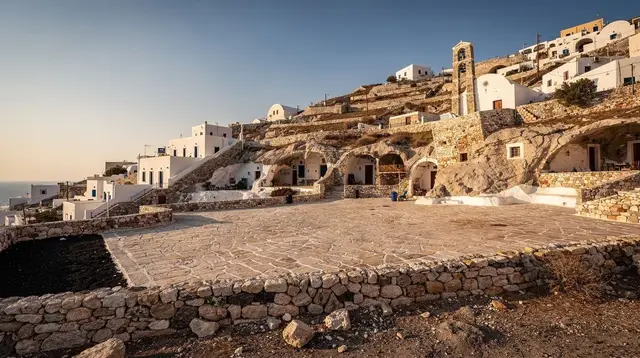
Imerovigli has an additional advantage: Skaros Rock, a bare promontory jutting out from the village that gives an unobstructed, three-sided view with no buildings in the frame. It takes a short walk to reach and rewards it with a foreground that Oia’s terrace, hemmed in by whitewashed walls and church domes, cannot offer. Firostefani, closer still to Fira, keeps the walkable caldera path atmosphere without Oia’s crowd pattern at all.
| Spot | Crowd level at sunset | View | Distance from Oia |
|---|---|---|---|
| Oia castle terrace | Very high, June–Sept | Caldera, blue domes, classic silhouette | — |
| Firostefani | Low to moderate | Caldera, volcano, open sky | About 10 km south |
| Imerovigli / Skaros Rock | Low | Caldera, volcano, unobstructed three-sided view | About 8 km south |
| Pyrgos kastro | Low | Whole island, less caldera focus | About 12 km south |
Neither Firostefani nor Imerovigli is a downgrade dressed up as a compromise. They are the same rim, the same sun, and the same sea, minus the queue. The only thing genuinely unique to Oia is its specific silhouette of domes and bell towers, which matters if that exact backdrop is the point of the photo rather than the moment itself.
What a Discreet Proposal Actually Looks Like in Oia
If Oia specifically is the goal, the way to keep it private is to change when you go rather than where. A few approaches that work in practice:
- Arrive at least two hours ahead and hold your spot. This costs time but guarantees a fixed position on the terrace by the time the light turns.
- Go for sunrise instead of sunset. The castle area is nearly empty at dawn, the light on the caldera is just as dramatic, and nobody is competing for the railing.
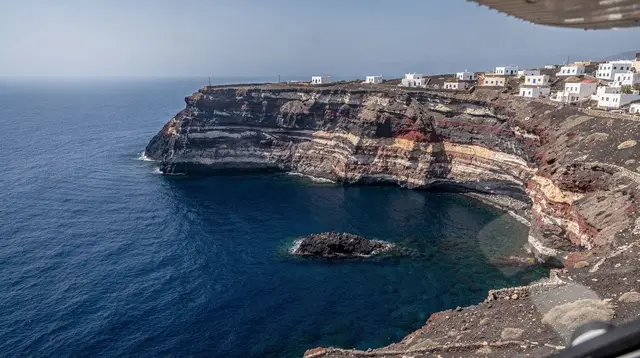
- Step down toward Ammoudi Bay. The path down from Oia to the water has its own sightlines over the caldera, away from the terrace crowd, and doubles as a quieter walk together before or after the moment.
- Take it to the water. A boat on the caldera looks back at Oia’s cliffside from the sea instead of competing for a spot on land, which solves the crowd problem entirely and adds its own view.
For that last option, several operators run trips built specifically around this moment. A private sunset cruise arranged around a proposal puts the couple on the water with the crew handling the timing and the photos, so neither of you is worrying about a stranger stepping into frame. For a couple who want the full ceremony treatment rather than a single moment, a staged Greek wedding experience builds an entire afternoon around it, costumes and setting included, away from the public terrace altogether.
Booking a Photographer or Videographer for the Moment
A phone in a friend’s hand can capture a proposal well enough, but it depends on that friend being in the right spot at the right second, in a crowd that may not give them room to move. A local photographer solves a different problem: they know which exact metre of the terrace, or which corner of Firostefani, will be clear at a given hour on a given date, and they can position the shot around your timing rather than around whoever else happens to be standing there.
Two ways this typically gets arranged:
- A dedicated proposal or couple’s session, timed to sunset or sunrise, usually forty-five minutes to two hours, built around one or two locations. The wedding proposal package with sunset views is built for exactly this brief.
- A longer roaming photo tour, moving between several viewpoints across a few hours, better suited to a couple who also want a wider set of images beyond the single moment. The five-hour highlights photo tour covers several villages in one booking, useful if the proposal is only part of what you want documented that day.
Either way, book the photographer before you book anything else for that day. Good ones are reserved weeks ahead in high season, and the whole point of hiring one is to remove the guesswork from timing, which only works if the booking itself is not last-minute.
Season by Season: When the Kastro Is (and Isn’t) a Problem
The crowd problem at Oia’s castle is not constant across the year, and knowing where you land on that curve changes how much planning the moment needs.
- High season, June to September: this is when the two-hour buffer matters most. Heat, long days and peak visitor numbers combine, and the caldera cruise boats add their own crowd on the water at the same hour. Plan the earliest arrival window described above, or move to Firostefani or Imerovigli without a second thought.
- Shoulder season, late April, May and October: noticeably calmer. A ninety-minute arrival window is usually enough, and the light is often just as good, sometimes better, without the summer haze.
- Winter, November to March: many restaurants, hotels and cruise operators in the caldera reduce hours or close entirely, and the terrace itself is often close to empty even close to sunset. The trade-off is a shorter window of daylight and a real chance of cloud cover, since this is also when the island sees most of its rain.
Santorini also went through a period of heightened seismic activity in early 2025, an earthquake swarm between the island and Amorgos that lasted around forty days and briefly emptied parts of the island of residents. It produced no eruption and has been over for some time; it is worth knowing about if you are researching the island’s safety, but it has no bearing on planning a sunset visit today and should not factor into the decision of where or when to propose.
Backup Plans If Weather or Crowds Ruin the Window
Even with careful timing, two things can still go wrong: cloud cover blocking the sunset itself, or a crowd that is simply larger than expected on a given evening. Neither has to sink the plan.
- If the sky clouds over, the moment does not need direct sun to work. Overcast light on the caldera is softer and often more flattering in photos than a hard sunset glare, and it removes the incentive for everyone else to crowd the terrace at the same time.
- If Oia is simply too full when you arrive, do not wait it out. Walk to Firostefani or Imerovigli, both under twenty minutes away by taxi, and use the same light with room to breathe.
- If the whole evening is a write-off, sunrise the next morning is a genuine alternative, not a consolation prize. The castle terrace before 7am in summer is close to empty, and the same view is available without a single hour of waiting.
Beyond the Ring: What Comes After
Once the moment itself is done, most couples want somewhere quiet to sit with it rather than heading straight back into a crowd. A table at one of the Firostefani or Imerovigli restaurants that face the caldera works well precisely because it is the same view without the terrace crush. For a longer celebration, a private villa stay built around the caldera view, like the option covered under a private luxury villa stay on Santorini, gives a couple their own version of the view for the rest of the trip rather than a single evening of it.
Couples who want to extend the day onto the water instead can pair the proposal or the photos with a full sunset cruise around the caldera, watching Oia’s cliffside from the sea as the light fades rather than standing in the crowd looking back at it.
For the photos themselves, once the moment is captured, a wider set of images across Pyrgos, the Akrotiri lighthouse or the caldera path between Fira and Oia is worth a separate booking on another day, covered in full in the Santorini photoshoot guide. Trying to fit both the private moment and a full shoot into the same hour at the same spot is usually what creates the timing pressure in the first place; separating them solves it.
Proposal and Wedding Photo Timing in Oia: Common Questions
How early should we get to the Oia castle before sunset?
In June through September, the viewing terraces around the castle start filling ninety minutes to two hours before sunset, and the best spots are gone well before that. Arriving at least two hours early buys you a fixed spot, but you will still be surrounded by other visitors doing the same thing.
Is there a quieter alternative with the same view as Oia?
Firostefani and Imerovigli sit on the same caldera rim, a few kilometres south of Oia, and catch the same light over the volcano and the sea. Both have far fewer people at sunset, and Imerovigli’s Skaros Rock adds a dramatic foreground that Oia’s castle terrace does not offer.
Can we still get a private moment during the summer crowds?
Yes, but not by fighting for space on the castle terrace at 8pm in July. Move the moment earlier in the day, choose a quieter village, or take it onto the water on a boat facing the caldera, where the view is arguably better and there is no crowd at all.
What time does the sun actually set in Santorini?
It varies by around three and a half hours across the year, from roughly 8:50pm in late June to roughly 5:15pm in late December. Check the date-specific time before you travel rather than relying on a number from a blog post, and build your arrival window around that figure.
Do we need to hire a photographer, or can a friend take the photo?
A friend with a phone can capture the moment, but a local photographer who knows the light and the crowd patterns will get you both in frame without a stranger’s shoulder in the shot, and can work around the exact spot and timing you want rather than whatever is left standing room only.
Is Firostefani or Imerovigli a compromise, or genuinely as good?
Genuinely as good for the light and the view, and better for the experience itself, since you are not sharing a narrow terrace with a tour group. The only thing Oia has that the others do not is the specific silhouette of its blue-domed churches, which matters if that exact backdrop is the point.
Photoshoots on GetYourGuide
Verified deep-linked GetYourGuide tours. Book through these links and we earn a small commission at no cost to you.
GetYourGuide does not provide a product photo for this activity — the image shows the meeting point, photographed by us.