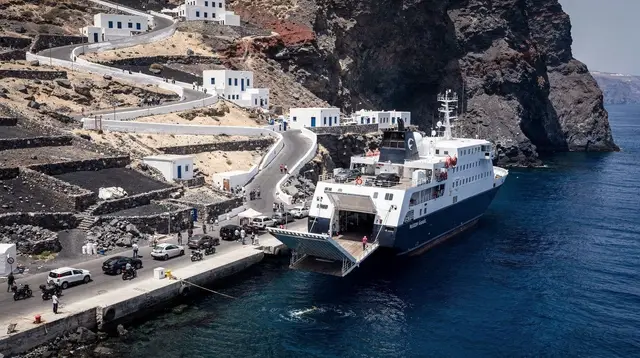
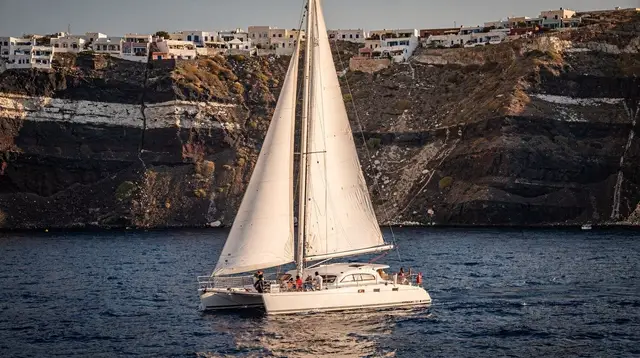
The other end of the island at golden hour
Everyone who plans a Santorini trip hears about the sunset in Oia before they hear about anything else on the island. Fewer hear about the lighthouse at the far southern tip, near the village of Akrotiri, which does the same basic job — sun going down over water — with none of the queue. It is not a replacement for Oia’s view of the caldera; it is a different view entirely, facing open sea rather than the crescent of cliffside villages. For a first-time visitor building a single-day plan around Oia, this page is a detour. For anyone who has already stood on Oia’s Kastro once, elbow to elbow, and wondered if there was somewhere quieter, this is that place.
It helps to be clear from the start about what this page does and does not cover. The Akrotiri lighthouse is a headland and a navigational tower on the island’s southern point. It is not the archaeological site of the same name, and it is not the White Beach or Black Beach that also sit near Akrotiri and are reachable only by boat. Three places, one shared name, three separate visits.
Akrotiri lighthouse vs Akrotiri village: same name, different places
This is the single most common mix-up on the southern end of the island, and it is worth untangling before anything else.
The village of Akrotiri gives its name to the whole area. A short walk or drive from the village centre is the Akrotiri archaeological site — the Bronze Age settlement buried by ash and excavated since 1967, now sheltered under a bioclimatic roof so it can be visited in any weather. That is a paid, ticketed, indoor-outdoor museum experience, built around walkways over an excavated townscape. Nobody goes there for sunset; they go for the ruins.
The Akrotiri lighthouse, by contrast, sits further out on the headland beyond the village, on the open southwestern tip of the island. There is no excavation here, no roof, no ticket. It is a stone tower with a working light, standing on a stretch of rock and scrub above the sea, and the only reason to come is the view — specifically, the view at the end of the day. If someone tells you they “went to Akrotiri for sunset,” they mean the lighthouse. If they tell you they “went to Akrotiri to see the ruins,” they mean the archaeological site. Both are true statements about the same small area of the island, and neither refers to the other place.
The mix-up matters practically, not just semantically: the two sites are a drive apart, they close and open on different logics (the ruins have entry hours and a ticket price, the lighthouse never closes because it is not an attraction with an operator), and turning up at one expecting the other wastes the part of the day that actually mattered — the light.
Getting there
The lighthouse sits at the very southern tip of the island, past the village of Akrotiri and past the turn for the Red Beach, on a narrow road that runs out toward the headland. There is no bus service out here; the KTEL buses that connect Fira with the south stop at Akrotiri village and the beaches, not at the lighthouse itself. In practice, this makes the lighthouse the least accessible of the island’s well-known sunset points for anyone without their own wheels.
Most visitors reach it one of three ways: a rental car or scooter (roughly 20 to 25 minutes from Fira, less from Akrotiri village or Kamari), a quad or ATV, which suits the rougher final stretch of unpaved road, or a taxi booked in advance and asked to wait, since taxis are scarce on the island and won’t simply pass by looking for a fare. A car is the simplest option and the one most guides quietly assume; if you don’t have one, folding the lighthouse into an organised route — a wine tasting itinerary that swings past the south, for instance — solves the transport problem for you.
The final approach is a dirt-and-gravel track rather than a paved road, with a small unpaved area to leave a car near the tower. It is passable in an ordinary rental car in dry weather but is not the place to test a low-clearance vehicle after rain, which is rare in the sunset season anyway.
What the sunset actually looks like from here
The core difference between this spot and Oia is the direction you are facing. In Oia, the crowd gathers to watch the sun drop behind the caldera, with the cliffside villages of the north forming layers in front of it — that famous stacked-village silhouette is the whole reason people fight for a spot on the Kastro. At the Akrotiri lighthouse, you are facing open water to the southwest, with the low shape of Thirassia visible off to one side and nothing but sea and sky ahead. There is no caldera wall in the frame, no whitewashed domes catching the last light. It is a plainer, wider, emptier kind of sunset — closer to a sunset over open ocean than the postcard version most people come to Santorini expecting.
That trade-off is exactly the point for the traveller this page is written for. If you have already had the layered, village-and-caldera version once, a second evening spent fighting the same crowd for a slightly different angle rarely feels worth it. An evening spent somewhere quiet, watching the same sun go down without having claimed a viewing spot two hours in advance, often feels like the better use of the last hour of daylight.
How it compares with the other sunset options
| Spot | View | Crowd level | Access | Cost |
|---|---|---|---|---|
| Oia’s Kastro | Caldera and stacked villages | Very high in season, arrive 90 min–2 hrs early | Walkable in village, no vehicle needed | Free |
| Akrotiri lighthouse | Open sea, Thirassia silhouette | Low to moderate | Car, scooter, quad, or booked taxi | Free |
| Imerovigli terraces | Caldera, closer to Fira | Moderate | Walkable from Imerovigli or Fira | Often a café/restaurant minimum |
| Skaros Rock | Caldera from a headland below Imerovigli | Low to moderate, short walk down | Short walk, uneven path | Free |
| Sunset by boat | Faces the caldera cliff from the water | Varies by boat size | Booked cruise required | Paid |
None of these is objectively “the best” — each solves a different problem. Oia gives the classic postcard at the cost of a long wait. Imerovigli and Skaros Rock give a caldera view closer to Fira with a shorter walk. A boat turns the whole equation around, letting you look at the cliffs instead of standing on them, which is often the most comfortable version of all. The lighthouse is the option for someone who has already tried the caldera-facing spots and wants something different rather than a variation on the same theme.
For a full rundown of comparable alternatives, see the dedicated guide to sunset spots beyond Oia, and for a side-by-side look at watching the same event from a deck instead of a rock, see sunset cruises compared.
Pairing the lighthouse with what’s already nearby
The lighthouse’s location on the southern tip puts it within easy reach of several other things this site covers, which is the practical argument for coming out this way at all rather than staying near the caldera villages all day.
The Akrotiri archaeological site is a short drive back toward the village, and because it sits under a roof, it is the standard recommendation for a day with wind, heat, or an unexpected shower — see the excavations guide for what the visit actually involves. A short distance further, the Red Beach has had repeated cliff falls in recent years and access has been restricted at times since 2018; check current conditions before planning to walk in, and read the access and safety notes rather than assuming the path is open.
Wine is the other natural pairing. Several of the island’s wineries sit inland from Akrotiri, and an afternoon tasting followed by a drive to the lighthouse for sunset is a common, sensible way to spend a half day in the south. For a private day built exactly around that structure, there’s a tour combining the Red Beach, Akrotiri, and wine tasting:
a private eight-hour day covering the Red Beach, Akrotiri, and wine tastingIf you’d rather see the excavated town itself with a guide before heading toward the coast, there’s also a guided walk through the site:
a guided route through the Akrotiri excavations paired with a nearby wineryFor general background on the island’s grape and its wineries before choosing a tasting, the wine tasting guide is the place to start.
Watching the same sunset from the water instead
For travellers who have found the whole business of standing on rocks or cliffs waiting for a specific minute a bit much, a boat solves the problem differently: it puts you on the water facing the island rather than on the island facing the water, and it removes the question of which viewpoint to fight for entirely. Two options that build the evening around exactly that:
a coastal cruise timed to the sunset along the caldera coastline a sunset cruise that passes Ammoudi Bay beneath OiaBoth put the caldera’s cliffs in front of you as the light changes, which is a genuinely different experience from either Oia’s Kastro or the open-water view from the lighthouse — worth weighing against a land-based evening if crowds are the main thing you’re trying to avoid.
Photography notes
The lighthouse’s appeal for photographers is less about the tower itself, which is a modest stone structure rather than a dramatic one, and more about having room to actually set up a shot without three other people in the frame. The headland gives a low, open horizon with no buildings to break the light, which suits a plain, sea-and-sky composition better than it suits the layered-village shots people associate with Santorini.
A few practical notes: the ground near the point is uneven rock and scrub rather than a paved viewing platform, so proper shoes matter more here than at a village-based viewpoint. There is no barrier at the edge of the headland in most places, so care is needed with tripods and with children near the drop.
And because the spot faces open water rather than the caldera, the best light here often comes slightly earlier or later than the “classic” caldera sunset — worth a short scouting visit at a different time of day if the shot matters to you. For a broader survey of where photographers concentrate on the island, see the best photo spots guide and, for a full day built around photography, the photography itinerary.
When to go
Sunset happens here every evening of the year, but the experience of watching it changes a great deal by season. In the height of summer, the meltemi wind can make an exposed headland like this uncomfortable in the evening, kicking up dust and making a long stay on the rocks less pleasant than a sheltered village terrace would be. In the shoulder months — April to June and September into October — the wind is generally gentler and the sky tends to be clearer, which is when this page recommends the visit most.
Winter is a different proposition again. Many of the boats and some of the restaurants that make the caldera side lively in summer close between November and March, and a stripped-back version of the island emerges — quieter, but genuinely different rather than simply a slower version of high season. A late-autumn or winter sunset from the lighthouse, with almost nobody else there, has its own appeal for a traveller who has come specifically for calm rather than spectacle. For more on what the island is like outside the main season, see the Santorini in winter guide.
Whatever the season, the same rule applies here as everywhere else on the island: check the actual sunset time before you go rather than assuming a fixed hour. It swings by more than three hours between the height of summer and the depths of winter, and turning up either too early or too late is the easiest way to feel like the trip out here wasn’t worth it.
Practical details before you go
There is no entrance fee, no ticket, and no operator at the lighthouse itself, which also means there is nobody to ask questions of if something is unclear on the day. Bring water, since there is nowhere to buy any at the headland. Wear shoes suited to uneven rock rather than sandals if you plan to walk out toward the point itself. And build in a buffer for the return drive after dark, since the road out to the headland has no street lighting and is easiest to navigate while there’s still some light left in the sky.
If the trip out here is part of a longer day that also takes in the volcanic islets or a wider loop of the south, a full-day option covering more ground in one booking is worth a look.
For everything else involved in putting together a day around the southern half of the island — where to eat, how long to allow, what else sits nearby — the villages guide and the beaches guide cover the ground this page doesn’t.
Akrotiri lighthouse: your questions answered
Is the Akrotiri lighthouse the same as the Akrotiri archaeological site?
No. The lighthouse is a sunset viewpoint on the southern headland with no facilities. The archaeological site is the excavated Bronze Age town under a roof, a few kilometres away near the village of Akrotiri. Same name, two different places and two different reasons to visit.
Can you go inside the Akrotiri lighthouse?
No. It is a working navigational light, not a visitor attraction, and there is no ticket booth, staff, or interior access. People come for the headland and the view, not the tower itself.
How do you get to the Akrotiri lighthouse without a car?
It is the hardest sunset spot on the island to reach without your own transport. There is no regular bus line to the headland, so most visitors arrive by rental car, scooter, quad, or a pre-booked taxi that agrees to wait, or come by boat as part of a cruise that passes the point.
Is the Akrotiri lighthouse crowded at sunset?
Rarely, compared with Oia’s Kastro. There is space to spread out on the rocks, and in peak season it can still fill a small parking area, but nothing like the crowds that gather 90 minutes to two hours early in Oia.
What is the view like from the Akrotiri lighthouse?
The sun sets over open water and the silhouette of Thirassia rather than over the caldera itself, since the headland faces southwest rather than into the caldera. It trades the layered village view of Oia for open sea, cliffs, and a lower, less crowded horizon.
Should I combine the lighthouse with the Red Beach or the Akrotiri ruins?
Many people do, since all three sit within a few minutes of each other on the southern tip. A common order is the archaeological site or a winery in the afternoon, a look at the Red Beach access situation, then the lighthouse for sunset — but treat each as its own stop rather than assuming one ticket or one path covers all of them.
Are there facilities at the lighthouse — food, water, toilets?
No. There is no shop, no taverna, and no reliable toilet at the headland itself. Bring water and plan to eat before or after, either in Akrotiri village or back toward Fira.
Is the Akrotiri lighthouse worth it if I’ve already seen Oia’s sunset?
That is exactly who it suits best. It won’t out-photograph the caldera villages, but it offers a calmer, unticketed evening with room to actually stand still, which is the main thing Oia’s Kastro no longer offers in high season.