Red Beach: Access and Safety in 2026
Is Red Beach in Santorini open and safe to visit in 2026?
Access has been unstable since a cliff collapse first closed the path in 2018, with further rockfalls in 2023 and December 2025. Parts of the trail remain partially restricted in 2026, so confirm the current status locally before walking in, and treat a boat trip past the cliffs as the reliable fallback.
What’s Actually Open at Red Beach Today
Red Beach, known locally as Kokkini Ammos, is the small cove of dark red sand wedged beneath a striped volcanic cliff near Akrotiri, on the southern tip of Santorini. It photographs beautifully and gets asked about constantly, and it is also the one beach on the island where the honest answer to “can I go?” is “check today.” The cliff above the sand is loose volcanic rock and ash, not solid stone, and it has come down onto the path and the beach itself in 2018, 2023 and again in December 2025. Each time, access has closed, reopened in a reduced form, and then closed again after the next rockfall.
Going into 2026, the situation is best described as partially restricted rather than either fully open or fully closed. Some sections of the route have reopened; the stretch along the base of the cliff that used to let visitors walk the full length of the beach has, more often than not, stayed fenced off since the most recent slide. None of this is settled enough to promise months in advance, which is why the single most useful thing you can do before making the trip is ask locally, on the day, rather than trust a fixed answer from any website, including this one.
This page exists to explain what’s actually going on with the cliff, what a realistic visit looks like when access is allowed, and what to do instead when it isn’t. It doesn’t compare Red Beach against the island’s other beaches, and it doesn’t describe Vlychada or the beaches near Akrotiri in any detail. For that, see the Santorini beaches guide and the Perissa versus Kamari comparison, or the dedicated page on Akrotiri’s white and black beaches.
Why the Cliff Keeps Failing
Red Beach owes its color and its danger to the same thing: it sits directly under a wall of oxidized volcanic scoria, the loose reddish rock left behind by an eruption long predating the famous Bronze Age one that buried Akrotiri. Loose volcanic material like this doesn’t behave like granite or limestone. It’s weakly bound together, it absorbs rain and expands and contracts with heat, and over time gravity wins. Chunks separate from the face and come down, sometimes as a scatter of rubble, sometimes as a larger slide that reshapes the base of the cliff and buries the path beneath it.
That happened first in 2018, prompting the first closure of the direct cliff-base route. A further rockfall in 2023 reinforced the restrictions. Then, in December 2025, another slide closed sections of the path again, and authorities were still assessing the extent of renewed restrictions at the time of this review. None of this is connected to Santorini’s 2025 seismic swarm between the island and Amorgos, a separate, well-documented episode of earthquake activity that ended without an eruption and without any direct link to this cliff.
Red Beach’s rockfalls are a slower, older story: gravity acting on soft volcanic rock that was never especially stable to begin with. For the fuller picture on the seismic swarm and what it did and didn’t involve, see Santorini safety and the 2025 earthquakes; it’s a separate topic from the cliff instability covered here.
The practical consequence is that Red Beach access isn’t a policy decision made once and left alone. It’s a running safety assessment revisited after every slide, which is exactly why no fixed answer holds for long, and why this page is written around “check before you go” rather than a confident yes or no.
Two Ways to See It: On Foot or From the Water
There are only two realistic ways to experience Red Beach, and knowing both before you plan the day means you’re never stuck without an option if the path turns out to be closed.
On foot, the standard approach starts at the car park near the Akrotiri archaeological site and follows a short path over a low ridge down to the beach. This shorter approach is the section most likely to be open when any access at all is allowed. The longer route along the base of the cliff itself, which used to let visitors walk the full length of the beach and continue toward neighboring coves, is the one most consistently affected by closures, since it runs directly beneath the unstable rock face. When authorities restrict access, this is usually the section fenced off first, sometimes for months at a stretch.
By water, boats running the south coast route from Akrotiri or from Perissa pass close beneath the cliffs, giving a clear view of the red and black rock striations without setting foot anywhere near the collapse zone. This is the fallback that works regardless of what the path is doing on a given day, and for a lot of visitors it’s genuinely the better vantage point, since it takes in the full sweep of the cliff face rather than a narrow view from the sand looking straight up.
a private half-day beach tour that can route past the Red Beach coastline and adjust on the spot if the path is closed that day is one way to hand the day’s logistics to someone who already knows the current status. If you’d rather stay on the water and skip the uncertainty entirely, a licensed boat rental or a private yacht charter along the south coast gives the same view of the cliffs from a position no rockfall notice affects.
What a Visit Looks Like When the Path Is Open
On the days access is allowed, Red Beach is small, and it fills quickly, since a restricted, intermittently open beach tends to be a crowded one whenever it does open. The sand itself is a deep rust-red mixed with black volcanic grit, and it gets hot enough by midday to make bare feet genuinely uncomfortable within seconds. Closed shoes or sandals you don’t mind getting wet are worth carrying even for a short visit; this is true on every dark-sand beach on the island, not just this one.
There are no facilities at the beach itself: no showers, no shaded seating beyond what visitors bring, no snack stand. Perissa and Perivolos, a short drive or bus ride away, have the full range of beach bars, sunbeds and tavernas if you want to make a full day of it before or after a quick stop here. If lounging matters more than the photograph, a sun bed and beach bar package at Perissa is a straightforward way to spend the rest of the day somewhere with none of the access uncertainty.
Swimming, when the beach is open, is generally fine in terms of the water itself; the caution applies entirely to the cliff, not the sea. Staying off any visible rubble at the base of the rock face and away from directly underneath the overhang, even for photos, is the one rule worth actually following, since that overhang is exactly where the next fall lands.
Seeing the Cliffs From the Water Instead
If the path is closed on the day you’re there, or you’d simply rather not deal with the uncertainty, viewing Red Beach from a boat is a genuinely good alternative rather than a consolation prize. The cliff’s banding, red scoria layered over black lava, is arguably more visible from a slight distance and low angle than it is standing on the sand looking straight up. South coast boat routes that also pass the Akrotiri lighthouse and the coastline toward the beaches near Akrotiri often fold in a pass by Red Beach as one stop among several, rather than treating it as a destination on its own.
For visitors who’d rather be in the water than looking at it from a deck, a introductory dive along the south coast puts you close to the same underwater volcanic terrain from a different angle entirely, no cliff access required. And for anyone who wants a livelier stop nearby rather than a quiet cove, water tubing at St George Beach is a short drive from the Akrotiri area and doesn’t depend on Red Beach’s access status at all.
Timing, Crowds and the Heat
Even leaving the access question aside, Red Beach rewards showing up early. It’s a small cove with no shade structures, and by late morning in the summer months both the crowd and the sun are at their most intense. Coming in the first couple of hours after sunrise, when it’s open, means fewer people navigating a narrow path and a cooler stretch of sand underfoot before the volcanic grit starts to radiate heat.
The meltemi, the strong seasonal wind that picks up through July and August, can also make small boats bounce along the exposed south coast, which is worth knowing if you’re planning to see the cliffs by water rather than on foot. Calmer conditions in the shoulder months, covered in the Santorini weather guide, tend to make for a smoother boat approach, even if the path itself is no more or less likely to be open at that time of year.
Red Beach Among Akrotiri’s Sites
Red Beach sits a short drive from the covered Akrotiri excavations, the Bronze Age town buried by the Santorini eruption and now protected under a roof, which makes it a reasonable pairing for one outing: ruins in the morning before the heat builds, beach in the late afternoon if access allows. The two have nothing to do with each other administratively, no shared ticket, no shared opening hours, and one being open says nothing about the other. Details on the excavation itself are covered in the Akrotiri excavations guide rather than here.
The Akrotiri lighthouse, a little further along the headland, is another stop that pairs naturally with the area and, like the boat routes past Red Beach, offers a view of the coastline that doesn’t depend on any path being open. Cruise passengers working with a fixed window of time often build a version of this route into a single shore excursion rather than trying to fit in a separate trip.
Making the Call on the Day
There’s no way to promise from here whether the path will be open when you arrive, and any page that tries is guessing. What’s reliable is the pattern: closures have followed rockfalls in 2018, 2023 and December 2025, restrictions have eased and tightened more than once since, and the boat route past the cliffs has worked every time regardless of what’s happening on land. Build the day with that fallback in mind, ask locally before committing to the walk, and you won’t be caught out either way.
Common Questions About Red Beach Access
Is Red Beach open right now?
It changes. The cliff path has been closed and reopened several times since 2018, most recently after a rockfall in December 2025, and partial restrictions were still in place going into 2026. Ask at your accommodation or a local tour desk on the day, rather than relying on anything written online, this page included.
Why does Red Beach keep closing?
The beach sits directly beneath a tall cliff of loose volcanic rock and ash. That material erodes and slides naturally, and it has come down onto the path and the sand in 2018, 2023 and December 2025. Each collapse triggers a fresh safety review before authorities decide whether to reopen access.
Can I still walk to Red Beach in 2026?
Sometimes, on part of the route, but never assume it. When the path is open it is usually the short approach from the Akrotiri car park; the older scramble along the base of the cliff is the section most often fenced off. Check before you set out and be ready to turn back.
Is it safe to swim at Red Beach when the path is open?
Swimming itself is not the issue, the cliff above the sand is. Even when the beach is accessible, stay off any rockfall debris and away from the base of the cliff, and don’t linger directly under the overhang for photos.
Can I see Red Beach without walking the cliff path at all?
Yes. Boats running along the south coast from Akrotiri or Perissa pass close beneath the red and black cliffs, which is how most visitors see the beach when the path is restricted. You get the same view of the striped rock without any of the access risk.
Is Red Beach part of the Akrotiri archaeological site?
No. Akrotiri is the covered Minoan excavation a short drive away; Red Beach is a separate stretch of coastline near the same headland. They’re often visited on the same trip, but one ticket has nothing to do with the other.
What should I bring if the path is open?
Closed shoes for the volcanic sand, which gets hot enough to burn bare feet by midday, water, and a hat. There are no facilities at the beach itself.
Where should I check before I go?
Ask locally on the day, either at your hotel, at the Akrotiri car park, or with a boat operator running the south coast route. Conditions have changed several times a year since 2018, and no single source stays current for long.
Beaches on GetYourGuide
Verified deep-linked GetYourGuide tours. Book through these links and we earn a small commission at no cost to you.
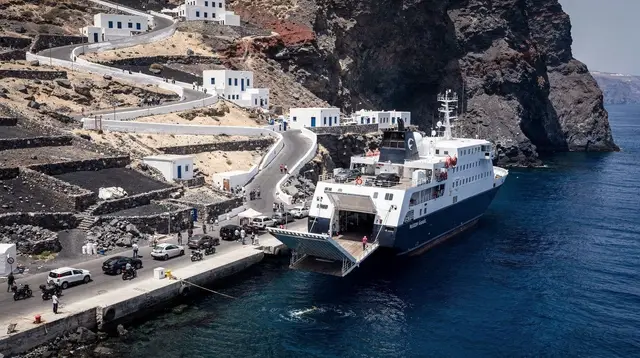
GetYourGuide does not provide a product photo for this activity — the image shows the meeting point, photographed by us.