The Meltemi Wind in Santorini, Explained
What is the meltemi and how does it affect a trip to Santorini?
The meltemi is a strong, dry north wind that blows across the Aegean, most often and most forcefully in July and August. On Santorini it can cancel or reroute caldera cruises to Nea Kameni and Palea Kameni, make some beaches uncomfortable, and is unrelated to the island's volcanic or seismic activity.
What the Meltemi Actually Is
Somewhere between one visit and the next, a lot of travellers hear the word “meltemi” for the first time from someone whose boat trip just got moved, delayed, or cancelled. It is worth understanding before it happens to you, because it is not an emergency, not a storm system, and not connected to anything happening underground — it is simply the Aegean’s summer wind, and Santorini sits directly in its path.
The meltemi is a strong, dry, north-to-northeast wind that blows down across the Aegean Sea in the warmer months. It forms from a pressure difference between a summer low over Anatolia and Turkey and higher pressure over the Balkans, and it strengthens as air is funnelled between the Greek mainland and the Cycladic islands. It is a completely normal, recurring feature of the season — sailors and fishermen have planned around it for as long as people have lived on these islands. What makes it worth a dedicated page is simply how often it changes a single day’s plan on Santorini, especially for anyone heading out onto open water.
Why July and August Are the Windiest Months
The meltemi does not blow at a constant strength all summer. It builds through June, is at its most frequent and forceful in July and August, and eases off through September. Within that window it typically arrives in multi-day spells rather than as one continuous gale — a few blustery days, then a calmer stretch, then another spell. It is also usually stronger in the afternoon than in the early morning, which is one reason operators sometimes run a trip at dawn that they would not attempt at 3pm.
This page focuses specifically on what the wind does to boats and beaches. For the fuller month-by-month picture of temperature, sea conditions and crowd levels, see Santorini weather month by month; for the broader question of when to book your whole trip, see the best time to visit Santorini. Neither of those pages substitutes for this one if you already have a boat trip booked in July or August and want to know what to expect.
What the Meltemi Cancels: Boat Trips and Volcanic Islets
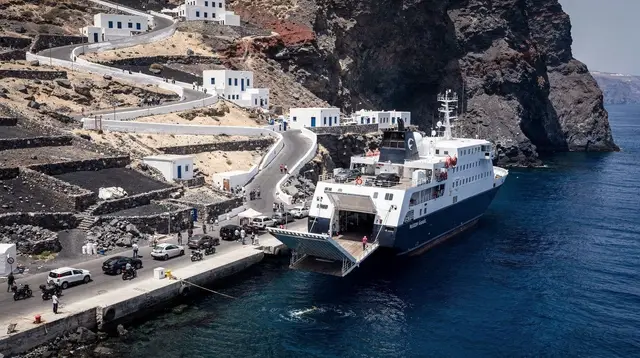
The single biggest practical impact of the meltemi is on boat-based activities, and above all on trips into the Santorini caldera that land on the volcanic islets.
Nea Kameni, the still-active crater at the centre of the caldera, is normally reached by boat, with visitors walking up a short ash trail to the rim. Palea Kameni, the neighbouring islet, is where boats stop so passengers can swim to the rust-coloured hot springs — there is no dock there, and no landing without getting in the water.
Both stops depend on a boat being able to approach the shoreline safely and, in the case of Palea Kameni, on the sea being calm enough to swim in comfortably. A strong meltemi spell can make either stop impractical, and operators running a full-day caldera cruise that includes both islets will sometimes drop a landing, shorten a swim stop, or reroute the whole itinerary rather than push through rough water.
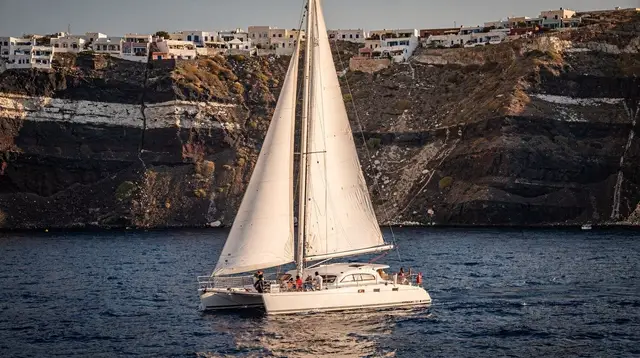
The same goes for the evening version of the trip. A catamaran sunset cruise around the caldera is sold on calm water and an open view of the sky over Oia and Imerovigli — exactly the conditions a stiff northerly undoes. Operators make the call on safety, not on refunds, and a cancelled or rescheduled sunset departure during a windy stretch of July or August is common enough that it should not come as a shock.
For a longer look at how caldera cruises are run and what a good operator does when the wind picks up, see the caldera cruise guide and the comparison of catamaran versus sailing boat trips. If you already have a booking and want to know what to actually bring in case conditions are marginal, what to bring on a caldera cruise covers it.
It is not only cruises. Diving and snorkelling trips can be affected too, since visibility and comfort both drop in a chop, and a guided diving tour around Santorini’s volcanic coastline may be moved to a more sheltered site on a windy day rather than cancelled outright — one advantage of diving with a local operator who knows which coves stay calm.
For the wider water-sports picture beyond diving, the Santorini water sports guide and the page on jet-skiing and paddleboarding both flag which activities are most weather-sensitive. Anyone weighing up renting a boat without a licence should treat the meltemi as the main reason that plan can go sideways — a small rented boat is far more exposed to wind and chop than a crewed cruise vessel with a captain reading the forecast.
Which Beaches Get Rough — and Which Stay Calm
The meltemi does not treat every stretch of coastline the same way, because Santorini’s coastline does not face in only one direction.
The caldera side of the island — Fira, Firostefani, Imerovigli, Oia — faces west and sits high above the water, so it is largely sheltered from the wind’s direct effect on the sea, even if it can still feel breezy up on the cliff. The beaches, by contrast, sit on the east and south coasts, more open to a north wind funnelling down the Aegean.
| Beach | Typical exposure | What a strong meltemi day looks like |
|---|---|---|
| Kamari | East-facing, fairly open | Choppier water, more airborne sand, less comfortable for lounging |
| Perissa / Perivolos | East–south, long open stretch | Similar to Kamari; the length of the beach offers little natural shelter |
| Vlychada | South-facing, cliffs behind | Usually calmer than Kamari or Perissa, though still affected in the strongest spells |
| Red Beach | South coast, small cove | Small and enclosed, but access is already restricted — see the note below |
| Ammoudi Bay | Below Oia, west-facing | Sheltered by the caldera cliffs, one of the calmer swim spots in a blow |
None of Santorini’s black-sand beaches sit directly on the caldera itself — the villages up on the cliff have no beach of their own, which is a separate point covered in the Santorini beaches guide. On Red Beach specifically, treat the wind as a secondary concern next to the access restrictions already in place after cliff falls in 2018, 2023 and December 2025; check current access before planning around it regardless of the forecast.
Whichever beach you choose in a windy spell, expect airborne sand at the very least, and treat a red or checkered flag from any lifeguard station as a hard rule, not a suggestion.
One Person’s Bad Wind Is Another’s Good Wind
It is worth saying plainly: the meltemi is not bad news for everyone. The same wind that grounds a caldera cruise or roughs up Kamari is exactly what windsurfers and kiteboarders wait all summer for. Steady, strong, predictable wind is the raw material of the sport, and Santorini’s exposed east coast beaches are precisely where that wind is most reliable.
A guided windsurfing lesson on Santorini is one of the few bookings on the island that gets better, not worse, when the forecast shows a strong meltemi day. If your trip includes both a caldera cruise and a windsurfing session, it is worth booking them on different days if you can — pick calmer-looking days for the boat and let the wind pick the day for the board.
How to Tell If the Meltemi Will Affect Your Day
There is no need to become an amateur meteorologist before a trip to Santorini, but a few habits go a long way:
- Check a marine or general weather forecast for wind speed two to three days out, not just temperature. A forecast in the 20–30+ knot range for a given day is the kind of number that makes cruise operators start planning alternatives.
- If you have a caldera cruise, volcano landing, or hot springs swim booked, message the operator the day before if the forecast looks windy. Most will tell you directly whether the trip is running as planned, running with a modified route, or being rescheduled.
- Mornings are usually calmer than afternoons in a meltemi spell, which is one reason some operators shift departure times earlier during July and August.
- If a beach day is exposed rather than fixed, keep a caldera-side or sheltered alternative in mind, such as Ammoudi Bay or a swim from a boat rather than a stretch of open sand.
- Do not treat a windy forecast as a reason to avoid the whole trip — it is a reason to build in some flexibility, not to cancel plans wholesale.
The Meltemi Has Nothing to Do With the Volcano
This is worth stating clearly because the two subjects sit close together on this site and are easy to conflate: the meltemi is ordinary Mediterranean weather, driven by summer pressure patterns across the Aegean, and it has no connection to Santorini’s volcanic system or to the seismic swarm that affected the island between late January and early March 2025.
That swarm — centred between Santorini and Amorgos, lasting roughly forty days and producing more than 28,000 recorded tremors — has been linked by published research to a deep magmatic intrusion, not to weather of any kind, and it ended without an eruption. A windy week in July tells you nothing about the ground beneath the island, and a calm sea tells you nothing about it either. For the fuller picture of that swarm and how the island’s safety is actually assessed, see Santorini safety and the 2025 earthquakes; this page is only about wind and water.
Planning Around the Wind
The most useful mindset for a July or August trip is to treat weather-sensitive bookings — caldera cruises, volcano landings, diving, and anything on a small boat — as flexible rather than fixed. Book with an operator who is upfront about their cancellation and rescheduling policy, keep a day or two of buffer if your itinerary allows it, and avoid stacking every water-based activity into your final day on the island. If you are travelling in the calmer shoulder months instead, the meltemi is far less likely to intrude on your plans at all; see the shoulder season guide for how that trade-off compares to peak summer.
None of this should discourage a summer trip. The meltemi is one of the most predictable features of a Santorini August — predictable enough that good operators build their whole summer schedule around it, and unpredictable enough, day to day, that a little flexibility on your end makes the difference between a frustrating cancellation and a pleasant reshuffle.
Meltemi FAQ: Wind, Boats and Beaches in Santorini
What exactly is the meltemi?
It is a seasonal north-to-northeast wind that blows across the Aegean Sea in summer, caused by a pressure difference between the Balkans and the eastern Mediterranean. It is a normal, recurring weather pattern, not a storm or a warning sign of anything unusual.
When is the meltemi strongest in Santorini?
It builds through June, peaks in July and August, and tapers off in September. Within those months it tends to blow in multi-day spells rather than constantly, often stronger in the afternoon than in the morning.
Will the meltemi cancel my boat trip to Nea Kameni or Palea Kameni?
It can. Operators running caldera cruises, volcano landings and hot springs swims make the call on the day, and safety comes first. A cancelled or rescheduled departure in a windy spell is common enough that it should not come as a surprise.
Which Santorini beaches are worst affected?
Open, exposed stretches on the east and south coasts, such as Kamari and Perissa, are the ones that can turn choppy and sandy in a strong blow. Sheltered coves and the caldera side, which faces west and away from the wind, are far less affected.
Is the meltemi dangerous?
For swimmers and small boats it can create rough, choppy conditions and should be respected, but it is a routine summer wind, not an emergency. Operators and lifeguards adjust their plans around it precisely because it is expected and well understood.
Does the meltemi have anything to do with Santorini’s volcano or the 2025 earthquakes?
No. The meltemi is ordinary Mediterranean weather driven by summer pressure patterns, while the island’s volcanic and seismic activity are separate geological processes. The two are unconnected, and one is not a sign of the other.
Is the meltemi good for anything?
Yes — windsurfers and kiteboarders look forward to it. The same wind that grounds a caldera cruise can be exactly the condition a windsurfing lesson needs.
Seasonal experiences on GetYourGuide
Verified deep-linked GetYourGuide tours. Book through these links and we earn a small commission at no cost to you.
GetYourGuide does not provide a product photo for this activity — the image shows the meeting point, photographed by us.