A long black beach with a mountain standing behind it
Perissa is the northern end of the longest stretch of black sand on Santorini, and it sits at the foot of the Mesa Vouno ridge — the same limestone wall that shelters Kamari on its opposite, eastern flank. The two beaches are separated only by that mountain, not by any real distance if you were a bird, but by road it’s a drive around the headland rather than a walk across it.
South of Perissa, the same sand keeps going, unbroken, into Perivolos and then further along the coast. This matters for how you plan the day: it is genuinely one beach split by convention, not two separate ones. Perissa is the quieter, more village-anchored end; Perivolos is where the beach clubs and the loungers-with-DJ-sets take over. If you’re after sunbeds, cocktails, and a beach-club scene, this isn’t the page for that — Perivolos is. If you want length, a real village, tavernas that serve locals as well as tourists, and the most direct road or path up to a genuine archaeological site, Perissa is the better base.
What sets Perissa apart from every other beach town on the island is what’s directly above it. From the sand, look up and to the south: that’s the same ridge that carries Ancient Thira on its crest, 396 metres up. No other beach town on Santorini puts you this close to a Bronze Age and classical-era city in one uninterrupted line from sea level to summit.
Getting to Perissa
Perissa is roughly 20–25 minutes from Fira by KTEL bus, taxi, or rental car, and about the same again from the ferry port at Ormos Athinios, since both routes cross the island’s spine rather than hugging the caldera rim. There is no direct road along the coast between the caldera villages and the south beaches — everything funnels through Fira or through Messaria and Emporio.
Buses run from the Fira central station and are the cheapest way in; see buses in Santorini for how the routes and timetables actually work in practice, because the printed schedule and the real one drift apart in high season. A rental car or scooter gives you the most freedom, particularly if you want to combine Perissa with Kamari or Akrotiri on the same day — see renting a car or scooter for what’s actually required, since licence checks at the pick-up counter are real and enforced. Taxis exist but are genuinely scarce on this island — booking ahead is the norm rather than something only anxious travelers do.
The beach itself
The sand at Perissa is volcanic black, fine, and — this is worth repeating on every beach page on this site because visitors keep learning it the hard way — it gets hot enough to burn bare feet by late morning in summer. Bring sandals you don’t mind walking on sand in, and expect the sunbed operators to have paved or matted paths from the loungers to the water for exactly this reason.
The beach itself is wide and unusually long by Cycladic standards, backed by a line of tamarisk trees that give patches of natural shade — something Kamari, on the beach’s opposite mountain flank, has less of. Sunbeds and umbrellas are available for a fee at the organized sections in front of the hotels and tavernas; the further sections towards Perivolos are more built up with beach bars, while the Perissa end nearer the village tends to be a touch calmer.
The water itself is a good depth for swimming without a long shallow wade, and one of the more distinctive activities based right on this stretch of coast is water tubing, launched from the nearby St George beach section of the same sandy run:
an inflatable-tubing session on the water just along this same black-sand coastIt’s a straightforwardly fun, non-technical activity — useful if you’re travelling with teenagers or just want an hour that isn’t lying on a sunbed.
The village behind the sand
Perissa’s village is compact, flat, and easy to walk — a genuine advantage over the caldera towns, where every errand involves stairs. It has a working, un-touristy core: a church, a scattering of family-run tavernas that serve the same grilled fish and horiatiki you’d find anywhere on the island but at prices that haven’t caught up to Oia’s, and enough small hotels and studios to make it one of the more affordable bases on Santorini. This is part of why it draws a different crowd than the caldera side: younger travelers, families on a budget, and people who’d rather spend the savings on activities than on a sea-view balcony they’ll only use at breakfast.
If eating and staying options are the deciding factor in choosing between the south coast towns, Perissa versus Kamari lays out the actual differences in village character, beach texture, and price level side by side.
Climbing to Ancient Thira
This is Perissa’s real distinguishing feature. The path up to Ancient Thira — a Dorian-era city built along the ridge of Mesa Vouno, inhabited from roughly the 9th century BC through the Byzantine period — starts from the Perissa side of the mountain and is the shorter, steeper of the two approaches (the other climbs from Kamari). It’s an unshaded path with real elevation gain to 396 metres, so this is not a stroll: bring water, start early or late in the day rather than at midday in summer, and wear proper shoes rather than beach sandals.
At the top, the ruins spread along the exposed ridge line with open views down to both Kamari and Perissa simultaneously, plus a long sightline out to sea — one of the better payoffs-for-effort views on the island, precisely because so few visitors bother with the climb.
For the fuller context on what you’re looking at up there, and how it differs entirely from the buried Bronze Age town at Akrotiri on the other side of the island, see the Ancient Thira guide and hiking beyond the caldera path, which covers this route and others that aren’t the famous Fira–Oia walk. For the mountain itself and its role as the island’s high point (the actual summit, Profitis Ilias, is a separate walk further along the same ridge), see Profitis Ilias and Mesa Vouno.
It is entirely possible to combine the two in one outing: walk up from Perissa, spend an hour at the ruins, and either retrace your steps or continue along the ridge and descend into Kamari — turning a beach morning into a half-day that also covers one of the island’s most substantial archaeological sites, with none of the crowding that Akrotiri sees in peak season.
If archaeology combined with an organized excursion suits your plans better than a self-guided walk, a comparable half-day option covers the excavated Bronze Age town on the island’s southern tip:
a guided walk through the excavated Bronze Age town at AkrotiriIt’s a different site from Ancient Thira — Akrotiri is the town buried by the eruption around 1600 BC, Ancient Thira is the later, classical-era city on the mountain above Perissa — and the two are worth telling apart rather than conflating.
Perissa, Perivolos, and Kamari — clearing up the geography
Three names get used loosely for what’s really two beaches. Perissa and Perivolos are one continuous stretch of black sand, divided only by an informal line roughly where the village core gives way to the beach-club strip further south. There is no headland, river mouth, or gap between them — you can walk the whole thing without leaving the sand. Kamari is a genuinely separate beach, on the opposite side of the same Mesa Vouno ridge, reached by a different road entirely.
The practical upshot: if a search or a recommendation mentions “Perissa” for a beach-club night out, it likely means the Perivolos end of the same beach. If it mentions Perissa for a quieter village stay with easy access to Ancient Thira, that’s this end. Knowing the difference saves a wasted taxi ride in high season, when every minute in the car matters.
When to go
Perissa works well across a longer season than the caldera villages, mostly because it doesn’t depend on the caldera view or sunset crowds for its appeal. June through August brings full summer heat, the busiest beach days, and the black sand at its hottest — footwear becomes non-negotiable rather than a suggestion (see black sand and burnt feet for exactly how bad this gets and when). Late April through June and September into October are the more comfortable windows: warm enough to swim, cooler underfoot, and with the village tavernas still fully open, unlike much of the caldera side.
Wind is worth a mention on any south-coast beach page: the meltemi, the strong seasonal north wind, is more of a factor for boat trips and the exposed west coast than for a beach tucked under a mountain, but it can still stir up the sea and blow sand around on stronger days in July and August — check conditions before committing to a full beach day if the forecast looks blustery.
Outside the main season, see Santorini in the shoulder season and Santorini weather month by month for what actually stays open on this side of the island once the peak crowds thin out.
Practical notes
- Footwear: closed sandals or beach shoes for the sand at midday; proper walking shoes if you’re doing the Ancient Thira climb.
- Cash: village tavernas and smaller sunbed operators often prefer cash; cards are accepted at the larger hotels and beach bars.
- Getting around without a car: entirely workable — the village is flat, the bus connects to Fira, and the beach itself needs no transport once you’re there. See buses in Santorini.
- With children: the shallow, gently shelving sand and flat village streets make Perissa an easier base for families than the caldera towns, where every walk involves steps.
- Evenings: the village has a handful of tavernas with live music or a more organized night out — a Greek-night format with meze and dancing is available if you want a set evening rather than picking a taverna cold:
Where Perissa fits in a wider Santorini plan
Perissa suits a beach-and-history day rather than a full-trip base for most visitors, precisely because it’s a 20-minute drive from the caldera side where the sunset views and most restaurants concentrate. It works well as one stop within a one-day Santorini itinerary built around the south coast — Akrotiri, the beach, Ancient Thira — or as the beach afternoon within a longer stay based in Fira or Oia. For the fuller picture of what else sits along this stretch of coast, things to do in Perissa and the general Santorini beaches guide cover the other black-sand options and how they compare.
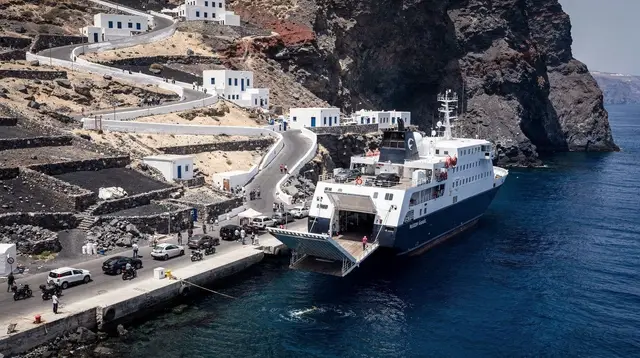
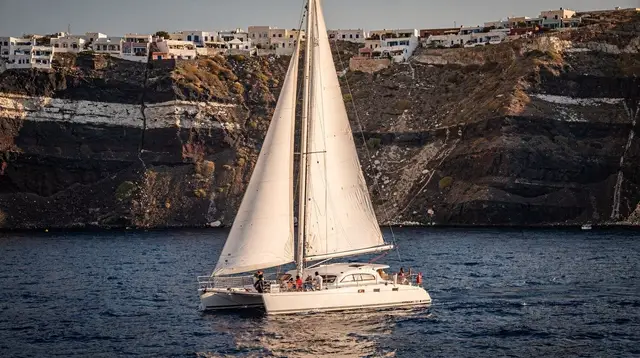
If you’re arriving by sea rather than staying on the island, a caldera-facing day on the water is a genuinely different way to see the coastline this page describes from below:
a full day out on the water along Santorini’s coastlinePerissa questions answered
Is Perissa the same beach as Perivolos?
Yes, functionally. Perissa and Perivolos are one continuous stretch of black sand on Santorini’s south coast, split only by an informal line rather than any physical gap. Perissa is the quieter, village-anchored northern end; Perivolos, further south, is where most of the beach clubs concentrate.
How long is Perissa beach?
Perissa forms the northern portion of what is Santorini’s longest beach once you include its continuation into Perivolos — several kilometres of black sand in total, running along the base of the Mesa Vouno ridge.
Can I walk from Perissa up to Ancient Thira?
Yes. A footpath climbs from the Perissa side of Mesa Vouno up to the ancient city at 396 metres. It’s steeper and shorter than the equivalent path from Kamari, has no shade, and needs proper shoes and water — this is a real hike, not a stroll from the beach.
Is Perissa better than Kamari?
They sit on opposite sides of the same mountain and offer a similar black-sand, family-friendly experience. Perissa generally has a longer beach and a slightly more budget-oriented village; Kamari has a marginally more developed seafront promenade. The Perissa versus Kamari guide compares them directly.
Do I need a car to stay in Perissa?
No. The village is flat and walkable, buses connect to Fira, and the beach is on your doorstep. A car or scooter helps if you want to combine Perissa with Akrotiri, Kamari, or the wineries in one day, but it isn’t required for a beach-focused stay.
Is the sand at Perissa hot?
Very, from around late morning through mid-afternoon in the summer months. The black volcanic sand absorbs heat and can be genuinely painful underfoot without sandals — bring proper footwear for the walk from your sunbed to the water.
What’s the best time of year to visit Perissa?
Late April through June and September into October give warm swimming weather without the peak-summer heat that makes the sand and midday sun the most punishing. Most tavernas and services stay open through this whole window, unlike parts of the caldera side that shut down earlier in the off-season.
Is Perissa a good base for a family trip?
It’s one of the more practical options on the island for families: flat streets, a long shallow beach, and a village pace that doesn’t require managing hundreds of steps every time you leave the hotel. See Santorini with kids for how it compares to other bases.