Santorini with Kids
Is Santorini a good destination for families with children?
Yes, with some planning around logistics. The caldera villages sit on top of a cliff with steep steps and no beaches, so families do better basing themselves near a flat, swimmable beach like Kamari or Perissa and treating the cliff-top villages as day visits. Skip quads, which cause more tourist hospital visits on the island than anything else, and use the cable car or a taxi to move between the port and Fira.
Why Santorini Needs a Different Plan with Children
Most of what makes Santorini famous — the cliff-top villages, the caldera views, the sunset crowds in Oia — sits on top of a 250 to 300 metre wall of volcanic rock with no beach anywhere near it. That’s not a problem for a couple on a short break, but it changes the shape of a family trip. The places you’ll actually swim, build sandcastles or let a toddler run around are on the east and south coasts, a taxi or bus ride from the postcard villages, and the two halves of the island don’t overlap the way first-time visitors expect, which is why sketching out a rough day-by-day itinerary before you book accommodation saves a lot of backtracking later.
This page is about the logistics that make or break a family stay: where a base works without constant stairs, which beach is manageable with small children, what to do when the weather or the wind cancels the boat trip you planned, and the one piece of advice we’d give every parent before they book anything — leave the quad rental off the list. Choosing when to visit also shapes how much of this you’ll need to plan around, since shoulder-season crowds and summer heat make for a very different trip with young children. None of this is a rundown of bookable activities; for that, see our guide to family-friendly tours in Santorini, which covers the operators and formats built for children. This page is the planning layer underneath it.
Choosing a Base That Doesn’t Involve Constant Stairs
The caldera villages — Fira, Firostefani, Imerovigli and Oia — are strung along the cliff rim, connected by narrow stone paths with steps between levels and drops on one side. They’re beautiful to walk through with kids for an afternoon, and largely impractical to live in for a week with a stroller, a nap schedule, or a toddler who wants to explore every ledge. There’s no beach at the bottom of any of them, and getting from a caldera-side room down to sea level means a car, a bus, or the cable car and steps described further down. The same steps and uneven paths are the reason we put together a separate guide to accessibility in Santorini for anyone travelling with limited mobility, not only very young children.
Families who want the caldera view without the caldera logistics tend to do better basing themselves in Karterados or one of the flatter inland villages and driving in for a village visit and dinner, rather than trying to manage daily life from a clifftop step. Families prioritising beach time over caldera views usually do better still basing themselves near Kamari or Perissa, where the seafront is flat, paved and a short walk from the room. Families who’d rather skip renting a car altogether can also look at our Santorini without a car itinerary, which shows how much of the island is reachable by bus and boat alone.
Our broader guide to where to stay in Santorini goes into the trade-offs by area in more depth; the family-specific point is simply this — decide whether the trip is built around the beach or the view, because very few properties genuinely deliver both without a car in between.
Beaches That Work for Families
We won’t run through every beach on the island here — that comparison lives in our full Santorini beaches guide — but a few points matter specifically for a family stay. Santorini’s sand and pebbles are volcanic, which means black or dark red rather than pale gold, and they absorb heat. By midday in summer the beach surface is genuinely too hot for bare feet, adult or child, so water shoes are close to non-negotiable rather than an optional extra.
Kamari sits under the dramatic wall of Mesa Vouno and has a long, paved seafront promenade lined with tavernas, showers and shaded seating, which makes it easy to retreat from the sun or find a toilet without packing up the whole beach setup. Perissa, on the other side of the same mountain, is the longest stretch of dark sand on the island and similarly well equipped, with sunbeds and facilities close to the water. Both are flat, both are reachable by the island’s KTEL bus network from Fira, and both let you set up for a full day without needing a car. Kamari’s black-sand promenade against the cliff wall behind it is also one of the more photogenic bases on the island, covered in our guide to the best photo spots in Santorini.
What we’re not going to do here is rank them against each other for you — that call depends on where you’re staying and how you’re getting around, and it’s covered properly in the beaches guide linked above. For a family trip, the practical filter is simpler than “which beach is best”: look for a paved or flat approach, shade options, and toilets within reach, and treat the volcanic sand’s heat as a given rather than a surprise.
A Rainy or Windy Day Plan: Akrotiri
Santorini doesn’t get much rain, but it does get wind, and the meltemi that blows through in July and August is strong enough to cancel the caldera cruises that are usually the highlight of a Santorini itinerary, and to make some beaches genuinely unpleasant for a few hours. When that happens, or on the rare wet day, Akrotiri is the plan that actually works regardless of weather.
The site is a Bronze Age town buried by the same eruption that shaped the caldera, excavated since 1967 and now covered by a permanent bioclimatic roof — which in plain terms means it’s an indoor-outdoor archaeological site you can walk through in wind, rain or blazing heat without it affecting the visit. Raised walkways run above the excavated streets and houses, which also makes it more manageable with a stroller than most sites on the island.
No human remains have ever been found there, which tends to make the story easier to tell to children than the town’s dramatic burial might suggest — the evidence points to people getting out in time. Entry runs in the region of 20 euros in high season, with a reduced rate outside it; check the current figure before you go, since like most sites here it isn’t fixed year to year. Our Akrotiri excavations guide covers the site itself in more detail if you want to prepare kids for what they’ll see.
For an indoor option that doubles as an activity rather than a sight, a hands-on cooking class with lunch included can work well on a blustery afternoon — it keeps children occupied with something physical while the adults get a proper sit-down meal at the end of it, and it doesn’t depend on calm seas the way a boat trip does. For other kid-friendly indoor options, our Santorini cooking classes guide compares formats by age and length.
Getting Down to the Old Port: Cable Car, Steps or Donkey
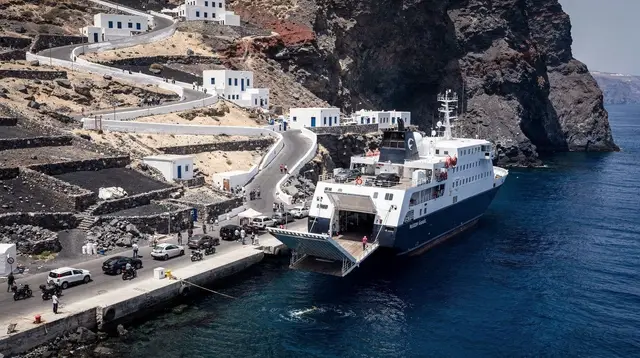
If your ferry or cruise arrives at Fira’s old port — used by cruise tenders and excursion boats, not the main car ferries, which dock at Athinios further south — you’ll need to get up or down the 220 metre cliff between the water and the town. Any excursions booked from a cruise stop are covered separately in our guide to Santorini shore excursions, worth checking before you commit to a tender time. There are three ways to do it, and with children the choice is fairly clear-cut.
| Option | Time | Notes for families |
|---|---|---|
| Cable car | About 3 minutes | Easiest with a stroller or small children; can queue heavily at midday in high season |
| 588 steps | 20 to 40 minutes on foot | Steep, uneven, shared with donkeys and their mess; hard with toddlers or a pushchair |
| Donkey ride | 15 to 25 minutes | Not designed for small children; a subject of ongoing animal welfare debate, covered below |
The cable car is priced per person, generally in the range of 6 to 10 euros for the short ride depending on the season and who’s selling the ticket — treat that as an order of magnitude rather than a fixed number, since it does shift. Full detail on timing, queues and the walk itself is in our cable car and 588 steps guide.
On the donkeys themselves: there is no outright ban on donkey rides in Santorini, though a weight limit was introduced in 2018 and tighter animal-welfare rules were under discussion for the 2026 season. We’d rather lay out the facts than tell you what to think about it, and our piece on the donkeys of Fira does exactly that. For a family trip specifically, the simplest practical note is that neither the steps nor a donkey are built with a five-year-old or a stroller in mind, and the cable car sidesteps the question entirely.
The Quad Question: Why We Don’t Recommend It for Families
Quad and ATV rental stands are everywhere in Santorini, and renting one feels like an easy way to give a family trip some independence. We’d ask you to think twice before doing it with children in the group. ATV and scooter accidents are the single leading cause of tourist hospitalisation on the island — not a close second, the leading cause — and the roads that make Santorini beautiful to look at (narrow, walled, full of blind curves between villages) are exactly the conditions that make a two-wheeled or open vehicle risky for an inexperienced rider carrying a passenger.
A proper motorcycle licence category is legally required to rent one, and it is checked less consistently than the risk would justify, which means the bar for actually getting on a quad is lower than it should be. None of that changes with a child riding pillion or squeezed onto a seat that was never designed for a second body, let alone a small one. Our piece on the quad accidents nobody warns you about and our fuller ATV and quad guide go into the numbers and the specific stretches of road involved; the short version for a family trip is simply that the convenience isn’t worth the exposure. If the appeal of a quad was really about independence on the water rather than the road, our guide to renting a boat in Santorini without a licence covers a legal, lower-risk way to get that same freedom.
Getting Around Without a Quad
The good news is that skipping the quad doesn’t mean skipping mobility. A hired car with proper seats and doors covers the same ground with none of the exposure, and our guide to driving in Santorini and car and scooter rental walks through what to expect on the island’s roads, including the tight lanes into the caldera villages that catch out even confident drivers.
If you’d rather not drive at all with children in the car, Santorini’s small, licensed taxi fleet — only around thirty cars for the whole island — makes booking a transfer in advance the norm rather than a luxury, and our taxis and transfers guide explains how far ahead to book in high season.
For a full day of sightseeing without the stress of navigating unfamiliar roads with a booster seat in the back, a private tour built around family pacing, with hotel pickup included removes the driving question entirely, and a broader guided island tour that includes transfers works well for families who’d rather see Akrotiri, the villages and a viewpoint or two in one organised day than plan each stop themselves. Multi-stop options that bundle a caldera cruise with a village visit are compared in our Santorini combo tours guide, worth a look if you want variety without renting a car.
The island’s public KTEL buses run from a central station in Fira out to the main beaches and to Oia, and they’re inexpensive, but they get crowded in season and stop running early in the evening — fine for a beach day, less reliable if you’re depending on the last bus back after dinner with tired children in tow.
Ferries, Transfers and the Realities of Island Hopping with Kids
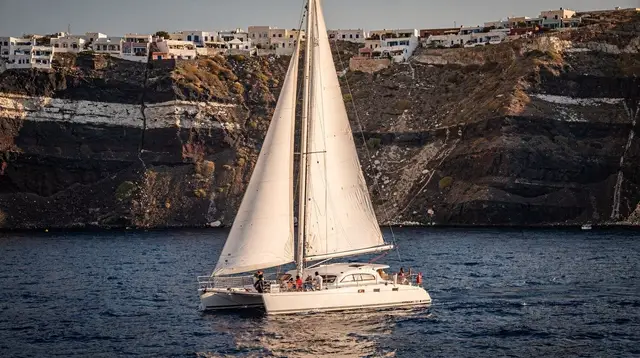
Santorini’s only ferry port, Athinios, sits at the base of a switchback road on the west side of the caldera and gets congested every time a boat arrives — there’s no dedicated pickup zone, so plan for a walk to a waiting car or taxi rather than a doorstep drop-off. If your trip includes a hop to a nearby island, our Santorini with kids itinerary lays out a realistic day-by-day pace, and it’s worth being honest with yourself about how much of that day a young child can handle on a boat: even the shorter routes, to Ios in roughly half an hour, involve queuing, boarding, and often a return crossing the same day. If you’re weighing a private boat trip against the ferry, our catamaran vs sailing boat comparison covers which option suits families better with young children aboard.
The meltemi wind that picks up through July and August doesn’t just affect sunset cruises — it can make a ferry crossing genuinely rough for a small child who isn’t used to open water, so building in a buffer day rather than a tight connection is worth the flexibility, especially outside the calmer shoulder months.
If safety questions around timing come up while you’re planning, our page on Santorini safety and the 2025 seismic activity covers the background factually — the earthquake swarm that began in January 2025 has fully ended, there was no eruption, and it isn’t a reason to avoid a family trip, but it’s a fair question for cautious parents to have answered rather than guessed at.
Packing and Practical Notes
A few items are worth packing specifically because of how this island behaves rather than out of general holiday habit. Water shoes matter more here than at most beach destinations, because the volcanic sand and pebbles get hot enough by midday to make bare feet genuinely uncomfortable on Perissa, Kamari and most of the coastline. Broad hats and a high-factor, reef-safe sunscreen are worth having on hand given how little natural shade the villages and beaches provide outside of taverna awnings.
Tap water across the island comes from desalination rather than any natural source — there are no rivers or usable springs on Santorini — and while it’s technically safe, it tastes brackish enough that almost everyone, residents included, drinks bottled water instead. A refillable bottle topped up from larger supermarket bottles is cheaper and less wasteful than buying small ones as you go. Evenings can turn breezy even after a hot day, particularly on a boat or up on the caldera rim, so a light layer for each child is worth having even in August. For a fuller rundown that isn’t specific to families, our general Santorini packing list covers the rest.
Frequently Asked Questions About Santorini with Kids
Which Santorini beaches are easiest with young children?
Kamari and Perissa are the two most practical choices: both are long, flat, and backed by a paved seafront with sunbeds, showers, toilets and tavernas within a short walk. The sand and pebbles are volcanic and get hot at midday, so water shoes matter more than they would on a lighter-coloured beach.
What can we do with kids on a rainy or windy day in Santorini?
Akrotiri is the standard answer. The excavated Bronze Age town is covered by a permanent roof, so it’s one of the few sights on the island unaffected by weather, and the raised walkways work well with a stroller. It also holds up as a plan when the meltemi wind is cancelling boat trips.
Should we rent a quad or ATV for a family trip in Santorini?
We’d steer families away from it. ATV and quad accidents are the leading cause of tourist hospitalisation on the island, the roads are narrow with blind corners, and a proper licence category is legally required and checked less consistently than it should be. A private driver, transfer, or hired car covers the same ground with a seatbelt for everyone.
How do we get down to the old port with kids and pushchairs?
From Fira, the cable car takes about three minutes and is by far the easiest option with small children or a stroller; it can queue badly at midday in high season, so early morning or later afternoon runs are smoother. The alternative is 588 stepped switchbacks shared with donkeys and mules, which is not comfortable with a pushchair or tired toddler legs.
Are the caldera villages like Oia and Fira suitable for toddlers?
They’re fine to visit but not to base yourself in with very young children. The villages sit on the rim of the caldera with steep cliff-edge paths, uneven stone steps between levels, and no direct beach access, so a stay there works better as a daytime outing than as the place you sleep and manage naps and strollers every day.
Is the water in Santorini safe for children to drink?
Tap water is desalinated and technically safe but tastes brackish, and most residents and visitors drink bottled water instead. Pack a refillable bottle and buy larger bottles at a supermarket rather than relying on tiny ones from kiosks, especially in the heat of July and August.
What should we pack specifically for a family trip to Santorini?
Water shoes are close to essential, since the volcanic sand and pebbles burn underfoot by midday; broad-brimmed hats and reef-safe sunscreen matter given how little shade the beaches and villages provide; and a light layer for evenings, since a boat trip or a caldera-side dinner can turn breezy even after a hot day.
Family-friendly things to do on GetYourGuide
Verified deep-linked GetYourGuide tours. Book through these links and we earn a small commission at no cost to you.
GetYourGuide does not provide a product photo for this activity — the image shows the meeting point, photographed by us.