Black Sand and Burnt Feet
I found out the hard way, on my first afternoon in Perissa, that “volcanic beach” wasn’t just a phrase in a brochure. I’d walked down from the road in flip-flops, and about four steps onto the black sand I was hopping sideways toward the water like it was a bed of coals. It more or less was.
The geology under your feet
Every beach on Santorini is made of the same material, more or less: fragments of the volcano itself, ground down by centuries of wave action into sand, pebble, and cinder. At Kamari and Perissa, either side of the Mesa Vouno ridge, that means fine black grains. At Vlychada and the Red Beach, oxidised cliff material gives the sand a rust-red or brown cast instead. Neither is a coincidence and neither is decorative — the whole island is the exposed rim of a volcanic caldera, so the beaches are quite literally made of what erupted here.
Dark material absorbs heat instead of bouncing it back, which is the whole problem. Pale quartz sand on a typical Mediterranean beach reflects a good share of the sun’s energy. Volcanic sand does the opposite: it soaks up radiation all morning and holds it. By early afternoon in high season, the surface temperature of black or red sand here can be high enough to genuinely burn skin within seconds of contact — not “uncomfortably warm,” but the kind of hot that makes people run rather than walk.
Why this catches people out
Most of us arrive expecting a beach day to work the way it does everywhere else: towel down, sandals off, wander to the water. On Santorini’s sand beaches, taking your sandals off at the towel is the mistake. The distance between where you set up and where the sea starts is exactly the stretch that gets hottest, because it’s dry and fully exposed, with no water nearby to moderate the temperature the way the shoreline does.
It’s worse on the long, open beaches with little shade — Perissa and Perivolos especially, where sunbeds and umbrellas cover only part of the sand and the rest bakes uninterrupted for hours. Kamari has a bit more built-up shade from the row of beach bars along its promenade, which helps if you can find a patch of it. None of these beaches are unusual by local standards — this is just how volcanic sand behaves everywhere on the island, Red Beach included, on the days it’s open at all.
What actually works
The fix isn’t complicated, but it has to be decided before you leave your hotel, not discovered on the sand. Rubber-soled sandals or proper water shoes — something that can get wet and stays on your feet in shallow water — solve almost the entire problem. Flip-flops help less than you’d think, since they slide and expose the sides of your feet, and they’re the first thing people lose to a bit of surf.
A folding beach mat, or just a large towel doubled over, gives you somewhere to stand and stage your things without touching bare sand while you get organised. It sounds like overpreparing for a beach day until you’ve tried unpacking a bag one-footed while balancing on the other.
Timing matters as much as footwear. Mornings before about 10am and the couple of hours before sunset are when the sand is genuinely walkable barefoot; midday through mid-afternoon in June, July and August is when it’s least forgiving, which is unfortunately also when most people are down there. If your schedule allows it, shifting a beach day earlier or later does more for comfort than any amount of gear.
The bigger picture
None of this is a flaw in the island, and it’s not something to avoid — it’s the same volcanic history that gives Santorini its cliffs, its wine, and the caldera itself. The sand is a physical reminder that you’re standing on the rim of something that erupted violently enough to reshape the whole archipelago. It just happens to also mean packing water shoes.
If you’re building out a beach day, the individual write-ups for Perissa, Kamari, Vlychada and the Red Beach go into what each one is actually like to sit on, how much shade there is, and how to get there — this page is only about the one detail that applies to all of them equally.
For a wider comparison across the island’s beaches, the Santorini beaches guide and the Perissa vs Kamari breakdown are the better starting points, and a general packing list will remind you to actually put the water shoes in the bag rather than the drawer.
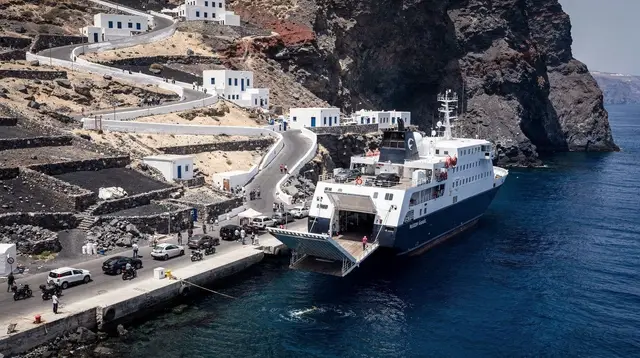
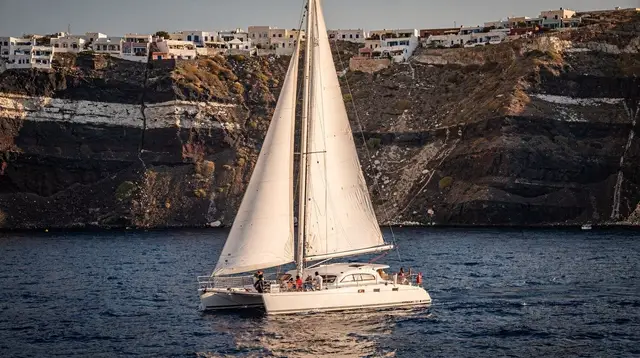
If sand and heat aren’t for you at all that day, a caldera day cruise around the volcano or a sunset cruise past the cliffs sidesteps the whole question — you’re on the water, not standing on it. For a quieter, smaller-group version of the same idea, a luxury day cruise or a sunset tour by boat gets you the same views of Kamari and Perissa’s black shoreline from somewhere considerably cooler underfoot.
Worth remembering too that the meltemi wind and general monthly weather both shift how bearable any given beach day is, sand aside — and if you’re travelling with kids, the footwear rule matters even more, since small feet burn faster than adult ones.
I still have the sandals I bought in a Perissa shop that afternoon, slightly too big, bright orange, and the single most useful five euros I spent on the whole trip.
Beaches on GetYourGuide
Verified deep-linked GetYourGuide tours. Book through these links and we earn a small commission at no cost to you.
GetYourGuide does not provide a product photo for this activity — the image shows the meeting point, photographed by us.