Santorini Wine Tasting: Understanding Kouloura Vines and PDO Santorini
What should I know before booking a wine tasting in Santorini?
Santorini's vines are trained low in a coiled basket shape called kouloura and grown without irrigation, relying on sea humidity and volcanic soil instead of rain. The appellation is PDO Santorini, and most tastings happen at wineries around Pyrgos, Megalochori and Exo Gonia. Harvest happens early here, often from late July, well ahead of most of Europe.
A Vineyard Built to Survive Wind and Drought
Before you book anything, it helps to understand what makes a Santorini wine tasting different from one anywhere else in Greece, or anywhere else at all. This isn’t a landscape of neat trellised rows climbing a green hillside. It’s a scatter of low, dark, basket-shaped vines sitting almost flat against volcanic ash, on an island with no rivers, no springs and barely any rain for months at a time. Everything about how the vines are grown here is a response to that: wind, heat, and an almost complete absence of fresh water.
This guide covers the vineyard itself — the kouloura training method, the lack of irrigation, the volcanic soil, and the PDO Santorini appellation that governs all of it — so that a winery visit or a tasting makes more sense once you’re standing in front of a vine that looks nothing like the ones you may have pictured. It won’t go deep into the Assyrtiko grape itself (that’s covered in Assyrtiko explained), the dessert wine Vinsanto (see the Vinsanto guide), or which specific winery to choose, which Santorini wineries compared handles in detail.
What Makes Santorini’s Vines Different: The Kouloura Method
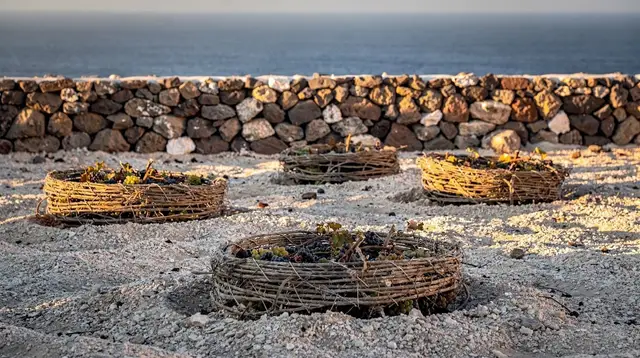
The most distinctive thing you’ll see in any Santorini wineries vineyard is kouloura: vine canes woven into a low, coiled basket that sits directly on the ground, rather than trained upward on wires or posts. The grape clusters grow inside the coil, protected on almost every side by the vine’s own leaves.
This shape solves two problems at once. First, wind: Santorini sits exposed in the Aegean, and the meltemi can blow hard for days at a stretch in summer (the meltemi wind explained covers this in more detail). A vine trained upright would be shredded or dried out by constant wind exposure. Kept low and coiled, the kouloura shields the fruit from the worst of it.
Second, and just as important, is moisture. With no irrigation, the vine needs every source of water it can find, and much of that comes at night: humidity carried in off the sea condenses as dew, and the coiled shape traps that moisture close to the grapes and the soil rather than letting it evaporate in the morning heat. It’s a slow, low-tech solution to a problem that would otherwise be very hard to farm around.
Kouloura vines are also old — many are ungrafted and decades, sometimes over a century, in age, since Santorini’s volcanic soil has kept phylloxera, the root louse that devastated European vineyards in the 19th century, from taking hold here. That’s a detail worth knowing before a tasting: some of what’s being poured comes from vines older than almost anything else in European viticulture.
No Rivers, No Irrigation: How the Vines Actually Get Water
It’s worth being direct about this, because it surprises most first-time visitors: Santorini has no permanent rivers, no natural springs, and no accessible groundwater to speak of. The island’s drinking water comes from desalination, not from any local water table, and the vineyards get nothing from an irrigation system at all.
Instead, the vines rely almost entirely on ambient humidity. Warm, moist air moving in off the sea condenses overnight as dew on the low-growing kouloura vines, and the plants absorb what they can through their leaves and through porous volcanic soil that holds moisture better than it looks like it should. It’s a genuinely dry-farmed vineyard, and one of very few wine regions anywhere that works this way at this scale.
The result is grapes that ripen under real water stress, which concentrates flavour and, according to most winemakers on the island, is part of why Assyrtiko carries such high acidity even when it’s grown somewhere this hot. It also means yields are naturally low; Santorini simply can’t produce large volumes per vine the way an irrigated vineyard can, which is one reason the wines carry a price above many other Greek whites.
The Volcanic Soil Underneath
Underneath the vines is a soil unlike almost anywhere else growing wine grapes: layers of volcanic ash, pumice and rock, laid down by the eruptions that built and repeatedly reshaped this island, most dramatically the Bronze Age eruption of around 1600 BCE that carved out the caldera (covered in how the Santorini caldera was formed). This soil is loose, mineral-rich, and drains fast — which sounds like a disadvantage until you remember there’s barely any rain to drain in the first place.
What it does provide is heat retention and a mineral character that shows up clearly in the finished wine. It’s also part of why phylloxera never spread here: the volcanic ash doesn’t support the pest the way clay or loam soils elsewhere in Europe do. Between the soil and the kouloura training, Santorini’s vineyards have ended up as one of the few in the world still farmed on their original, ungrafted rootstock.
PDO Santorini: What the Appellation Actually Means
Santorini’s wines fall under PDO Santorini — Protected Designation of Origin — a legal framework that ties the wine to this specific place and to specific methods, including the kouloura vine training described above. To carry the PDO Santorini label, wine has to be made from grapes grown on the island itself, using approved traditional practices, and vinified locally rather than shipped elsewhere for production.
It’s a guarantee of origin and method, not a guarantee of any particular flavour or a quality score — but in practice, it’s a useful signal when you’re comparing bottles or reading a wine list. If you see PDO Santorini on a label, you know the grapes came from these exact vineyards, farmed this exact way, without irrigation, on this volcanic soil.
The appellation doesn’t cover only Assyrtiko. Other permitted varieties include Aidani and Athiri among the whites, and Mandilaria and Mavrotragano among the reds, though Assyrtiko dominates what’s actually planted and poured. Vinsanto, the sweet, sun-dried wine, falls under its own related designation and its own production rules — worth knowing exists here, though it’s covered properly in the Vinsanto guide rather than this one.
The Grapes You’ll Actually Taste
At almost every tasting on the island, Assyrtiko will make up most of what’s poured — it’s the grape Santorini is built around, dry, high in acidity, and distinctly mineral despite the heat it’s grown in. Understanding why it tastes the way it does comes down to everything above: no irrigation, kouloura training, volcanic soil. For the grape itself, its characteristics and how to read it on a tasting sheet, Assyrtiko explained goes further than this page needs to.
You’ll likely also come across Nykteri, a dry white vinified from grapes harvested and pressed through the night to keep them cool, and possibly a pour of Vinsanto to close a tasting, since it’s traditionally served last. Reds are far less common on tasting menus here; Mandilaria and Mavrotragano exist but occupy a much smaller share of what’s planted and poured than the white varieties.
When the Grapes Are Picked: An Early Harvest, Not a Late One
One assumption worth correcting before you plan around it: Santorini’s harvest is early, not late. Picking often starts in late July or August, sometimes earlier than that, which is weeks ahead of grape harvests almost anywhere else in Europe. The intense summer heat and the dry conditions push ripening forward rather than delaying it, so if you’re picturing an autumn grape harvest to time a visit around, that’s the wrong season for this island.
That timing shift matters for anyone visiting a working winery: if you want any chance of seeing harvest activity, high summer is when it happens, not September or October as it would be in most other wine regions. By the time autumn arrives, the harvest here is typically long finished.
Where the Vineyards Are: Pyrgos, Megalochori, Exo Gonia and Beyond
Most of Santorini’s wineries sit inland, away from the caldera-edge villages most visitors head to first. Pyrgos, with its old kastro, and Megalochori, a quieter wine village nearby, both sit close to a concentration of vineyards and tasting rooms. Exo Gonia is another, home to smaller, more design-focused wine spaces. Vothonas is where you’ll find the island’s dedicated wine museum, built into old underground cellars.
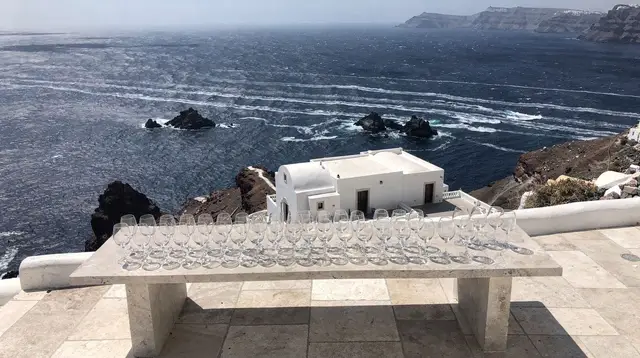
Fewer wineries sit directly on the caldera rim, but a handful do, including some near Oia, pairing a tasting with the same views the sunset crowds come for. None of this requires memorising a map before you arrive — most tasting experiences and guided tours already route between two or three of these villages for you, and Santorini wineries compared breaks down which specific estates suit which kind of visit.
What a Wine Tasting Experience in Santorini Actually Includes
Formats vary more than the word “tasting” suggests. Some are built around a single winery, others move between two or three, and some fold wine into a broader afternoon or evening with food and a view included.
| Format | What it typically covers | Best suited to |
|---|---|---|
| Sunset tasting at a caldera-view winery | A flight of local wines paired with the view over the caldera, timed toward sunset | First-time visitors who want the view and the wine together |
| Guided tasting with a local host | A short explanation of kouloura, PDO Santorini and the grapes, alongside pours at one or more wineries | Anyone who wants context, not just a glass |
| Wine museum visit with audioguide | Self-paced walk through underground cellars and winemaking history, ending in a tasting | Independent travellers who prefer reading over a guided script |
| Wine paired with food | Wine alongside local cheese or olive oil to compare how the wines behave with food | Visitors treating the tasting as a meal, not just a stop |
A guided sunset session such as the Santorini sunset wine tasting pairs a flight of local wines with the same caldera view everyone comes for, timed to end as the light drops. If you’d rather have someone walk you through the kouloura method and the appellation in person rather than read about it beforehand, a guided wine tasting with a local host covers exactly that context alongside the pours.
For a more self-directed option, the wine museum visit with an audioguide in Vothonas lets you move through the underground cellars at your own pace before the tasting itself — a good fit if you’d rather read the history than have it narrated. And if you want to see how the local wine behaves alongside actual food rather than on its own, pairing it with a Greek cheese tasting gives a clearer sense of how Assyrtiko’s acidity works at the table, not just in the glass.
Choosing Between a Winery Visit and a Guided Tasting Tour
The decision usually comes down to how much you want handled for you. Renting a car or booking a taxi to a single winery gives you more time in one place and lets you linger, but you’re on your own for context unless the winery provides a guide. A guided tasting tour, by contrast, typically moves between two or three wineries or villages, includes the explanation of the kouloura method and the appellation as part of the visit, and removes the need to arrange transport on roads that can be narrow and, around Megalochori and Pyrgos, poorly lit after dark.
Neither is objectively better; it depends on whether you’d rather set your own pace or have someone else structure the afternoon. Santorini wineries compared is the place to go once you’ve decided which style suits you and want to pick an actual estate — along with dedicated looks at visiting Santo Wines, visiting Venetsanos winery, and the Santorini wine museum in Vothonas.
Practical Tips Before You Book
A few things worth knowing regardless of which tasting format you pick. Most wineries and tasting venues are inland, away from the caldera-edge villages, so factor in transport time if you’re staying in Fira or Oia. Sunset-timed tastings fill up fastest in July and August, both because of demand and because that’s also when the meltemi wind can occasionally disrupt outdoor seating at rim-edge venues.
If you’re visiting outside peak summer, check opening hours directly — smaller, family-run wineries around Megalochori and Exo Gonia can run reduced schedules in the shoulder months, and some close entirely in winter, in step with the wider seasonal slowdown covered in Santorini in winter. And if wine tasting is one part of a longer day that also includes food, an olive oil tasting farm-to-table experience makes a natural pairing, since olive oil production follows the same dry-farmed, no-irrigation logic as the vines themselves.
For planning the rest of your stay around a tasting, best time to visit Santorini and Santorini food guide are useful next stops.
Santorini Wine Tasting FAQ
Why are Santorini’s vines shaped like a basket?
The training method is called kouloura: canes are woven into a low, coiled basket resting on the ground. It shields the grapes from Santorini’s strong wind, keeps them close to the warm volcanic soil overnight, and traps the humidity the vine depends on since there’s no rain to rely on through summer.
Does Santorini irrigate its vineyards?
No. There is no irrigation system for Santorini’s vines. The plants survive on dew and night humidity carried in from the sea, absorbed through the leaves and the porous volcanic soil, which is part of why the wines taste as concentrated and mineral as they do.
When is the grape harvest in Santorini?
Early. Picking often begins in late July or August, weeks ahead of harvests almost anywhere else in Europe. The heat and dry summer push ripening forward rather than delaying it, so this is not a late-season activity to plan around.
What does PDO Santorini actually guarantee?
PDO Santorini is a Protected Designation of Origin: the grapes must be grown on the island using traditional methods like kouloura training, and the resulting wines, mainly Assyrtiko-based, must be vinified there too. It’s a legal guarantee of origin and method, not a quality score.
Is a Santorini wine tasting suitable if I don’t know much about wine?
Yes. Most tastings are built for a general audience, pairing a handful of pours with a short, plain-language explanation of the grape, the soil and the kouloura method rather than technical tasting notes aimed at specialists.
Should I visit a winery myself or join a guided tasting tour?
Both work; it depends on how much you want explained to you and whether you want transport handled. A self-driven winery visit gives you more time in one place, while a guided tasting covers several wineries or pairs tasting with a sunset view and drops the logistics.
Wine Tasting on GetYourGuide
Verified deep-linked GetYourGuide tours. Book through these links and we earn a small commission at no cost to you.
GetYourGuide does not provide a product photo for this activity — the image shows the meeting point, photographed by us.