Venetsanos Winery: Santorini's Oldest Cellar Above Athinios Port
What makes Venetsanos different from Santorini's other wineries?
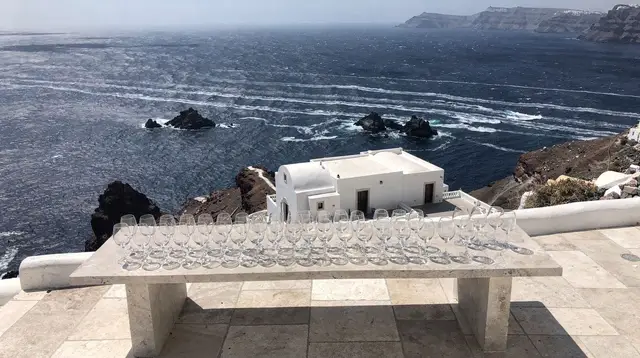
Venetsanos occupies the oldest surviving winery building on the island, cut into the cliff above Athinios ferry port rather than the caldera villages. It was built in 1947 as a gravity-fed cellar, so the architecture and the view over the switchback port road are as much the point as the tasting itself.
The winery that looks over a working port, not a postcard view
Most first-time visitors picture a Santorini winery as a wide terrace facing the caldera at golden hour, glass in hand, nothing but sea and cliff in front of them. Santo Wines delivers exactly that, and does it at scale. Venetsanos sits a few kilometres south, above Athinios, the island’s one ferry port, and it earns its place on this site for a different reason: it occupies the oldest winery building still standing on Santorini, built into the cliff in 1947, before pumps and refrigeration made gravity-fed winemaking obsolete everywhere else.
If you’re comparing where to spend your one wine-tasting stop, our Santorini wineries compared guide runs through the full list side by side. This page stays narrow on purpose: what Venetsanos actually is, why the building looks the way it does, and why it sits above a ferry port rather than a sunset-facing village.
Built for gravity, not for a view
The winery dates to 1947, when the Venetsanos family constructed a cellar that used the slope of the cliff itself as part of the production process. Grapes came in at the top level. From there, must and wine moved downward through the building by gravity, floor by floor, instead of being pumped between vats on a single level — the standard method on the island before electrification made pumping cheap and universal.
That history is why the building reads more like a stacked ruin than a modern tasting room. Levels are cut into the rock face, connected by external stairs and terraces, with openings that look more like a fortified settlement than a commercial cellar. Production at Venetsanos has scaled back from its mid-century peak, but the structure survives largely intact, and it is now treated as much as a piece of built heritage as a functioning winery. Walking through it gives a clearer sense of pre-industrial Santorini winemaking than any modern facility on the island can, because the building itself is the machine.
This is also where Venetsanos earns its place next to Santo Wines rather than being folded into the same recommendation. Santo Wines is a cooperative built for volume and view; Venetsanos is a single historic structure built for gravity and shade. Neither is “better” — they answer different questions, and our wineries compared page is where to weigh them against each other and against Domaine Sigalas, Gavalas, and the rest.
Athinios, not the old port of Fira
Here is the mix-up worth clearing up before you plan a visit: Venetsanos overlooks Athinios, not the old port of Fira. They are two different harbours, roughly ten kilometres apart by road, and confusing them is the single easiest way to end up in the wrong place at the wrong time.
- The old port of Fira (Skala) sits directly below Fira town, reached by cable car or the 588 steps, and takes only cruise tenders and small excursion boats.
- Athinios (Ormos Athiniou) is the island’s sole ferry port for Piraeus, the other Cyclades, and Crete, further south on the west coast, reached by a steep switchback road with no cable car and no steps.
Venetsanos sits directly above Athinios, on the cliff overlooking that switchback road. From the terrace you can watch ferries manoeuvre into the harbour and traffic climb the hairpins toward Fira — a genuinely different scene from the caldera panoramas sold everywhere else on the island. If you’re arriving or departing by ferry, our Athinios port guide is worth reading alongside this one, since Venetsanos makes a logical stop either just before boarding or just after landing.
What a visit actually involves
Venetsanos runs less like a polished visitor centre and more like a small museum with a tasting counter attached. Expect to walk through several of the old production levels — vats, presses, and stairways cut into the rock — before or after the tasting itself, rather than being shown straight to a terrace table.
Tastings centre on the island’s core grape, Assyrtiko, in dry and sometimes barrel-aged styles, alongside Vinsanto, the sun-dried dessert wine every domaine on Santorini produces in its own way. This page is about the building rather than the bottle: for the grape and the winemaking method behind what you’ll be tasting, Assyrtiko explained and our Vinsanto guide go into that in full, and our wine-tasting guide covers etiquette and typical flight formats across the island’s domaines. Some flights are self-guided with tasting notes at the counter; others come as part of a set tour that adds a short introduction to the building’s history.
Because the winery sits on a working cliff road rather than inside a pedestrian village, there is less foot traffic here than at Pyrgos or Megalochori, and no crowd competing for terrace seats the way Oia’s clifftop does at sunset. That relative quiet, more than the wine list, is what regular visitors come back for.
Practical details: how long to allow, accessibility, and best season to visit
A Venetsanos stop runs shorter than a full Santo Wines visit: budget 45 minutes to an hour for the self-guided walk through the old production levels plus a standard tasting flight, longer if you take the guided version that includes the building’s history. There is no terrace booking system to navigate here — the constraint is opening hours rather than table availability, and the winery, like most of the island’s smaller domaines, keeps shorter hours outside the main April-to-October season and can close for stretches in winter, so check ahead if you are visiting in January or February.
The building itself is the one thing to plan around if mobility is a concern. Because the cellar is cut into the cliff in stacked levels connected by external stairs rather than laid out on a single floor, a full walk-through involves more steps than a flat, purpose-built tasting room would. Visitors who need step-free access should ask on arrival whether a tasting can be served at the entrance level without the full cellar walk; our accessibility in Santorini guide covers which sites and wineries across the island are realistically manageable for limited-mobility travellers, and which, like parts of this one, are not.
Timing the visit around the island’s calendar matters more here than at the caldera-facing wineries: shoulder-season months bring quieter roads down to Athinios and shorter waits at the tasting counter, while July and August add ferry traffic on the switchback road below the terrace. Our best time to visit Santorini guide breaks down those trade-offs month by month. If a single winery stop feels thin for a whole outing, Santorini combo tours compared lines up the caldera cruise, village, and wine-tasting combinations that fold a cellar visit into a longer day.
Venetsanos versus Santo Wines, in one paragraph
If you only have time for one winery stop and are torn between the two most-searched names on the island: choose Santo Wines for a wide caldera-facing terrace built specifically for the golden-hour crowd, with a large-scale, cooperative feel. Choose Venetsanos for the building itself — a functioning piece of 1947 industrial architecture cut into the cliff, a quieter terrace, and a view that includes the working port rather than only open sea. Neither replaces the other, and several of the tours below combine a winery stop with Pyrgos or Oia so you’re not forced to choose only one.
| Venetsanos | Santo Wines | |
|---|---|---|
| Building | 1947 gravity-fed cellar, original structure | Modern cooperative facility |
| Location | Above Athinios ferry port | Above the caldera, near Pyrgos |
| Atmosphere | Small, quiet, heritage-focused | Large, built for sunset crowds |
| Best read alongside | Athinios port guide | Santo Wines visit |
For the full field beyond these two, Santorini wineries compared lines up Venetsanos, Santo Wines, Gavalas, Estate Argyros, Domaine Sigalas, and the wine museum in Vothonas against each other.
Getting there and combining the visit
Venetsanos sits on the road connecting Athinios to the inland villages, which makes it easy to combine with a stop in Megalochori or Pyrgos, both a short drive away and both covered in our villages guide. There is no KTEL bus stop directly outside; a rental car, scooter, taxi, or an organised tour that includes transport are the realistic ways to reach it. Our driving in Santorini guide covers what that road down to Athinios is actually like to drive, switchbacks included.
A tour that bundles Pyrgos and a winery stop removes the transport question entirely and tends to pair well with a wider loop of the island’s inland side:
a Pyrgos village tour with winery visit and tastings covers Pyrgos’s kastro alongside a stop at a working cellar, and is a straightforward way to see the inland villages and taste in the same afternoon.
For a broader loop that adds Oia and a sunset stop to the winery visit, a sunset tour combining Oia, Pyrgos, and a winery visit covers more ground in one outing if a single cellar stop isn’t the whole day’s plan.
If food is as much a draw as wine, a Megalochori tomato museum and winery tour pairs a cellar visit with the island’s other agricultural heritage stop, the tomato-processing museum in Megalochori village.
Planning around it
A Venetsanos stop fits naturally into a half-day loop of the island’s south and inland side rather than standing alone as a destination. It works well timed on the way to or from a ferry at Athinios, or slotted into an afternoon that also covers Megalochori or Pyrgos. If you’re building a longer wine-focused day around several domaines, our wine itinerary sequences stops so you’re not doubling back across the island. And if the goal is simply to see the Santorini wineries region as a whole before picking where to spend your time, that hub page is the wider starting point this guide sits under.
Frequently asked questions about visiting Venetsanos winery
Is Venetsanos the same as Santo Wines?
No. Santo Wines is a large cooperative with a wide terrace built for caldera sunset crowds, covered separately in our Santo Wines guide. Venetsanos is a single historic building from 1947, smaller, and positioned above Athinios port rather than the main caldera rim.
Is Venetsanos winery near the old port of Fira?
No, and this is the most common mix-up. Venetsanos overlooks Athinios (Ormos Athiniou), the island’s one ferry port, on the west coast south of Fira. The old port of Fira, reached by cable car or the 588 steps, is a separate harbour used only by cruise tenders, further north.
Can you see the caldera from Venetsanos?
Yes. The terrace looks west over the caldera and south along the cliff toward Athinios, taking in the road that ferry traffic climbs in switchbacks. It is a lower, quieter angle than Oia or Imerovigli, with the working port in the frame rather than out of sight.
Why was the winery built into the cliff like that?
Venetsanos was built in 1947 as a gravity-fed winery: grapes arrived at the top, and the process moved downward through the building by gravity rather than by pumping, which is why the cellar is stacked in levels cut into the rock instead of laid out on one floor.
What do you taste at Venetsanos?
Standard flights centre on Assyrtiko in its dry and sometimes oak-aged forms, alongside Vinsanto, the island’s sun-dried dessert wine. Grape varieties and winemaking style are covered in depth in our Assyrtiko and Vinsanto guides; this page focuses on the building and the visit itself.
Do I need a car to get to Venetsanos?
A car, scooter, taxi, or an organised tour are the practical options, since Venetsanos sits on the road down to Athinios rather than in a village centre served by the KTEL bus network. Many visitors combine it with a wine-tasting or Pyrgos-area tour that includes transport.
Should I visit Venetsanos for sunset?
It works well earlier in the day, when the light on the cliff and the port road is clearest, but it also holds its own at sunset without the density of Oia. If sunset from a terrace with a glass in hand is the priority above all else, our sunset guides compare several spots including this one.
Wine Tasting on GetYourGuide
Verified deep-linked GetYourGuide tours. Book through these links and we earn a small commission at no cost to you.
GetYourGuide does not provide a product photo for this activity — the image shows the meeting point, photographed by us.